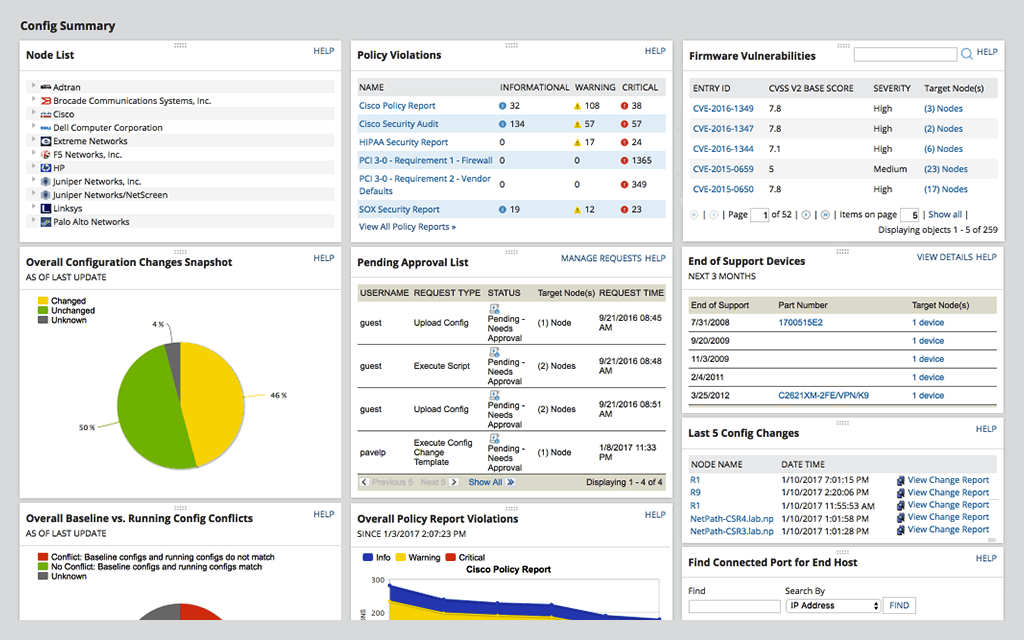
SolarWinds Network Configuration Manager is network diagnostics and troubleshooting technology, from Austin-based SolarWinds.
N/A
SolarWinds NPM
Score 7.9 out of 10
N/A
SolarWinds NPM is a monitoring and performance management platform. It provides performance troubleshooting support, auto network discovery, customizable thresholds, and can be rapidly deployed.
Auvik has some similar features but it is very expensive. SolarWinds Network Configuration Manager (NCM) has gone up in price but it is much more affordable than Auvik. Auvik has no way of sending a script to more than one device at a time so that is a downside of Auvik versus …
We evaluated PRTG Network Monitor which was similar to SolarWinds but was very resource-intensive and the server kept crashing when we got close to 100 devices
whereas on SolarWinds we were able to add several thousand devices. We
also evaluated Nagios Core as a free …
Solarwinds Network Configuration Manager is extremely powerful in allowing our organization to automate specific tasks. It is extremely simple to use and offers a Graphical User Interface for performing tasks. I am a very curious person, which has led me to use Ansible simply …
SolarWinds NCM solution is more flexible and GUI is from my point of view more intuitive, from the other hand Manage Engine solution is [a] cheaper solution which has almost [the] same functionality but suffers of luck of deeper integration with other Manage Engine modules.
At the time SolarWinds was the biggest player in the space and their whole portfolio was very comprehensive. As time progressed and newer technologies came about (i.e. SDWAN) their products couldn't keep up with the consumer demands and changing market. Security became such a …
NCM is superior to ManageEngine or Spiceworks in its ability to automate the primary tasks of a configuration management tool. Of course, it integrates well with other applications in the SolarWinds Orion suite of applications. The list of vendors supported by NCM is larger as …
If it has been used and it has been functional since it reduces the work time by more than half, making the process faster, safer, and more precise, carrying out not so complex and functional processes referring to configurations of multiple devices at the same time in an agile …
SolarWinds Network Configuration Manager (NCM) was by far the easiest to implement and it just started working right out of the box. Within a few hours were we populating our config backup repository and soon after that, we were writing scripts to audit our configurations. …
We have a very diverse IT environment (Cisco/Palo Alto, VMWare, Cisco UC, SD-WAN, Windows Servers) and we wanted to have one suite of software that we could manage as many of our different areas in one single pane of glass. SolarWinds allows the network team, VOIP team, Storage …
Prior to implementing SolarWinds NCM, we were utilizing a free solution called RANCID. This solution is a Cisco specific opensource tool that allows a simple backup of Cisco device configurations. This tool was very limited in our ability to search, backup, restore, and …
We tried a few different products at a cheaper level such as Spiceworks and PRTG. But were unable to make them work for everything we would get with Solarwinds. We also tried a few products at a higher price point like Ipswitch by What's up Gold and BladeLogic Network …
We selected NCM because of its integration with NPM and other products. Pricing, Support, and Thwack all played a major part in the reason for the procurement and implementation of this system.
When I took over my current position, we'd already purchased SolarWinds Network Configuration Manager, but we were not using it. I can't, therefore, compare it with other tools, as the only thing I have to compare it to was our manual processes. When compared to any …
We used to use Kiwi Cat Tools to backup the configurations on our network devices. SolarWinds Network Configuration Manager has replaced that functionality and added so much more. We now are also able to run configuration change jobs and reports to make sure that all of our …
Probably the best feature of NCM is integration with other SolarWinds products. This enabled us to have a single pane of glass for management of all our network infrastructure. Simply adding NCM management to all our devices also gave us basic performance monitoring to the same …
We haven't vetted out any other solutions for backing up our network devices. NCM does this job well, but isn't the most user friendly software out there. Our Ubiquiti networking hardware is managed through an admin console for all Ubiquiti devices. It manages our configs, and …
PRTG has been a very old tool that was good for plotting the utilization graphs of interfaces but lacked comprehensive device views, overall end-to-end dashboards, comprehensive reports, and alerting functions. WhatsUpGold lacked comprehensive Dashboards, Alerts, and Reporting …
We evaluated PRTG Network Monitor which was similar to SolarWinds Network Performance Monitor but was very resource-intensive, and the server kept crashing when we got close to 100 devices. Whereas on SolarWinds Network Performance Monitor, we were able to add several …
We tested Observium as an alternative to Solarwinds in the past and it required all host to be added by DNS instead of IP addresses which we prefer. We have over 2000 devices so creating DNS records for all of these was a deal breaker.
SolarWinds is an all in one solution. We don't need to install different servers for different packages. It provides easy installation, easy maintenance, easy monitoring by NOC and end-users of NOC. SolarWinds tools have more features than other tools. We have done POC for many …
For the most part, SolarWinds products work great 95% of the time. They have great functionality, but since SolarWinds is an application that has been developed for several years, there is plenty of bloat, which causes some severe slowness. If you can deal with the slowness, …
Most have been SolarWinds products for either monitoring and management. As I mentioned, the top usage now is for alerting on up/down. Performance monitoring is mostly on an ad-hoc basis.
I don't think this is really a fair comparison, but both Cacti and Nagios have some similar functionality to SolarWinds NPM in that they all do performance monitoring on networked devices. Cacti and Nagios both lack the in depth feature set and customization that NPM offers, …
A lot easier to configure. Maybe I got used to the software we are currently using or I am not too experienced in the field but I got literally lost in HP IMC not knowing what to do. İ really like SolarWind's next-next done configuration.
Solarwinds NPM is significantly better than Intermapper. We haven't used Intermapper in a couple years now but it was leaps and bounds ahead of Intermapper for Network monitoring.
I've personally used SolarWinds Network Performance Monitor and Network Configuration Manager for about 10 years and it has made the task of keeping the network up and running much easier. Much more granular control than options like Nagios, MRTG, and PRTG.
Network Configuration Manager is well suited for backing up configurations of all your devices. It also has a great comparison tool for seeing only the differences in config. Another great feature is it's ability to push a script to any number of devices. This is very handy for pushing changes to one, 10 or multiple devices. There are also some great reports that you can run against the devices in inventory
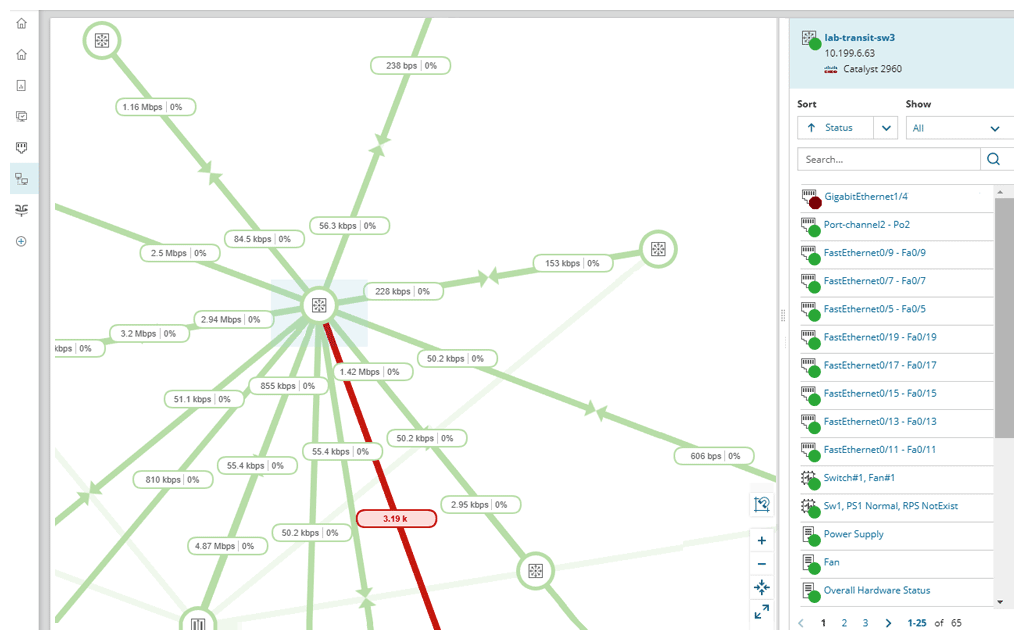
SolarWinds Network Performance Monitor (NPM) is excellent on node monitoring, for servers, switches, voice routers, etc. It also provides quick information on the dashboard, so you can take a look an in a few seconds determine is an entire site is down, if portions are down, and what may be causing the issue. We have experienced some difficulty when working with our wireless environment. It is less than natural when attempting to determine if a wireless access point is down itself, or if the switch feeding the access point is down, either port or switch. It does a very good job telling you if a switch is down, but troubleshooting the devices (specifically access points) it struggles.
For our use case, it does everything great and some of the features we underutilize but I would like to be able to set a configuration baseline when initially adding a node instead of after the configuration is pulled but it's not a particularly big deal to let it pull the configuration then set it as the baseline.
Medium complexity to set up in the beginning if using any non-standard devices or configurations, else fairly easy (e.g. Cisco Nexus or IOS-based devices). Reports are fairly straightforward to set up. Updates to the platform are fairly straightforward and don't take a major effort. Easy to add or remove devices.
The entire IT staff relies on NPM in its daily operations. It would be impossible for us to maintain our level of service without it. If SolarWinds gets to proud of their product and begins to over charge for it, we would be forced to reconsider and use a different product. But as it stands it is worth the price to renew it.
The user interface is lacking. It is difficult to navigate at times and things can be done multiple ways. Quite often I am confused by how their notification structure works. It is not very intuitive. They do offer a free Academy. They also offer a community of other technical folks. I have enjoyed both.
SolarWinds Network Performance Monitor (NPM) is quite an extensive product, covering all our bases and requirements. There are a lot of customizable options and features which you can work with for their alerting which is really useful. I haven't found anything yet which I thought SolarWinds Network Performance Monitor (NPM) could do, but it actually couldn't so overall it works nicely and does the job.
To be fair, I have not had to involve Support in a number of years, but when I did, I was greeted with enthusiastic engineers who wanted to understand and solve the issue. It was a fairly complex scenario and I have discovered in my most recent implementation that engineering included that option as a standard now.
In all of the times that we called support, someone at SolarWinds had the answer for us in a timely manner. Through thwack and other internet searching, we have been able to resolve all of our issues that arose to our satisfaction. The support staff have always been knowledgeable of their products or had a fellow support staff member to rely on to get the needed answers.
Solarwinds has actually produced new training since I last used it that is available on their site at any time. Their previous training was more than enough to get us started but now there is significantly more content. Since I'm comfortable with the Orion platform and the products we use I haven't checked the new training out yet but we have new staff go through portions of that training and they always come away with an understanding of the platform and ready to use it
The training is good but during the implementation, you can get situations not learned during the training. The trainer was very open to hearing the questions about use cases and always sharing his experience. I really recommend having official training to take advantage of all features that the NPM can bring.
it was a fairly easy implementation and everything was pretty straightforward. only challenge we had was getting all the snmp communities updated on the networking equipment
Make sure your inventory is accurate. Stand up some virtual machines for testing prior to installation. Make sure your database and its credentials are setup. Think about things you want to monitor that may not be obvious - UPS units, Door hardware, PBX systems, Fabric Channel switches, firewalls, routers, switches. Try to setup SNMP on these devices and have an IP that you will assign to the new server. If you do that it will go well.
At the time SolarWinds was the biggest player in the space and their whole portfolio was very comprehensive. As time progressed and newer technologies came about (i.e. SDWAN) their products couldn't keep up with the consumer demands and changing market. Security became such a big focus that once Solarwinds got hacked we had to remove all their products from our environment
We use NPM along with PRTG Network Monitor. While NPM is great at monitoring network devices and network links and some aspects of the servers, PRTG provides more in-depth monitoring for Server systems, applications and application ports such as Web Ports etc. PRTG also provides a more comprehensive Root cause analysis.
Saves 100s of hours a year in man hours over manual configuration.
Saved easily 50k in lost revenue when a switch rebooted with months old unsaved configuration. NCM let us quickly restore a snapshot of the running config from the previous day.
Saves us several man hours per week of config auditing by reducing all changes to a summary email.
SolarWinds allows us to proactively address hardware issues before they impact the business. We recently had a server that was experiencing issues sporadically and we were able to use the data from SolarWinds to track down and correct the issue before it tanked the server.
SolarWinds gives our IT department some piece of mind knowing that they'll be alerted of any issues real time.
We can use SolarWinds data to justify needed to replace or upgrade certain equipment that is key to our core business.