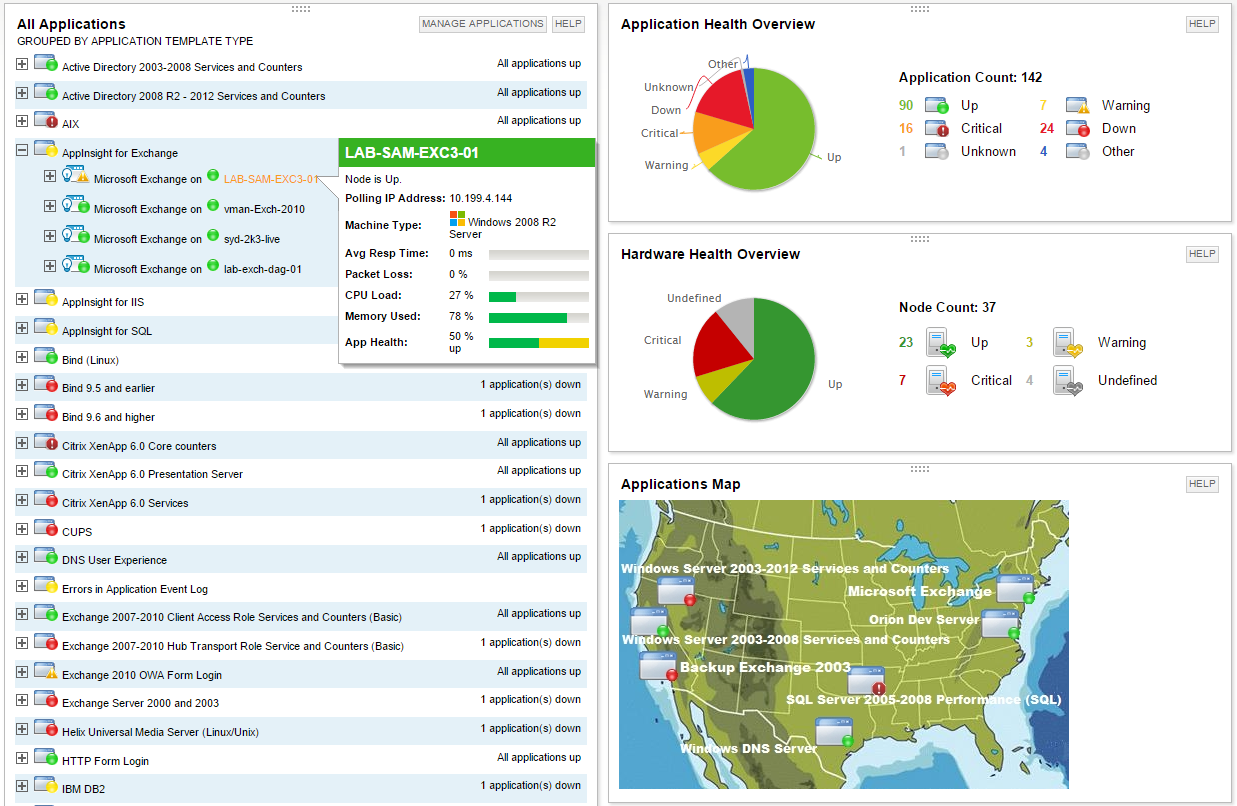
SolarWinds Server & Application Monitor (SAM) delivers application and server monitoring capabilities. SAM allows for self-service for easy setup, 1200+ monitoring templates, and customization options, as well as integrate with other SolarWinds products.
N/A
Pricing
SolarWinds Server & Application Monitor
Editions & Modules
No answers on this topic
Offerings
Pricing Offerings
SolarWinds Server & Application Monitor
Free Trial
Yes
Free/Freemium Version
No
Premium Consulting/Integration Services
No
Entry-level Setup Fee
No setup fee
Additional Details
SAM pricing starts at $2,995.
More Pricing Information
Community Pulse
SolarWinds Server & Application Monitor
Considered Both Products
SolarWinds Server & Application Monitor
Verified User
Engineer
Chose SolarWinds Server & Application Monitor
It provides accurate information on outages and traffic predictions, saving the company a lot of money. It provides clear visibility into performance issues, and one can easily identify solutions from it. It has a very good UI interface compared to the other technologies …
SolarWinds Server & Application Monitor (SAM) is an Excellent for Windows-heavy, on-prem or hybrid environments with Solid out-of-the-box templates (SQL Server, IIS, Active Directory) with Mature alert engine with dependencies, suppressions, escalations; Although it is Not …
Compared to other monitoring products we evaluated or have used in the past, SolarWinds Server & Application Monitor stands out as being significantly easier to use and quicker to adopt. It delivers excellent value for the price, offering a broad set of monitoring capabilities …
Compared to these two options; LogicMonitor and BMC Truesight that i have also used, I will give my option of how I think SolarWinds Server stacks up against them both. SolarWinds vs LogicMonitor, hands down I think LogicMonitor comes out on top. With its reliability, functions …
Nagios requires far more manual work to configure than SolarWinds does, though that also encourages customization and perfect-fit solutions. Nagios also requires far, far fewer resources to run than SolarWinds: SolarWinds wants great gobs of memory and disk, while Nagios is …
Senior IT Technologist II & Desktop Support Supervisor
Chose SolarWinds Server & Application Monitor
It has been a while since we first purchased SolarWinds, but I looked over several other products that I can't remember now. Many other products tried to scan the network to find computers but given that our computers are located in various places across campus with other …
SolarWinds Server & Application Monitor is able to provide 90% of the functionality my business requires. SolarWinds is able to scale out functionality by purchasing additional modules to meet the individual needs of its customers. While this functionality provides …
SolarWinds is cost-effective, we have a great solution provider that helps us with tool integrations and maintenance, the integration capability and extensive documentation also help a lot in the ability to use it in various monitoring models and scripts.
We also evaluated Nagios Core as a free alternative but being free it could not be trusted to be secure, and it was very difficult to add and manage devices.
Solarwinds Server & Application Monitor is a great comprehensive monitoring solution. It covers all aspects of monitoring your infrastructure via a modular approach. While other applications can be slightly better at asset management or monitoring one specific application or …
PRGT Network Monitor seems to be very good, initially, but, in our experience, when we reached close to 100 devices, the system kept crashing and behaving erratic. Prometheus was missing many features and required some CLI scripting and the GUI was years behind SolarWinds. The …
SolarWinds Pingdom and AppOptics [are] full-fledged Application Performance Management Tools. [SolarWinds] SAM provides Server and Application Monitoring using [SolarWinds] SAM templates, [but] it does miss out on APM capabilities which other APM solutions offer.
In comparison to Spiceworks [Connectivity Dashboard,] SolarWinds [has] way [more] features and [an] easy-to-use system. ManageEngine [Application Control Plus] also provides a good look [at the] dashboard but needs a lot more enhancements when it comes to real-time monitoring. P…
I have used WhatsUp, Nagios, and Zabbix. Very similar in ease of use to WhatsUp, but missing some features of the Zabbix and Nagios XI on the nix side of the house.
I can safely say SolarWinds comes up on top versus the individual products we used in the past. SolarWinds was selected because of its ease of use, its visual layout which allows you to easily and quickly browse through the information its currently providing for a monitored …
It is a well-suited software for monitoring and surveillance of your deployed nodes. The error-readability and filter options for filtering out logs and errors could be improved. But overall, it has a good UI design, is user-friendly, and is very easy to learn and access for new users.
We are heavily invested in Solarwinds products for a reason. They are generally easy to setup and run with, requiring only some interfacing with support or help articles on rare occasions. They do what we bought them to do and we can't ask for more.
SolarWinds Server & Application Monitor is quite easy to use and super versatile. It allows you to do just about anything you can through premade templates or through scripting. You can use an agent on the servers if you want to, or you can monitor through WMI or SNMP credentials. You can customize thresholds for alerting quickly, and you can configure alerts to be as complex or as simple as you want.
The graphical interface and the performance of the database leave a little to be desired, they could be better explored.Some functionality and screens do not work well depending on the browser used. The integrations never had any problems or caused crashes in other systems.
I think there was only a couple times I had to open a support case for SAM and one time they got multiple engineers on the phone to get a better idea what I was trying to monitor and was able to point me in the best direction to monitor that system.
Nagios requires far more manual work to configure than SolarWinds does, though that also encourages customization and perfect-fit solutions. Nagios also requires far, far fewer resources to run than SolarWinds: SolarWinds wants great gobs of memory and disk, while Nagios is refreshingly humble. Nagios starts working from the first minute, too, whereas SolarWinds needs lots of set-up time.