AppDynamics is an APM and Mobile APM program, with application mapping and predictive capabilities. These capacities enable automated remediation and code-level diagnostics in real time. It can be deployed on-premise or as a SaaS.
N/A
Sumo Logic
Score 8.8 out of 10
N/A
Sumo Logic is a log management offering from the San Francisco based company of the same name.
$3
Per GB Logs
Turbonomic, now part of the Concert platform
Score 8.8 out of 10
Enterprise companies (1,001+ employees)
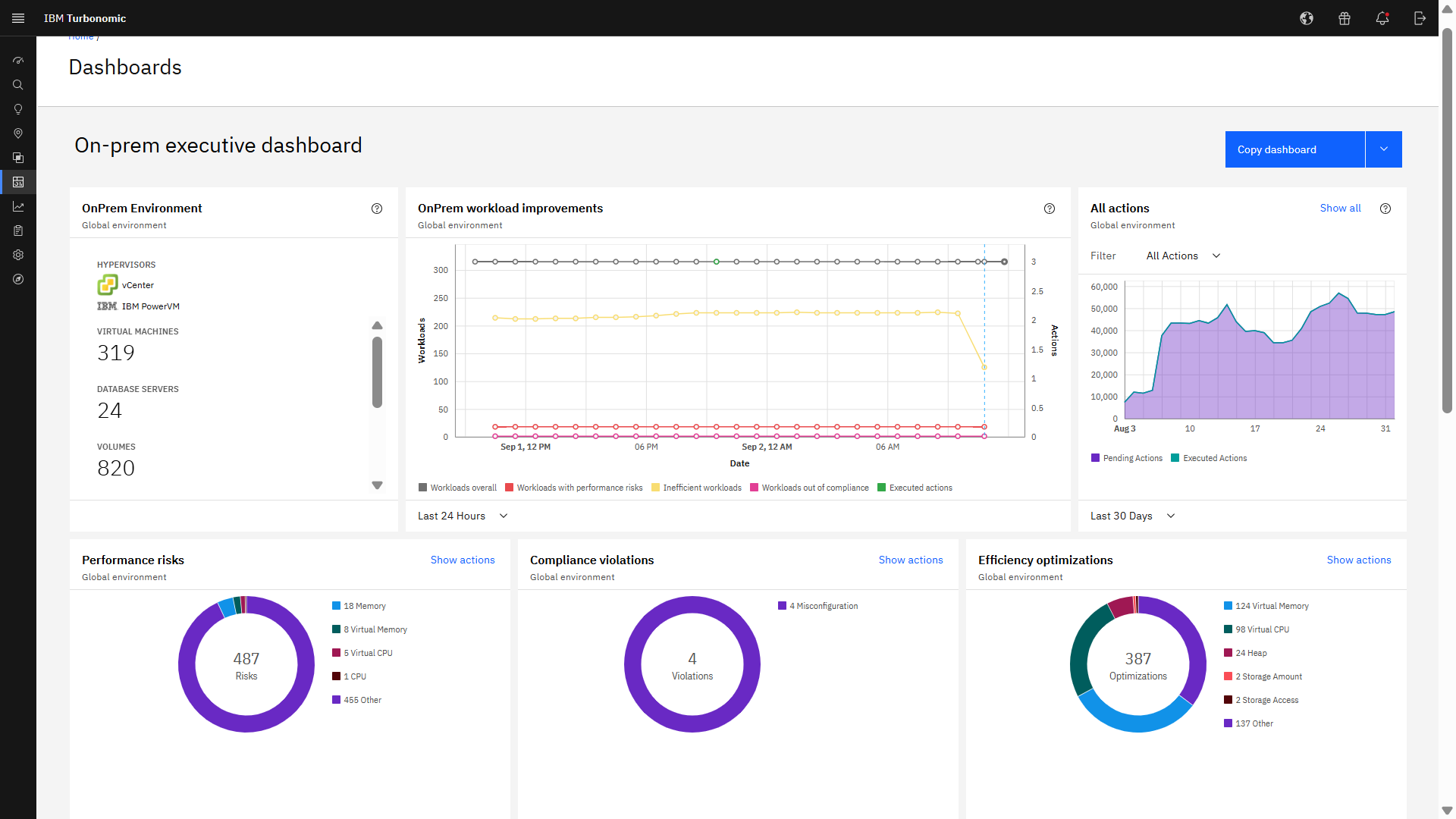
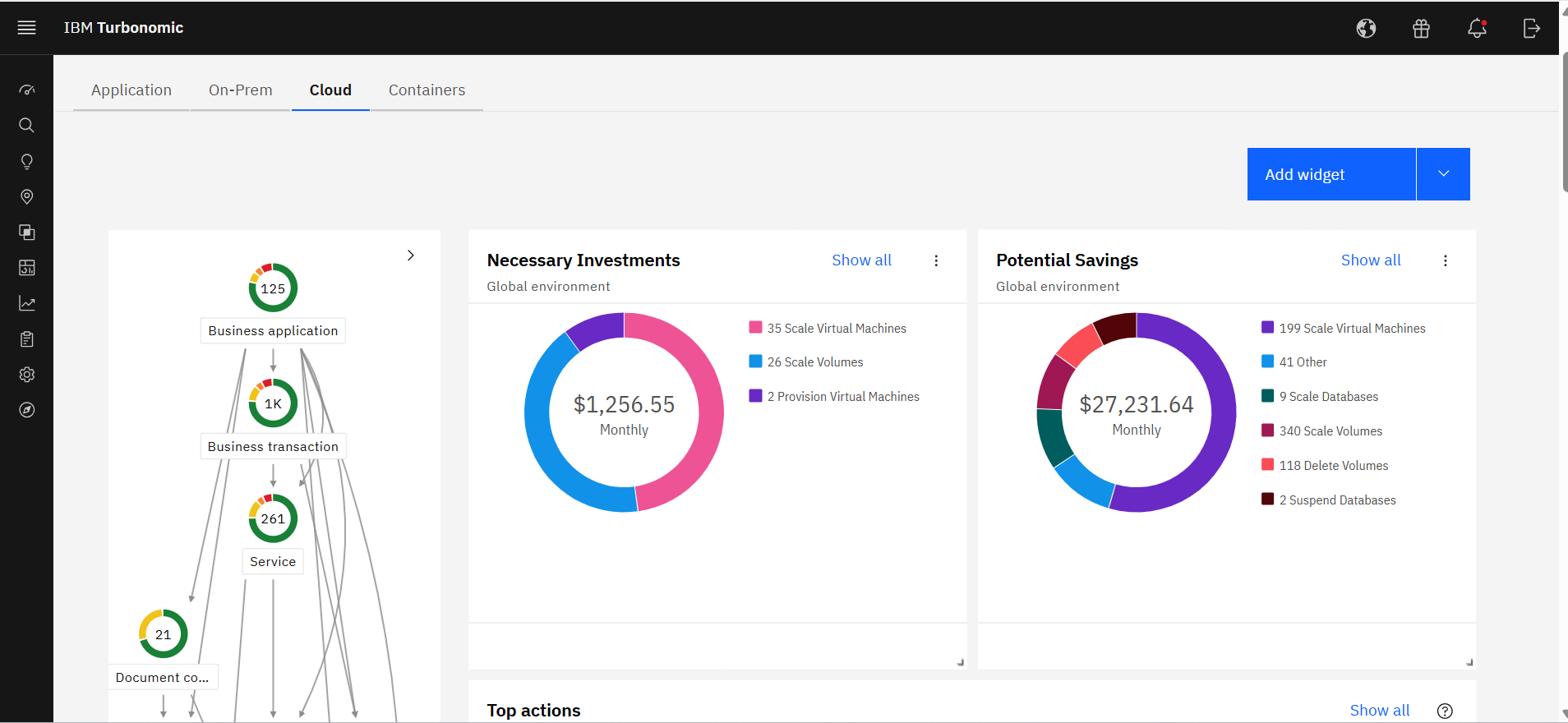
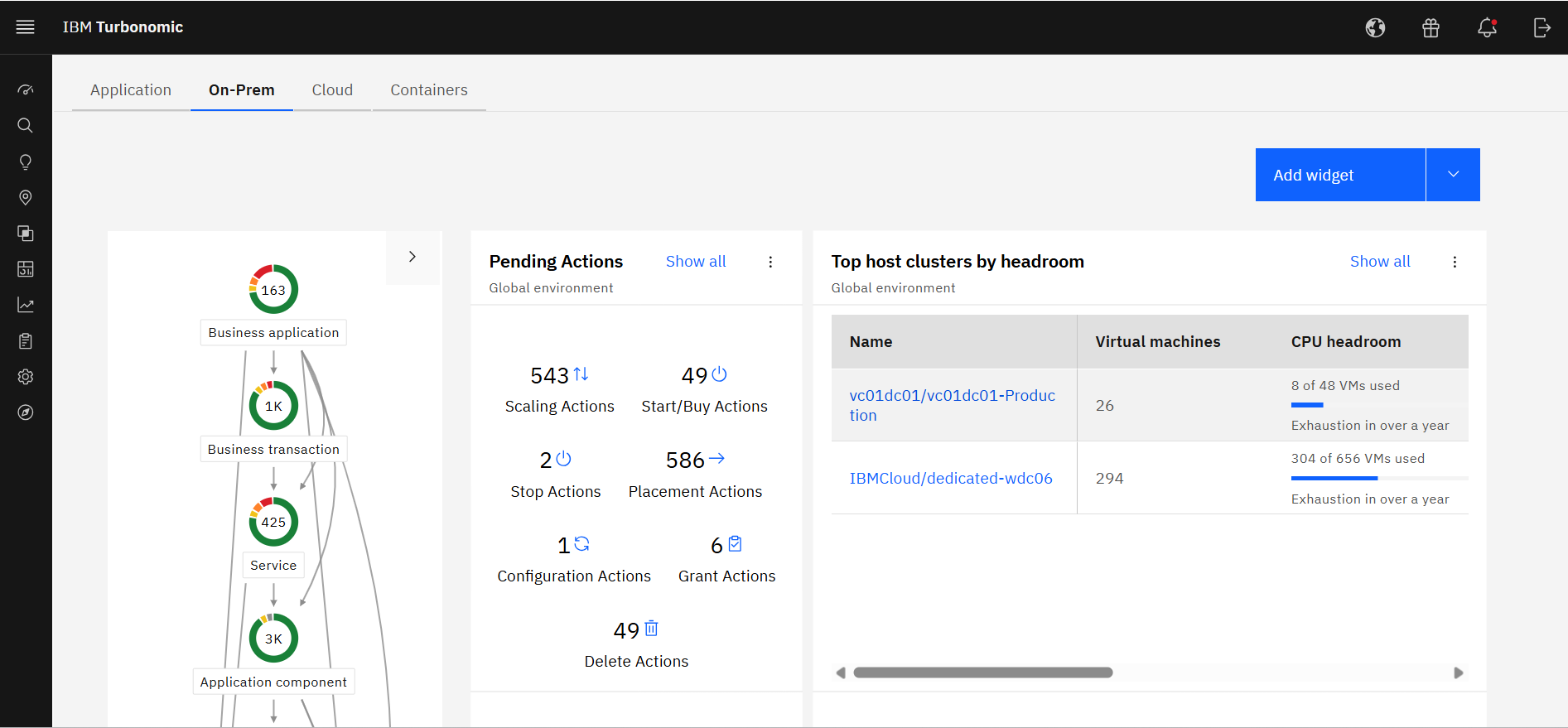
IBM Turbonomic is a performance and cost optimization platform for public, private, and hybrid clouds used by cloud, infrastructure operations, and architecture to assure application performance while eliminating inefficiencies by dynamically resourcing applications through automated actions. One of the key features of IBM Turbonomic is its ability to continuously adjust application resources in real time. By monitoring resource utilization and application performance,…
N/A
Pricing
Splunk AppDynamics
Sumo Logic
Turbonomic, now part of the Concert platform
Editions & Modules
No answers on this topic
Essentials
$3.00
Per GB Logs
Enterprise
$4.00
Per GB Logs
Enterprise Security
$4.25
Per GB Logs
Enterprise Suite
$4.75
Per GB Logs
IBM® Turbonomic On-Prem
Varies - Request a Quote
per month IBM Turbonomic On-prem optimizes data center resources in real time, ensuring app performance at the lowest cost by aligning infrastructure supply with dynamic application demand.
IBM® Turbonomic Cloud Standard
Varies - Request a Quote
per month For customers with more than USD 1.6 million in annual cloud spend or 50 Managed Virtual Servers (MVS) or greater
IBM® Turbonomic Hybrid Standard
Varies - Request a Quote
per month Advanced hybrid cloud optimization capabilities for customers with 200 managed virtual servers (MVS) or more
Chose Turbonomic, now part of the Concert platform
Splunk is good at diagnosis, and I found the UI a bit easier to get up to speed on. However, diagnosing an issue does not equate to fixing an issue...Turbonomic supports both. With Azure, I found it far more intuitive to pick up fast, but you are limited to Microsoft, and that …
Chose Turbonomic, now part of the Concert platform
Turbonomic is class apart compared to the others. It helps you achieve what is not possible with the other solutions. Turbonomic can work in an auto-mode and keep delivering savings and business performance. No other product comes even close.
Team Building | Product Owner | Capability Building
Chose Turbonomic, now part of the Concert platform
IBM Turbonomic has grown to a respectable level now in the market and after associating with IBM its value has been increased in terms of trust and results. From technical point of view this is a potential solution and provide almost all similar features like its competitors. …
Platforms for software as a service (SaaS) frequently cater to a large number of users with a variety of needs and usage patterns. Because AppDynamics offers multi-tenant monitoring capabilities to track performance across various customer environments, it is a good choice for SaaS platform monitoring. SaaS providers can maximize resource utilization, proactively detect and resolve performance issues, and provide a dependable and consistent user experience for their clients with AppDynamics.
SumoLogic is a fantastic log aggregator and analysis tool, a fine alternative to Splunk. Searching is powerful and mostly intuitive and results come fast. If you have application logs in clusters or Kubernetes pods that lose their logs every time they're restarted, Sumo is the solution for you
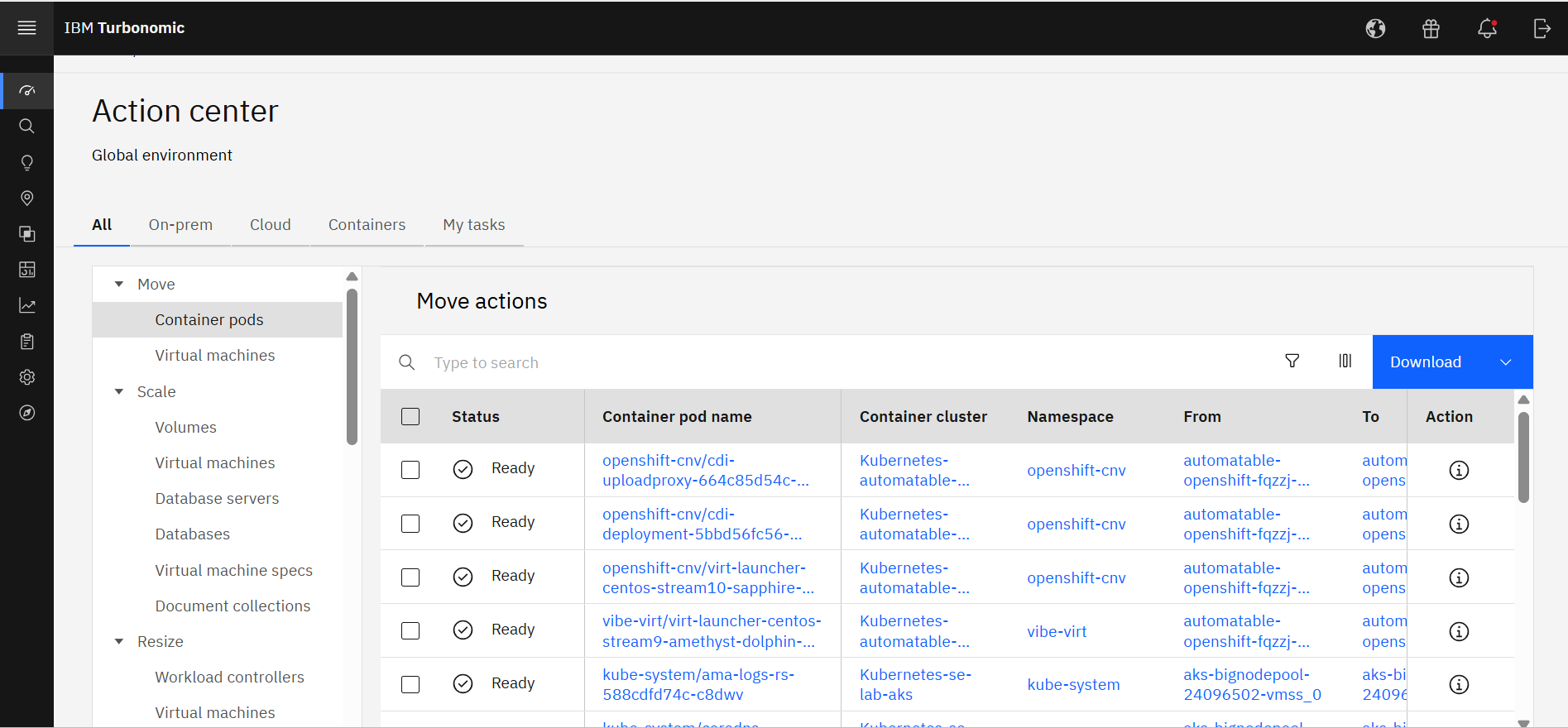
Datacenter Consolidation and Hardware Optimization: This scenario is relevant to you as a hardware manager. It applies when you have physical servers (like Power or System z) and want to maximize virtual machine density. Why it works: IBM Turbonomic analyzes the peak usage times of each VM. If VM "A" is active during the day and VM "B" at night, it places them on the same physical host. Ideal scenario: Data migration projects or when you're told, "[...], there's no budget for more servers this year, make everything fit on what we have." Consolidación de Datacenters y Optimización de Hardware,Este escenario te toca de cerca como encargado de Hardware. Cuando tienes servidores físicos (como los Power o System z) y quieres maximizar la densidad de máquinas virtuales.Por qué funciona: IBM Turbonomic analiza las horas pico de cada VM. Si la VM "A" es activa de día y la VM "B" de noche, las coloca en el mismo host físico.Escenario ideal: Proyectos de migración de datos o cuando te dicen: "[...], no hay presupuesto para más servidores este año, haz que quepa todo en lo que tenemos". This review was originally written in Spanish and has been translated into English using a third-party translation tool. While we strive for accuracy, some nuances or meanings may not be perfectly captured.
Business Transaction Monitoring is one of its signature strengths. This represents a major differentiator from generic infrastructure monitoring tools.
AI‑driven anomaly detection and intelligent alerting provide a significant advantage over traditional monitoring.
When combined with Splunk AppDynamics, full‑stack observability becomes a key part of Cisco/Splunk’s unified observability strategy.
Sumo Logic allowed for our InfoSec team to ingest logs from our CDN directly, in real-time, instead of massive compressed archives that were sent every two-hours (the only alternative at the time). Sumo Logic had an app for these logs, that allowed us to easily get an immediate payoff from the data, with canned dashboard and saved searches.
Sumo Logic has a fairly extensive REST API when it comes to log sources, source configurations, dashboard data, searches, etc. Their wiki for the API is usually kept up to date.
Sumo Logic, during the period of time I had used their product, had added the ability to configure agents via configuration files. This allowed customers to configure their endpoints, and modify the endpoints, with configuration management tools like Chef / Puppet / Salt. Beforehand, the only option was to always make changes either via the web portal or REST API.
The solutions engineers were extremely helpful, and easily reachable when issues would occur.
Users at our company found it easy to get started, working on new dashboards, scheduled searches, and alerting. The alerting worked well with our third-party paging tool.
AppDynamics may enhance its capacity to track transactions through complex distributed systems and microservices, offering a more comprehensive understanding of application behavior.
Better search and filtering capabilities would enable engineers to quickly obtain deeper context by drilling down into individual data points.
AppDynamics might be more widely available to engineers and organizations if it offered subscription plans or tiered pricing options.
It would be nice if the UI included a break-down of features that are both licensed as well as un-licensed. That way, you could not only see what you have, but what you don't.
The right-sizing recommendations are great, but very little info is given about why the recommendation is being made. More info would not only increase understanding, but would also help drive decision-making.
cause it achieves all our targets and we are satisfied with using Splunk also stable no technical challenges or problem caused by Splunk a lot for innovative integrations also all layers are using splunk NOC team , DEV team, application support team, managers security team also in forcasting for EA team
We are certainly happy with Turbonomic as a whole and have invested quite a bit of time and effort into learning the ins and outs of the product. We have our reporting setup the way we want it and have gained definite value from these features. I will say though that many products nowadays are offering more native monitoring, reporting, and alerting features which may eventually steer us away from this product
Splunk AppDynamics is great product that has positively maintained solid application workflows. It has simple and clean UI that displays graphical representation of our database and application behaviour. It gives us an opportunity to customize and set most reliable alerts and data configurations that aligns with our policies. It is easy to monitor operation hypothesis and lower RCA if you identify application coding errors.
Sumo Logic is very powerful but definitely requires some configuration work to get the most out of it. You can get a certification related to this, but it is definitely not something you can just throw together.
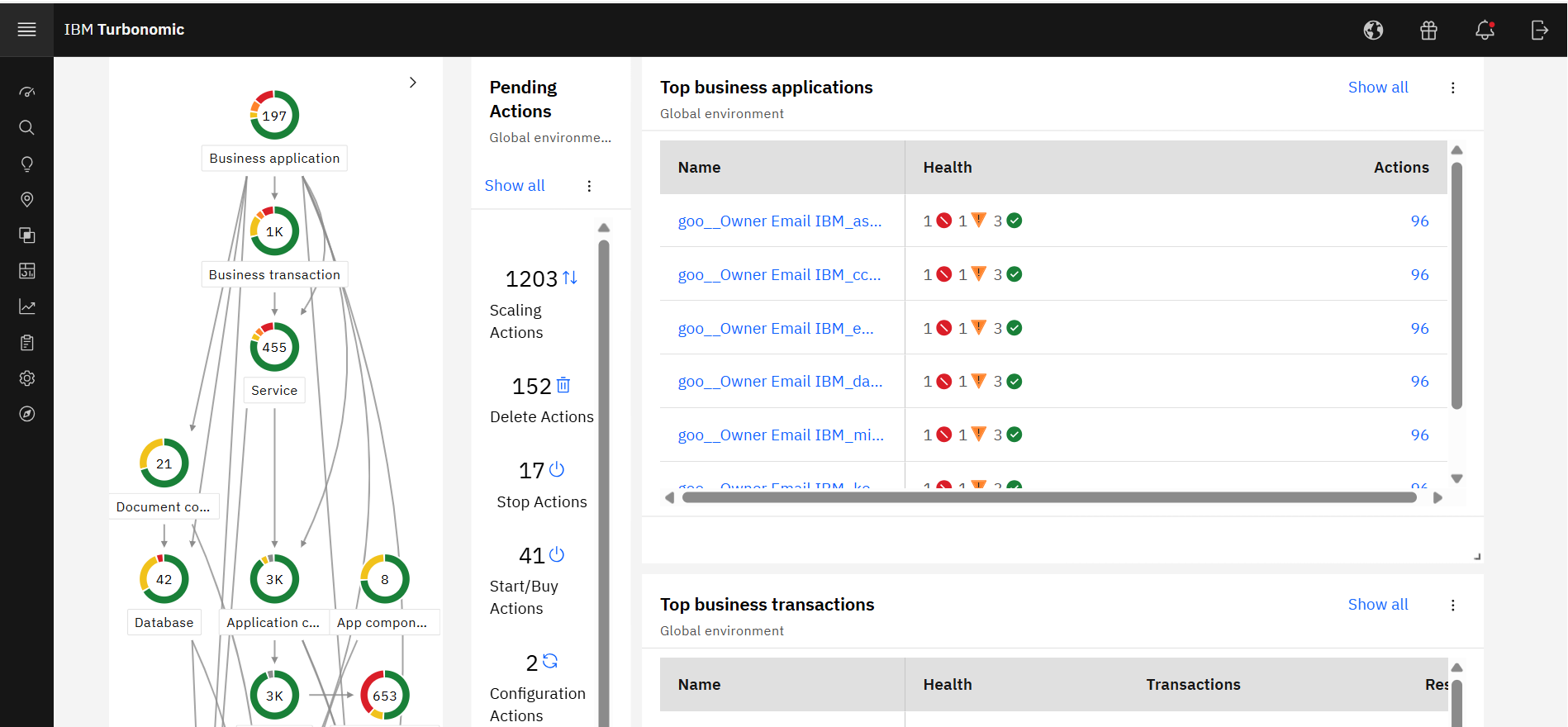
Excellent approach to larger VM organizational management. They have an very clean integrated dashboard that allows us to see everything in our environment and what that is doing in real-time. It works on multiple hyper-visors really well and integrates capacity planning on my local site as well as my cloud locations.
On a scale of 1 to 10, I would rate the availability of Splunk AppDynamics as a 9. Overall, the platform has proven to be highly reliable and is available when we need it. It consistently supports our monitoring and performance management needs across critical applications and infrastructure. There have been occasional issues with platform availability, such as intermittent application errors or brief unplanned outages. However, these instances have been infrequent and typically resolved quickly, minimizing any significant impact on operations. The stability and uptime of the platform have met our expectations, and we continue to rely on it as a core component of our APM strategy.
On a scale of 1 to 10, I would rate the performance of Splunk AppDynamics as a 6. While the platform generally delivers the expected functionality, we’ve experienced periodic slowness—particularly with page loads and report generation. These performance issues can be frustrating, especially when trying to quickly access critical data during incident response or analysis. One contributing factor may be our use of a shared controller environment with other enterprises, which can introduce resource contention and impact overall responsiveness. In some cases, this has led to delays in accessing dashboards or completing complex queries. Despite these challenges, the platform remains a valuable tool, and we’re exploring options to improve performance, including potential changes to our deployment model and support agreements.
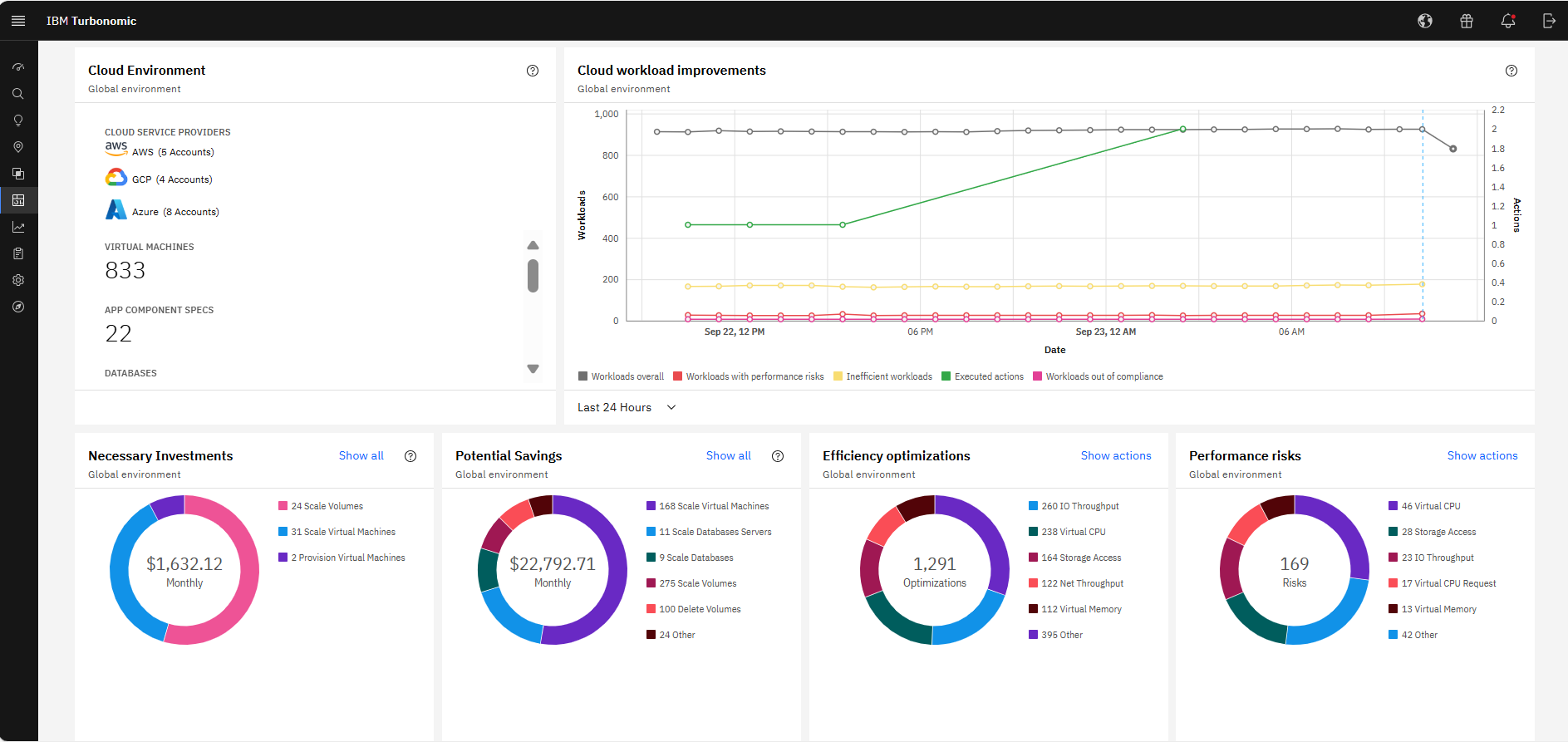
It allocates resources among applications by showing more on the cost breakdown by cloud service, with metrics on cloud provider information like Azure Management, Identity, Networking, Storage with costs per day, and total services costs. This then could facilitate and show the corresponding actions thereafter upon scaling.
AppDynamics has its own community site that includes forums and a knowledge base. On the forums, you can converse with other members of the community and ask technical questions as you have them. Though this forum isn’t filled with people there are active members for you to gain some valuable insights.
I would give this rating because I attended a free Sumo Logic training at a WeWork in Chicago. I found the training very useful, and I learned a lot of features that I was not aware of before I went to the training. I like the idea that SumoLogic provides free training seminars. I am certified in level1, and I plan on certifying to level2.
When I contact support I get a quick response and they are able to solve my problem quickly. I also get a sense that they want to make sure that we are getting value from the product and walk me through whatever steps are needed to accomplish my goals.
Alex (from VMTurbo) has worked with the product for years and helped develop the product. He was very knowledgeable and was able to provide our support team with details knowledge on how to get our deployment configured correctly as well as help with another VMTurbo POC within another customers environment.
On a scale of 1 to 10, I would rate the online training for Splunk AppDynamics as a 7. The training was generally acceptable and covered the core concepts and functionality of the platform. However, there were some challenges with communication during sessions—particularly around clarity and instructor engagement—which occasionally made it difficult to fully grasp certain topics. Additionally, the training could benefit from being more focused and tailored to specific roles or use cases. A more structured approach with clearer learning paths and practical, hands-on examples would enhance the overall effectiveness and help users apply the knowledge more confidently in real-world scenarios.
After buying VMTurbo Operations Manager, I was invited to an online user training event. I felt this training was effective and dug just deep enough to be informative yet still keep my attention. Additionally, the webinar was free.
On a scale of 1 to 10, I would rate our satisfaction with the implementation of Splunk AppDynamics as a 9. The deployment process was smooth and well-coordinated, thanks to the collaborative efforts between Cisco Professional Services, our internal business stakeholders, and agency technical teams. Key Insights from the Implementation: Cross-functional Collaboration Was Critical: Engaging both technical and business teams early in the process ensured that the platform was configured to meet a wide range of operational and strategic needs. Value of Expert Guidance: Cisco’s Professional Services provided invaluable expertise, helping us navigate complex configurations and tailor the solution to our environment. Their involvement accelerated deployment and ensured best practices were followed. Importance of Planning and Communication: A well-defined implementation roadmap and regular communication across teams helped us stay aligned, manage expectations, and address challenges proactively. Scalable Architecture: We designed the implementation with scalability in mind, allowing us to expand usage across agencies and applications without major rework. Overall, the implementation laid a strong foundation for our APM program and positioned us for long-term success.
I was satisfied with the implementation, as at the time, it was the best way to implement the product with the available feature sets in Sumo Logic. User creation and management became more of an issue during continued use, instead of it being an issue related to deploying the product in our environment.
The implementation was very simple. Just upload an OVA file and power on the VM. Once it comes up enter some networking information and you can then access the web interface. From there, just begin configuring the system for your environment by adding you license and the various virtual environments and storage through the inventory tab
It is distinguished from these programs because the platform provides visualizations of application processes, showing the interplay between various parts and services. Understanding the architecture of complicated apps and finding their weak spots is greatly aided by this.
Sumo Logic works very well out of the gate. For a small business it has given us what we need. I worked at a larger company previously, and we produced so many logs we had to create a custom logging service to handle them all. Cost and availability are big issues when deciding between the different services, whether self maintained and hosted, or provided by another company.
As the organization had experience of years in using IBM products, we had the confidence that they will provide us with great support. And we needed a reliable solution as a financial institute to ensure continuous operations. Even though the price was very high, we made the correct decision to go ahead with IBM Turbonomic as the feedback from existing users in the region was very positive. We needed a solution which was capable of handling our automation requirements. All these were green in IBM Turbonomic.
While the overall value of the Splunk AppDynamics platforms is strong, the pricing structure and contract terms can be complex and difficult to navigate. Unit pricing, licensing tiers, and billing frequency are not always intuitive, which can make it challenging to align purchases with the State’s evolving needs. I rely heavily on our Account Manager to help interpret and tailor the licensing model to our specific requirements. Their support has been invaluable in ensuring we make informed decisions. The most impactful change would be to simplify the licensing and pricing model. Clearer documentation, more transparent pricing tiers, and streamlined purchasing processes would significantly improve the experience and reduce administrative overhead.
On a scale of 1 to 10, I would rate the overall scalability of Splunk AppDynamics as a 7. The platform is designed to support enterprise-wide deployments across multiple departments and sites, and it performs well in large-scale environments. Its architecture allows for horizontal scaling and supports a wide range of application types and infrastructures. However, the agent management and deployment process can be complex and time-consuming, especially when onboarding a large number of applications or systems. Coordinating agent installation, configuration, and updates across diverse environments requires careful planning and often significant manual effort. Streamlining these processes—perhaps through more centralized management tools or automation—would enhance scalability and reduce operational overhead. Despite these challenges, once deployed, AppDynamics scales effectively and provides consistent performance and visibility across the enterprise.
Our experience with the professional services team supporting Splunk AppDynamics has been exceptional. They demonstrated deep technical expertise, strong collaboration skills, and a clear understanding of our business objectives. Their guidance was instrumental in the successful implementation of our APM program and platform integration. The rating of 9 reflects our high level of satisfaction, with a small margin left to acknowledge that continuous improvement is always possible. Overall, their support has been a key factor in the success of our deployment.
Professional services were always there to guide us in our transformation to the cloud. They understood our business model and then were able to provide guidance on what we needed from the tool.
Through the identification of performance bottlenecks and efficient resource allocation, AppDynamics has contributed to cost savings and resource optimization. This has a direct positive impact on our overall return on investment.
While AppDynamics' numerous capabilities help maximize efficiency, they may place a strain on your system. Organizations with limited infrastructure capacity may have difficulties and therefore give this serious thought before implementing it.
Application performance has been a big one. With Turbonomic keeping everything running at top performance, it can make changes when extra resources are need, quicker than somebody being notified and then making the necessary changes.
Turbonomic has been a great cost savings for us on multiple occasions. We use it every time we are improving servers.
With the planning feature we get the best performance form new hardware purchases