TrustRadius: an HG Insights company

Algolia

Score8.5 out of 10

130 Reviews and Ratings

What is Algolia?

Algolia offers AI-powered solutions to improve online search and discovery experiences, with tools for business teams and APIs for developers that help to improve user engagement and conversions across websites, apps, and e-commerce platforms.

Read more details.

Media

Screenshot of Index & Query Rules Management. Query Rules help to enhance an engine's ranking behavior for specific queries. Setting up rules can uncover and enable users to respond more specifically to the intent behind users' queries.
Screenshot of Query Monitoring. This offers insight into the status, performance and overall activity happening within the search engine.
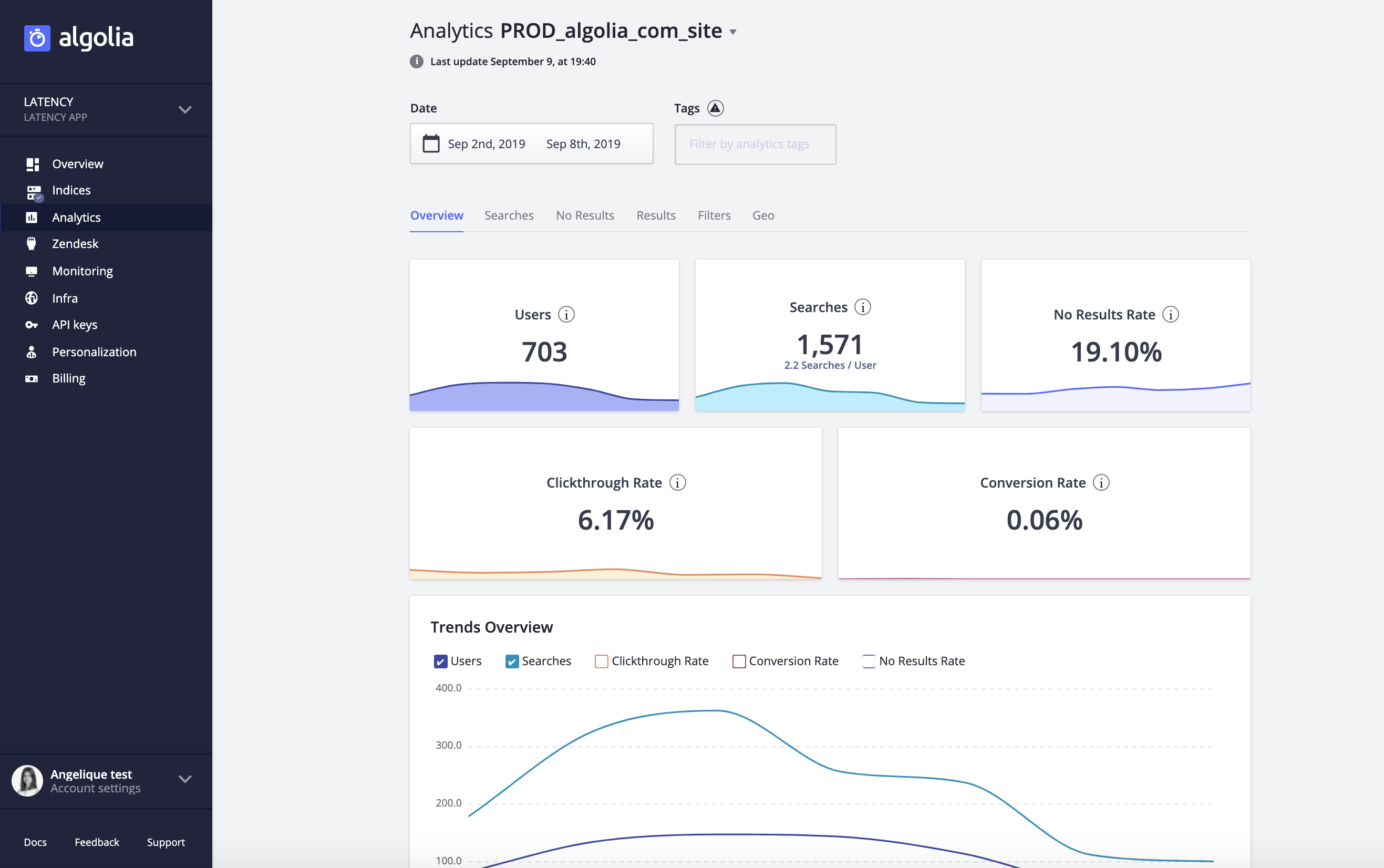
Screenshot of Algolia Analytics. The search bar is a feedback form. Algolia's analytics drives insights from search to click to conversion.
Screenshot of The Algolia Dashboard, offering products to accelerate search and discovery experiences across any device and platform.
Screenshot of The advanced front-end libraries, API clients, and extensive documentation that help developers build, deploy, and maintain.
Screenshot of Where users getting started simply choose an index, denote the events, and choose a model.

1 / 6

Screenshot of Index & Query Rules Management. Query Rules help to enhance an engine's ranking behavior for specific queries. Setting up rules can uncover and enable users to respond more specifically to the intent behind users' queries.

Who Buys & Uses Algolia

Pros

  • Delivers fast and highly relevant search results
  • Enhances product discoverability and user experience
  • Supports effective merchandising and personalization strategies

Cons

  • Initial setup and integration can be complex, especially with specific platforms
  • Requires developer involvement for deep customization or complex integrations
  • Challenges ensuring consistent functionality for features like synonym definitions

Easy scalable and complex if you want search engine to deliver best search experiences.

Use Cases and Deployment Scope

Algolia helps our customers find the best products based on their search/demands and interests like color, usage, or brand preferences. It also allows us to set up the best sorting for those results to make sure margin, popularity, and availability are included on the results page. Another problem where Algolia acts as a solution is when we try to improve our results based on search terms, suggesting new kinds of synonyms or highlighting issues in specific queries where we have the opportunity to act individually.

Pros

  • Sorting and filtering based on custom setup is easy and intuitive to modify and create for each index (database of products, brands...).
  • Offering an excellent back office where you can improve your results weekly based on specific search terms.
  • Search personalization and neural search where users can use our finder like a chat.

Cons

  • Dynamic re-ranking should use more available data to increase the quality of the results.
  • Search autocomplete path as part of the search flow can become Algolia's not-so-best friend. It could be hard to set up events before the search results page appears.

Return on Investment

  • Improved CTR in search result pages.
  • Reduced the number of searches without results.

Usability

Alternatives Considered

Doofinder Site Search and Elasticsearch

Other Software Used

BrowserStack, Dynamic Yield, Hotjar

Boosting Engagement and Efficiency with InstantSearch and Merchandising

Use Cases and Deployment Scope

he implementation of Algolia has fundamentally transformed our platform's discovery phase by addressing the critical friction point of search abandonment. By leveraging Algolia’s sophisticated typo tolerance, we have effectively eliminated the "no results" barrier that often occurs when users make minor spelling errors or phonetic guesses. This ensures that the search interface remains resilient and helpful, guiding users toward the products they intend to find rather than forcing them to restart their journey. This optimization has served as a primary driver for higher conversion rates, as it maintains a fluid path from initial intent to the product page.Furthermore, we have moved beyond a one-size-fits-all search model by integrating Algolia’s AI-powered personalization engine. By capturing and analyzing individual search and click-stream data, the system now dynamically re-ranks results to align with each customer’s unique preferences and historical behavior. This transition to a more intuitive, intent-based discovery experience ensures that the most relevant items are surfaced immediately, significantly reducing the time-to-purchase. The result is a highly personalized digital environment that not only enhances the overall customer experience but also builds long-term brand loyalty through a more relevant and engaging interface.

Pros

  • Typo-tolerance
  • Documentation is easy to navigate and all encompassing
  • Easy Integration to frameworks
  • Advanced Query Suggestions and Synonyms
  • Custom Ranking and Rules Engine

Cons

  • API integration documentation for Laravel Scout could be improved with more step-by-step examples.
  • For a beginner, its is quite a steep learning curve to implement API's in relating applications.
  • Simplified UI for complex Ranking and Sorting rules
  • While Algolia is incredibly powerful, the usage-based pricing model can become difficult to forecast as a business grows. For high-traffic stores, the cost per search or record can escalate quickly, making it a significant expense compared to self-hosted alternatives. Providing more granular cost-control tools or more flexible tiers for high-volume users would help in planning long-term budgets.

Return on Investment

  • After implementing InstantSearch, our team observed a 24% increase in click-through rate and a 45% boost in conversion rate. Additionally, the bounce rate on category pages dropped by 15% following the introduction of Merchandising.
  • The time to conversion decreased from an average of 4 minutes to just 60 seconds, thanks to accurate search results being instantly delivered to customers' queries, saving them valuable time.
  • Following the launch of the enhanced typo tolerance and synonym mapping, we observed a 10% decrease in customer support inquiries regarding product availability. Customers who previously reached out because they "couldn't find" a specific item are now successfully self-serving through the search bar. This reduction in support volume has allowed our team to allocate resources more effectively toward complex customer needs rather than basic navigation assistance.
  • Given the limited screen real estate on mobile devices, Algolia’s "InstantSearch" results were a game-changer. We saw a 35% increase in mobile-specific conversions because users no longer had to navigate through deep menu hierarchies; they could find and purchase products with just a few taps. The speed and accuracy of the mobile search experience have bridged the gap between desktop and mobile performance across our store.

Usability

Alternatives Considered

Typeset

Other Software Used

Microsoft Teams, Microsoft Visual Studio Code, PhpStorm

Algolia is great for all E-commerce websites big or small

Use Cases and Deployment Scope

We use Algolia to provide a better shopping experience on our BigCommerce website. The out of the box site search on BigCommerce does not meet our standard needs. We use Algolia for advanced product filtering and product search. It allows us to curate the right products to the right customers based on their search and needs.

Pros

  • Advanced Product Filtering
  • Advanced Product Search
  • Advanced Product Categorization
  • Lightning Fast Search

Cons

  • Ease of Use
  • Learning Curve
  • Site Search Ease of setup

Return on Investment

  • Fast search capabilities
  • Happy Customers
  • Improved conversion rates
  • Better data insights

Usability

Other Software Used

HubSpot Marketing Hub, HubSpot Sales Hub, HubSpot Data Hub, BigCommerce, Smartsheet

Algolia as a Core Engine for Search Merchandising and User Experience

Use Cases and Deployment Scope

We use Algolia primarily as the search engine for our internal site search and as a key tool for online merchandising. It allows us to manage our eCommerce platforms through navigation rules and search results that are aligned with user interactions and product performance. Algolia helps us address critical business challenges such as improving product discoverability, optimizing search relevance, and enabling data‑driven merchandising decisions. By leveraging its capabilities, we can tailor search and navigation experiences based on customer behavior and commercial priorities, which has directly contributed to an improved user experience across our four eCommerce sites. Over time, we have progressively adopted and taken advantage of the new tools and features Algolia has developed, continuously enriching the search and discovery experience and ensuring our platforms evolve in line with our customers’ expectations.

Pros

  • Develops tools to make job easier and expand customer experience in our sites
  • Ongoing communication and support to fully leverage the platform
  • Gives consistant and constant valuable information about our sites so we can take informed decisions

Cons

  • As they are constantly developing new rules, we could use some demos or guided meeting so we van use those tools correctly

Return on Investment

  • It reduced bounce rate on our search results page
  • Our convertion rates increades significately

Usability

Alternatives Considered

Apache Solr

Other Software Used

Kevel, SAP Commerce Cloud

One of the best recommendation tools in the market

Use Cases and Deployment Scope

Algolia has helped us index different facets of our website: blog, template store, and docs as individual entities, which helps us deliver detailed search results depending on the context a visitor is searching in at a given time.

The recommendation algorithm/service also helped us share recommendations of similar templates to visitors, which might have helped with activation.

Pros

  • Recommendation based on similar items
  • Functional search

Cons

  • We weren't able to get search working with question forms eg: "How to create XYZ" didn't show up when you search "XYZ"
  • The ability to index full page content

Return on Investment

  • Improved engagement when users found one of their use cases

Usability

Other Software Used

Contentful, Slack, PostHog