TrustRadius: an HG Insights company

SwaggerHub

Score8 out of 10

13 Reviews and Ratings

What is SwaggerHub?

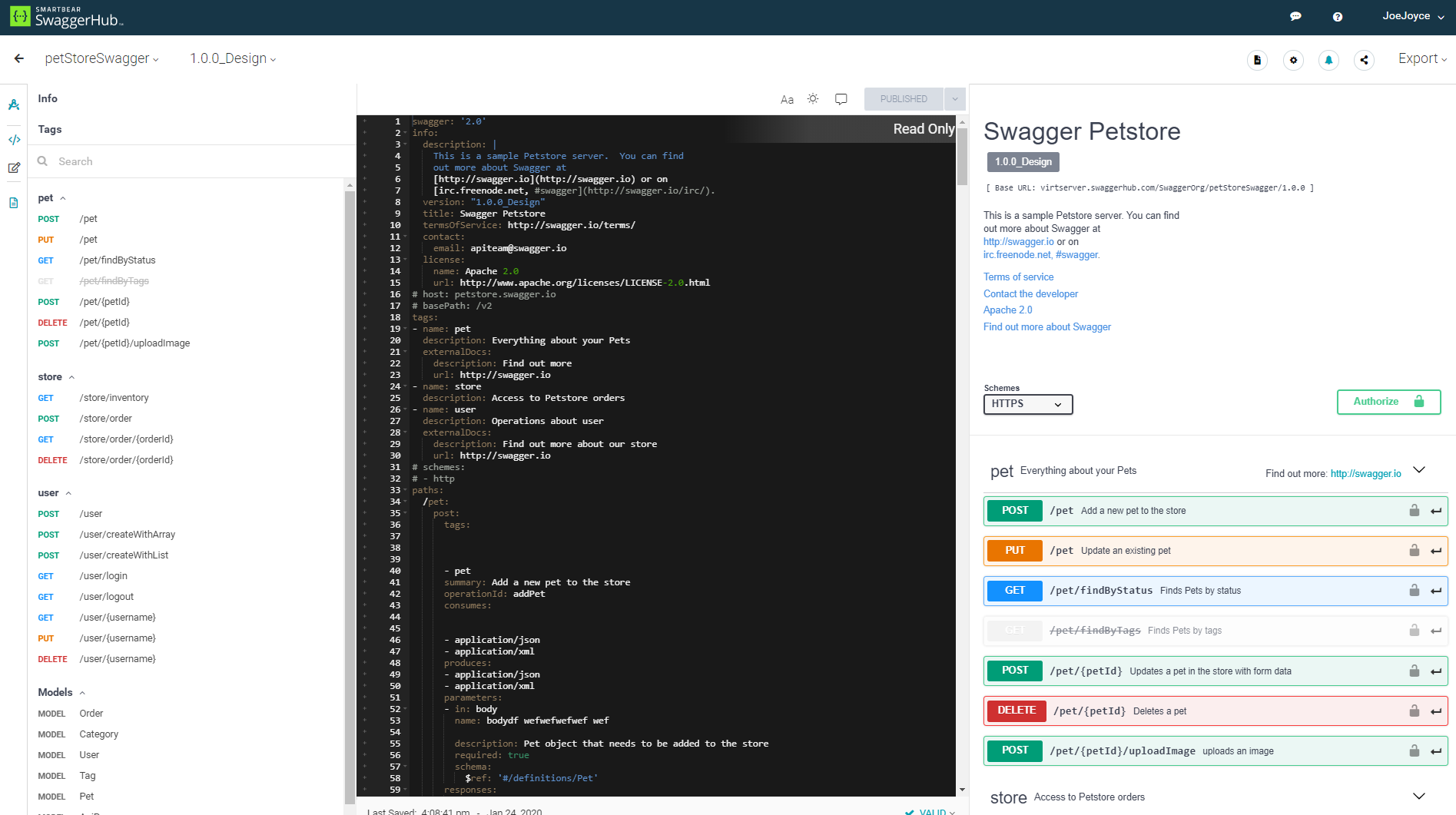
SwaggerHub is a platform for API design and documentation with OpenAPI. Whether it’s push generating an API’s design and code to source control hosts, deploying the API to API Management platforms, or triggering a Jenkins build, SwaggerHub boasts a host of integrations.

Faster, Standardized API Design

Design APIs in an editor that is built for efficiency without any loss in design consistency.


Work Better Together

The platform is designed to give developers the freedom they want and architects the visibility they need.


Facilitate the API Lifecycle

SwaggerHub is engineered to give organizations and teams the best possible experience for maintaining and scaling their API development, from design to deployment.


Hosted, Interactive API Documentation

Make APIs easier to use for internal and external users, with SwaggerHub's auto-generated API documentation.


Categories & Use Cases

Media

Faster, Standardized API Design

Top Performing Features

  • API versioning

    There are mechanisms to roll out new versions of the API and the ability to migrate applications to new versions.

    Category average: 8.4

  • API access control

    Authentication and authorization systems to ensure that users of the API have permission

    Category average: 8.7

  • API user onboarding

    Systems to allow users to sign up, receive access credentials and be assigned usage rights

    Category average: 8.4

Areas for Improvement

  • API usage data

    Analysis of traffic patterns to track how API is being used

    Category average: 8.3

  • Usage billing and payments

    Support for payment mechanisms such as monthly fees, or other payment patterns

    Category average: 8.1

  • Rate limits and usage policies

    Usage quotas to restrict traffic volumes to keep traffic loads manageable

    Category average: 8.3

SwaggerHub - Easy to use API designer

Use Cases and Deployment Scope

SwaggerHub is used in our organization to document our APIs and build out the models for them. This helps our entire team, by keeping them updated and know which resources we have and what to expect back from them. My favorite problem that this addresses is our testing. We can easily import the API into ReadyAPI and build out our tests directly from that, without having to build out an API at that step.

Pros

  • Designing APIs
  • Documenting APIs
  • Helps all devs stay up to date

Cons

  • I have been told that the models take quite some time to build out
  • Would love to see some more capability on import, as far as adding variables into endpoints

Most Important Features

  • Export/Import
  • Ease of sharing
  • Easy interface

Return on Investment

  • Tests get created faster when we can import the API
  • We are able to maintain our APIs when something gets added/deprecated

Other Software Used

ReadyAPI (formerly SoapUI Pro, LoadUI Pro, & ServiceV Pro), TestRail, TestProject, Jenkins

SwaggerHub's Swag

Pros

  • Helps in defining the API contracts by simple YAML file definitions
  • REST service/API documentation is hassle free
  • Auto-generated code capability helps in reducing the efforts to define clients

Cons

  • Swagger Editor can be bit more user friendly by providing the means to persist different projects as part of user profiles
  • Swagger UI's testing capability or means to test APIs can be improved
  • Swagger UI clients can be added as part of Spring ecosystem

Return on Investment

  • It helped a lot in saving efforts to define APIs and share them with multiple teams/squads
  • Clear documentation of APIs
  • Auto generation of API definitions based on completed APIs

Alternatives Considered

SoapUI Open Source and supported by SmartBear

Other Software Used

Google Kubernetes Engine, Azure DevOps Services (formerly VSTS), Amazon Elastic Compute Cloud (EC2), Slack, Apache Kafka, Jira Software

Design First approach to microservice APIs

Pros

  • Treating the design as documentation ensures that we have consistent and well defined APIs
  • API consumers can export the swagger definition or code stubs to use within their development environment
  • We can iterate through multiple versions of a definition privately before making a version publicly available

Cons

  • Under the Swagger 2.0 standards you can only provide one example for each endpoint. A complex /search endpoint is a great use case for having multiple examples.
  • Not able to define events that will be created or consumed by an API.

Most Important Features

  • Ability to define multiple versions of each API
  • Shared domain models to ensure consistent definitions across APIs

Return on Investment

  • Design consistency
  • Reduced rework
  • Ease of use

Other Software Used

Visual Studio IDE, Azure Kubernetes Service (AKS), Microsoft SQL Server

One of the best tools for API management

Pros

  • It is easy to share or use together for a collaborative team project.
  • Make better for the organization when it comes to documentation of API.
  • User-friendly to understand for non-developer to their needs.

Cons

  • The user interface could be more improved to sustain with other similar tools in the market.
  • Beneficial if we have better integration with third party softwares.
  • Nice to have ability to download the documentation in usable formats.

Most Important Features

  • It helped a lot in saving efforts to define APIs and share them with multiple teams.
  • Clear documentation of APIs
  • Auto generation of API definitions based on completed APIs

Return on Investment

  • It helped us with testing the API and brought us more clarity on the use cases we need to address.
  • Faster API development lifecycle.
  • Good documentation capabilities of APIs.

Alternatives Considered

Postman and Azure DevOps Services (formerly VSTS)

Other Software Used

Azure DevOps Services (formerly VSTS), ServiceNow IT Service Management, Microsoft SQL Server

The best way to document your APIs & share APIs

Pros

  • The UI & easy of integration with bitbucket & other repositories.
  • It is easy to document your API using Swagger 2.0 or Open API specification.
  • You can use the "Try It Out" button and invoke API, authenticate and execute the APIs.
  • It also has ways to integrate AWS API gateway, Bitbucket, Github & other tools.
  • Helps streamline the development especially sharing APIs across multiple departments & developers.

Cons

  • It doesn't have a way to write test cases like postman has.
  • It does't have environments to configure different ENV variables like Postman has.
  • And may be having a client app for Swagger would be nice to have.

Most Important Features

  • API documentation & specification
  • Testing the APIs directly using the SwaggerHub UI.
  • Committing the new API definitions to Bitbucket & also AWS API gateway using the SwaggerHub integrations.

Return on Investment

  • We used the free version, our API is public if you know the URL.
  • It definitely helped us a lot & helped save a lot of time in speeding up the development.
  • It also helped us with testing the API and brought us more clarity on the use cases we need to address.

Alternatives Considered

Postman

Other Software Used

AWS Lambda, Amazon API Gateway, Amazon CloudSearch, Bitbucket, Trello, Amazon DynamoDB