
Action1 vs. AWS CodeDeploy
| Product | Rating | Most Used By | Product Summary | Starting Price |
|---|---|---|---|---|
 Action1 | Score9.4 out of 10 | N/A | Action1 is an autonomous endpoint management platform that is cloud-native, scalable, and configurable in 5 minutes. It is free for the first 200 endpoints, with no functional limits. By pioneering autonomous OS and third-party patching - AEM’s foundational use case - through peer-to-peer patch distribution and real-time vulnerability assessment without needing a VPN, it eliminates costly, time-consuming routine labor, preempts ransomware and security risks, and protects the digital… | N/A |
 AWS CodeDeploy | Score10 out of 10 | N/A | AWS CodeDeploy is a fully managed deployment service that automates software deployments to a variety of compute services such as Amazon EC2, AWS Fargate, AWS Lambda, and on-premises servers. AWS CodeDeploy aims to make it easier for users to rapidly release new features, avoid downtime during application deployment, and handle the complexity of updating applications. | $0.02 per on-premises instance |
| Action1 | AWS CodeDeploy | |||||||||||||||
|---|---|---|---|---|---|---|---|---|---|---|---|---|---|---|---|---|
| Editions & Modules | No answers on this topic |
| ||||||||||||||
| Offerings |
| |||||||||||||||
| Entry-level Setup Fee | Optional | No setup fee | ||||||||||||||
| Additional Details | — | — | ||||||||||||||
| More Pricing Information | ||||||||||||||||
| Action1 | AWS CodeDeploy | |
|---|---|---|
| Considered Both Products | No answer on this topic | No answer on this topic |
| Key User Insights | ||
| Would buy again | ||
100% Would buy again 20 Answers | 100% Would buy again 5 Answers | |
| Delivers good value for the price | ||
100% Delivers good value for the price 19 Answers | No answers on this topic | |
| Happy with the feature set | ||
100% Happy with the feature set 20 Answers | 80% Happy with the feature set 4 Answers | |
| Lived up to sales and marketing promises | ||
100% Lived up to sales and marketing promises 19 Answers | No answers on this topic | |
| Implementation went as expected | ||
100% Implementation went as expected 20 Answers | No answers on this topic | |
| Action1 | AWS CodeDeploy | |
|---|---|---|
| Small Businesses |  Avast CloudCare Score10 out of 10 | No answers on this topic |
| Medium-sized Companies |  LogMeIn Resolve Score9.1 out of 10 | No answers on this topic |
| Enterprises |  ManageEngine Endpoint Central Score9 out of 10 | No answers on this topic |
| All Alternatives | View all alternatives | View all alternatives |
| Action1 | AWS CodeDeploy | |
|---|---|---|
| Likelihood to Recommend | 9.7 | 10.0 |
| Likelihood to Renew | 9.4 | - |
| Usability | 9.5 | 10.0 |
| Support Rating | 5.0 | - |
| Implementation Rating | 10.0 | - |
| Action1 | AWS CodeDeploy | |
|---|---|---|
| Likelihood to Recommend |
|
|
| Pros |
|
|
| Cons |
|
|
| Likelihood to Renew |
| No answers on this topic |
| Usability |
|
|
| Support Rating |
| No answers on this topic |
| Implementation Rating |
| No answers on this topic |
| Alternatives Considered |
|
|
| Return on Investment |
|
|
| ScreenShots | Action1 Screenshots 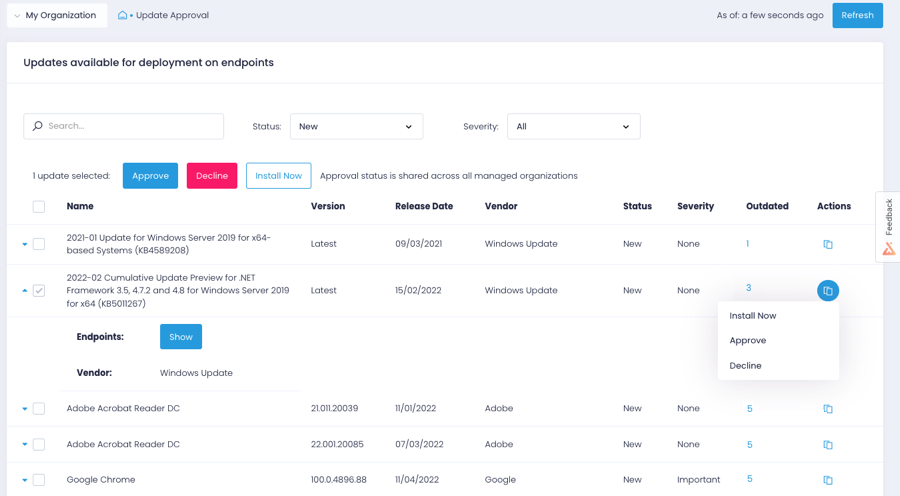 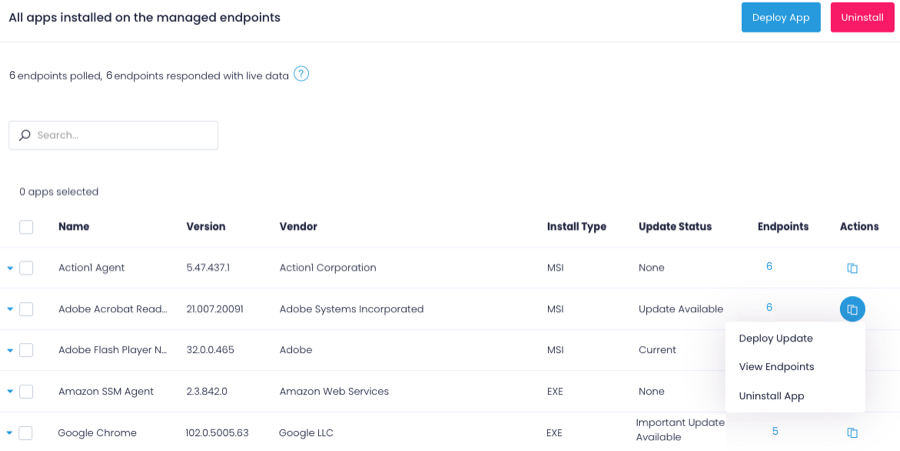    |




