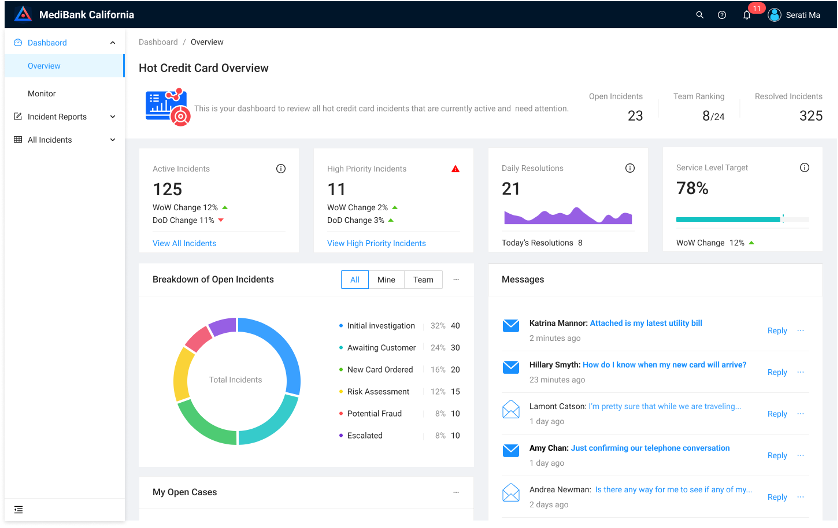
AntWorks RPA, ANTstein, was a robotic automation platform (RPA) that featured a machine learning platform built on fractal science to deploy AntWorks Bots, including QueenBot, processes which perform the automation. The product has been discontinued and is no longer available for sale.
N/A
Nintex
Score7.9 out of 10
N/A
Nintex offers a platform that helps companies discover, automate, and optimize business processes.
ANTstein needs no code or minimal programming. This makes the assigning tasks to bots much easier without wasting time. ANTstein in very useful in performing rule-based tasks. For some tasks and special cases, human assistance is still needed to make decisions.
A de minimis incentive was given to thank the reviewer for their time. The incentive was not used to bias or drive a particular response, nor was the incentive contingent on a positive endorsement. More Info
We use Nintex to automate fundraising outreach at scale. It helps us send personalized emails to a large contact list, and we’d also like to automate follow-ups when there’s no reply. If you need highly customized solutions or clean, fully controllable code, I wouldn’t recommend Nintex. It has many features, but it’s not the same as building your own system from scratch. That said, it can save a lot of time for standard automation workflows.
A de minimis incentive was given to thank the reviewer for their time. The incentive was not used to bias or drive a particular response, nor was the incentive contingent on a positive endorsement. More Info
First: Being accoladed by infomationweek.com as a cognitive tool for machine learning and analytics, challenges repeated tasks to complete within no time, thus called AI based RPA.
It understands the category of data and segregates the data into structured and semi-unstructured. Thus, it helps in achieving cognitive tasks in Image and pattern recognition. OCR capabilities make it compete with other RPA in the market.
Its business pillars lie in Business Process as a Service (BPAAS) and Technology as a Service (TAAS). I used to integrate Zoho CRM, SugarCRM and FreshSales CRM with YellowAnt bot. Oauth 2.0 and token management play an important role in Antworks.
The best part of the Antworks is that they have queenbot™ which makes colonies and give birth to threads to work on different computers and machines to automate a single and repetitive task.
A de minimis incentive was given to thank the reviewer for their time. The incentive was not used to bias or drive a particular response, nor was the incentive contingent on a positive endorsement. More Info
Integrations with other services using various secure authentication methods, along with the seamless integration with SharePoint, are the icing on the cake. This makes it superior to other BPM tools available in the market.
Flexibility in application development - The diverse configurable properties offer multiple ways to utilise the controls and events, affording the flexibility to expand your scope and enabling the creation and use of processes in a myriad of ways.
The streamlined and efficient deployment process significantly accelerates release management, allowing for faster and smoother implementation of updates and new features.
The user interface of the pages offers a more refined and appealing look and feel compared to most other BPM tools.
A de minimis incentive was given to thank the reviewer for their time. The incentive was not used to bias or drive a particular response, nor was the incentive contingent on a positive endorsement. More Info
A de minimis incentive was given to thank the reviewer for their time. The incentive was not used to bias or drive a particular response, nor was the incentive contingent on a positive endorsement. More Info
If you are creating a process with parallel subprocesses, there's no way to see, in a single view in Nintex, all the steps for the subprocesses. You have to view each sub-process in its own view, so it's hard to see what's going on at a high level.
There isn't an easy way to filter the processes by another user (not yourself) in Nintex. There is a report that shows processes and objects by user, but that's not as convenient. This is something that I've seen in other tools (OpenPages by IBM) so I am surprised that it is missing.
Nintex doesn't really have a way to capture iterative processes (which we have a lot of). It's designed for linear processes.
A de minimis incentive was given to thank the reviewer for their time. The incentive was not used to bias or drive a particular response, nor was the incentive contingent on a positive endorsement. TR verified that a representative sample of customers was invited. More Info
We are currently investigating which collaboration platform best suits our needs. Chances are that we move to SharePoint Online and then we're going to also consider the microsoft power platform (power automate and power apps) to develop forms and workflows. Aspecially the pricing model for the cloud is currently a blocking factor to go for the Nintex solution in the Cloud.
A de minimis incentive was given to thank the reviewer for their time. The incentive was not used to bias or drive a particular response, nor was the incentive contingent on a positive endorsement. TR verified that a representative sample of customers was invited. More Info
Based on the on-prem experience with this tool, I believe that they have a lot of potential to help the online version catch up to where the on-prem left off. Nintex developed their online version and it is not as fully formed or capable compared to the on-prem version, and the licensing model scales back what we would have liked to be an expansion or at least continuous improvement of existing flows. It is also not near as user friendly specifically to non-developers and has an uncanny similarity to Microsoft Flow in the online instance. Consistent with my reviews of the tool - I believe they have some good approaches to design thinking that, if translated well from on-prem to online, could make this a clear winner again.
A de minimis incentive was given to thank the reviewer for their time. The incentive was not used to bias or drive a particular response, nor was the incentive contingent on a positive endorsement. TR verified that a representative sample of customers was invited. More Info
The Nintex Process Platform has never crashed or had any availability issues during my usage. However there was an issue that was of my own making that caused a slowdown of the system. I had set up a process to run once a day and check for employees on a list that had certain parameters selected, and for some reason that I had to troubleshoot, the process instead ran constantly, which filled the cache quickly. I ended up having to dismantle that process so the system didn't crash.
A de minimis incentive was given to thank the reviewer for their time. The incentive was not used to bias or drive a particular response, nor was the incentive contingent on a positive endorsement. TR verified that a representative sample of customers was invited. More Info
Unlike any other process automation product out there. Not only is it a low-code, easy to use tool for building processes in environments like SharePoint or Salesforce, they have really started to expand their tool-set by offering tools to manage other things like process mapping, RPA, mobile,etc.
A de minimis incentive was given to thank the reviewer for their time. The incentive was not used to bias or drive a particular response, nor was the incentive contingent on a positive endorsement. TR verified that a representative sample of customers was invited. More Info
ANTstein is designed to automate the entire business process rather than merely a single discrete task. Leveraging fractal networks, rather than neural network technology, ANTstein is able to use relatively small data sets to train the engine thus enabling faster training, testing, deployment and execution of business processes.
A de minimis incentive was given to thank the reviewer for their time. The incentive was not used to bias or drive a particular response, nor was the incentive contingent on a positive endorsement. More Info
The support team works as fast as they can and they are usually fast to solver the issues. Sometimes they need more time to solve one of them because our workflows and so on are more complex than usual clients.
A de minimis incentive was given to thank the reviewer for their time. The incentive was not used to bias or drive a particular response, nor was the incentive contingent on a positive endorsement. TR verified that a representative sample of customers was invited. More Info
A de minimis incentive was given to thank the reviewer for their time. The incentive was not used to bias or drive a particular response, nor was the incentive contingent on a positive endorsement. TR verified that a representative sample of customers was invited. More Info
I used the Nintex training software, it was easy to watch and follow along. It didn't go too fast and was descriptive enough to understand what the steps needed were in order to produce efficient workflows and user friendly forms.
A de minimis incentive was given to thank the reviewer for their time. The incentive was not used to bias or drive a particular response, nor was the incentive contingent on a positive endorsement. TR verified that a representative sample of customers was invited. More Info
1.Start with Simple Workflows: Begin with basic workflows to gain user confidence before tackling complex processes. 2.Involve Stakeholders Early: Engage business users and IT early to align workflows with real business needs. 3.Comprehensive Training: Invest in user training to ensure smooth adoption and reduce resistance. 4.Leverage Prebuilt Templates: Use Nintex’s templates to speed up implementation and maintain consistency. 5.Iterate and Optimize: Continuously improve workflows based on user feedback and performance metrics.
A de minimis incentive was given to thank the reviewer for their time. The incentive was not used to bias or drive a particular response, nor was the incentive contingent on a positive endorsement. TR verified that a representative sample of customers was invited. More Info
Mostly we use data scraping tools and then take deep insights from the extracted data. Till now, we were unable to perform automation after scraping the data with the above-mentioned tools. But using ANTworks, we can automate the complete process. Our mainstream work process looks like: Twitter Hashtag extraction > Saving the scraped data to CSV > Importing the CSV in Python > Natural Language Understanding / NLTK in python > Creating pos/neg columns > giving positive and negative insights using analysis.
A de minimis incentive was given to thank the reviewer for their time. The incentive was not used to bias or drive a particular response, nor was the incentive contingent on a positive endorsement. More Info
Microsoft environment does not have the scalability of Nintex; it is perfect for small and medium-sized companies, especially in environments where Microsoft environment is almost entirely used. Although Microsoft offers options to connect to other applications, its platform lacks the development and robustness that Nintex provides. Nintex not only covers Microsoft environments but also Google and other important platforms.
A de minimis incentive was given to thank the reviewer for their time. The incentive was not used to bias or drive a particular response, nor was the incentive contingent on a positive endorsement. More Info
The scalability is really bottlenecked by the imagination of the user. I was able to make processes for my own personal usage, making my daily tasks easier. I was also able to make processes that affected hundreds of employees, making large standardization and efficiency gains. So either way, the system is used the same way, and I was the limiting factor.
A de minimis incentive was given to thank the reviewer for their time. The incentive was not used to bias or drive a particular response, nor was the incentive contingent on a positive endorsement. TR verified that a representative sample of customers was invited. More Info
A de minimis incentive was given to thank the reviewer for their time. The incentive was not used to bias or drive a particular response, nor was the incentive contingent on a positive endorsement. More Info
People have woken up to the amount of overlap after mapping their processes.
People can be resistant to process changes. You need to have the support from above or support from the 'business' that you are process changing to be able to see the positive impacts.
Numbers talk. if you can get a general salary figure from your HR dept to show savings for 'employee bands', then when you present reports, they will be all the richer in data.
A de minimis incentive was given to thank the reviewer for their time. The incentive was not used to bias or drive a particular response, nor was the incentive contingent on a positive endorsement. TR verified that a representative sample of customers was invited. More Info