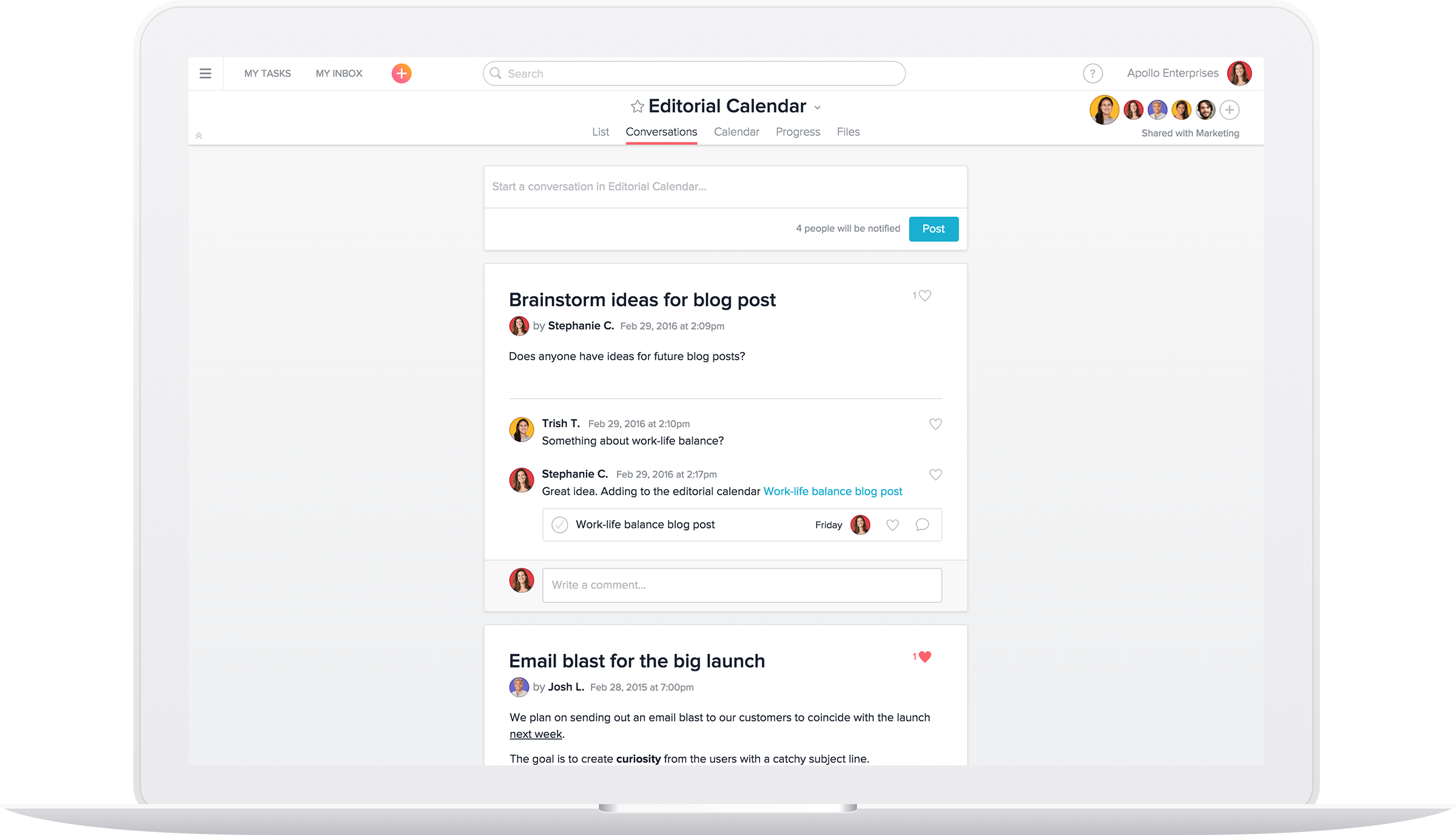
Asana is a web and mobile project management app. With tasks, projects, conversations, and dashboards, Asana lets an entire team know who's doing what by when, enabling workload balancing. Users can also add integrations for GANTT charts, time tracking and more.
$13.49
per month per user
MySQL
Score 8.3 out of 10
N/A
MySQL is a popular open-source relational and embedded database, now owned by Oracle.
Asana is very simple and straight forward, other more expensive products offer more features but require you to do project management their way. Asana provides a nice interface for task management.
MySQL
No answer on this topic
Features
Asana
MySQL
Project Management
Comparison of Project Management features of Product A and Product B
Asana
8.3
179 Ratings
7% above category average
MySQL
-
Ratings
Task Management
9.2179 Ratings
00 Ratings
Resource Management
8.0152 Ratings
00 Ratings
Gantt Charts
9.061 Ratings
00 Ratings
Scheduling
8.4162 Ratings
00 Ratings
Workflow Automation
8.9132 Ratings
00 Ratings
Team Collaboration
9.3178 Ratings
00 Ratings
Support for Agile Methodology
8.57 Ratings
00 Ratings
Support for Waterfall Methodology
8.57 Ratings
00 Ratings
Document Management
8.2150 Ratings
00 Ratings
Email integration
8.2142 Ratings
00 Ratings
Mobile Access
8.7149 Ratings
00 Ratings
Timesheet Tracking
6.16 Ratings
00 Ratings
Change request and Case Management
8.44 Ratings
00 Ratings
Budget and Expense Management
7.077 Ratings
00 Ratings
Professional Services Automation
Comparison of Professional Services Automation features of Product A and Product B
The usability of Asana is broad since it's available in a variety of platforms that are widely used nowadays. I think that it would be great for people who are constantly on the move and switching devices, since it has allowed me to work from my phone, too. I also think that Asana has proven itself to handle a large quantity of work
MySQL is best suited for applications on platform like high-traffic content-driven websites, small-scale web apps, data warehouses which regards light analytical workloads. However its less suited for areas like enterprise data warehouse, OLAP cubes, large-scale reporting, applications requiring flexible or semi-structured data like event logging systems, product configurations, dynamic forms.
Through it, we were able to communicate and cooperate with the rest of the team to complete the work in the required manner and at the appropriate time.
Learning curve: is big. Newbies will face problems in understanding the platform initially. However, with plenty of online resources, one can easily find solutions to problems and learn on the go.
Backup and restore: MySQL is not very seamless. Although the data is never ruptured or missed, the process involved is not very much user-friendly. Maybe, a new command-line interface for only the backup-restore functionality shall be set up again to make this very important step much easier to perform and maintain.
For teaching Databases and SQL, I would definitely continue to use MySQL. It provides a good, solid foundation to learn about databases. Also to learn about the SQL language and how it works with the creation, insertion, deletion, updating, and manipulation of data, tables, and databases. This SQL language is a foundation and can be used to learn many other database related concepts.
It is very user-friendly. Takes a new employee an hour to start figuring out how the system works. That's an important factor. You don't want to encounter the issue where employees need a week to understand how the system works. For example, JIRA, I tried using it for a week and I still don't understand the complicated layout. Asana has a simple interface. Once you see it, you get it type of program.
I give MySQL a 9/10 overall because I really like it but I feel like there are a lot of tech people who would hate it if I gave it a 10/10. I've never had any problems with it or reached any of its limitations but I know a few people who have so I can't give it a 10/10 based on those complaints.
I haven't had to use their support so I can't rate it. The fact that I haven't needed them reflects the ease of use of the product. I would recommend that any new users schedule a complete demo of the product to ensure that they are using it to it's fullest (there's a lot of useful features).
We have never contacted MySQL enterprise support team for any issues related to MySQL. This is because we have been using primarily the MySQL Server community edition and have been using the MySQL support forums for any questions and practical guidance that we needed before and during the technical implementations. Overall, the support community has been very helpful and allowed us to make the most out of the community edition.
Asana is a top-tier project management software that helps us organize and track projects from start to finish. It allows us to apply tasks/to-dos to multiple projects without duplication, divide complex projects into smaller tasks, and track project progress. It also helps us organize work on Kanban boards or linear lists. It stands out from the crowd in a big way compared to the competition.
MongoDB has a dynamic schema for how data is stored in 'documents' whereas MySQL is more structured with tables, columns, and rows. MongoDB was built for high availability whereas MySQL can be a challenge when it comes to replication of the data and making everything redundant in the event of a DR or outage.