BMC Helix ITSM replaces Remedy. It is a broad suite of ITSM, tools with strong integrations to other BMC tools and in-built ITAM. The product is used mainly by global brands and is offered in on-premise and SaaS configurations.
N/A
ManageEngine Patch Manager Plus
Score 8.4 out of 10
N/A
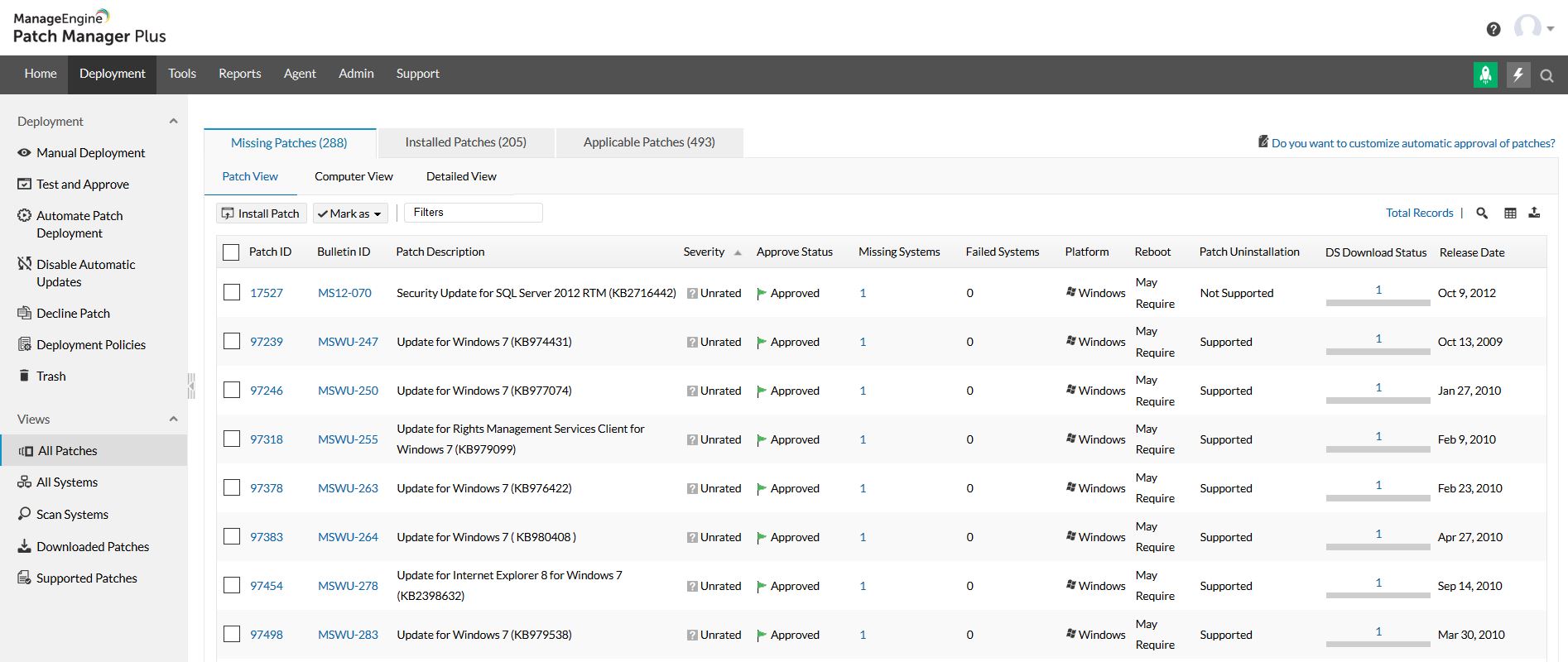
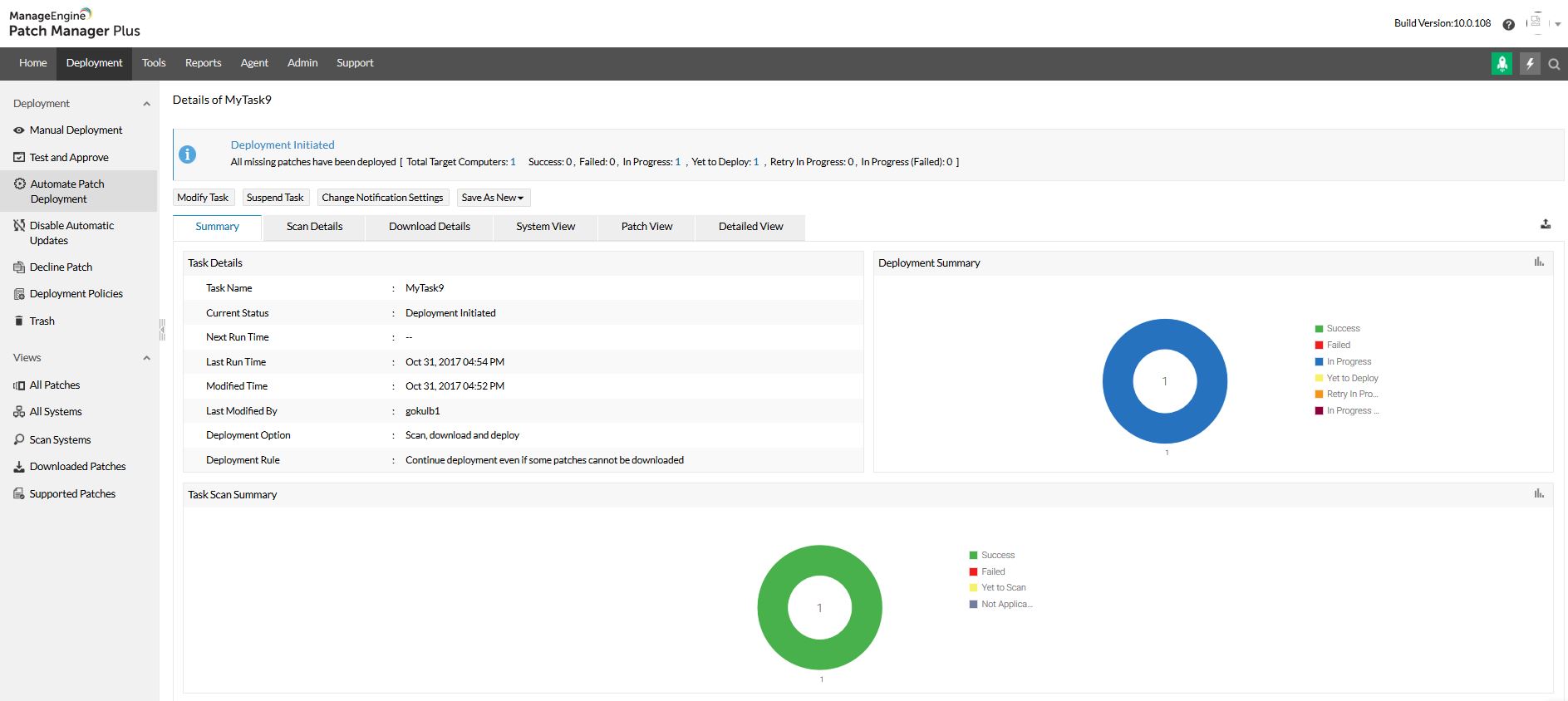
Patch Manager Plus is an automated patch management software that provides enterprises with a single interface for all patch management tasks. The vendor claims it works across platforms, helping users patch Windows, Mac, Linux & 300+ third-party applications. With Automated Patch Deployments, users can automate the entire process of patch management:…
$245
50 endpoints
Pricing
BMC Helix ITSM
ManageEngine Patch Manager Plus
Editions & Modules
BMC Helix ITSM
Contact Sales
Professional
$245.00
50 endpoints
Enterprise
$345.00
50 endpoints
Professional
$345.00
50 endpoints
Enterprise
$445.00
50 endpoints
Offerings
Pricing Offerings
BMC Helix ITSM
ManageEngine Patch Manager Plus
Free Trial
No
Yes
Free/Freemium Version
No
Yes
Premium Consulting/Integration Services
No
Yes
Entry-level Setup Fee
No setup fee
Optional
Additional Details
—
—
More Pricing Information
Community Pulse
BMC Helix ITSM
ManageEngine Patch Manager Plus
Features
BMC Helix ITSM
ManageEngine Patch Manager Plus
Incident and problem management
Comparison of Incident and problem management features of Product A and Product B
BMC Helix ITSM
8.6
114 Ratings
4% above category average
ManageEngine Patch Manager Plus
-
Ratings
Organize and prioritize service tickets
9.1112 Ratings
00 Ratings
Expert directory
8.781 Ratings
00 Ratings
Service restoration
8.793 Ratings
00 Ratings
Self-service tools
8.5102 Ratings
00 Ratings
Subscription-based notifications
7.982 Ratings
00 Ratings
ITSM collaboration and documentation
8.499 Ratings
00 Ratings
ITSM reports and dashboards
8.6102 Ratings
00 Ratings
ITSM asset management
Comparison of ITSM asset management features of Product A and Product B
BMC Helix ITSM
8.3
101 Ratings
1% above category average
ManageEngine Patch Manager Plus
-
Ratings
Configuration mangement
8.597 Ratings
00 Ratings
Asset management dashboard
8.493 Ratings
00 Ratings
Policy and contract enforcement
8.074 Ratings
00 Ratings
Change management
Comparison of Change management features of Product A and Product B
BMC Helix ITSM fits our environment particularly well, where standardized, auditable processes are already in place: Incident and Problem Management can be structured cleanly, with clear ownership, escalations, and fully traceable documentation—crucial in a highly regulated banking context. Through the customer platform/portal, users can log incidents and requests consistently, track their status transparently, and use a single central communication channel across service boundaries. This supports a service-oriented setup spanning multiple business services and locations. It becomes less suitable—or at least more effort-intensive—when core foundation data is not yet stable: an immature CMDB, insufficient ITAM data quality, and an unstructured knowledge base limit the value of automation and self-service. In addition, heterogeneous integrations and strict authorization models can increase implementation and ongoing maintenance efforts, especially when SLAs are not harmonized across different customer environments.
If you are managing a very large number of computers, I would say 1000+, the standard patching tools provided by Microsoft will fail to do their job properly. This is where you will benefit from ManageEngine PATCH MANAGER Plus, being agent-based it is fast, easy to manage, and reliable. If you require functionality more than just patching, like security auditing, you have to look elsewhere.
AI drive incident correlation leading to identifying problems and major incidents quickly.
Digital Workplace gives end-users a modern and personalized UI to submit requests, monitor service health, and receive self-help.
As an enterprise ITSM, it is critical that Request, Incident, Problem, Asset, and Change Management are integrated and flow together. BMC Helix is built on this principle.
Service Level management configs can be lengthy, and when changes are needed to specific SLA, it does take a long time to configure. Templates work but only for certain things, lots of manual work is still required.
The Online product documentation can be confusing or in same cases not correct.
BMC products are sometimes expensive. When partners try to resell licenses or increase their own allotment, it becomes very expensive.
Overall the product enhances the capability of incident management, problem management and change management. The AI based framework helps generated better visibility and reports. The effectiveness of enhanced service desk suuport improves end user experience as the incidents are handled well in time and aged incidents are highlighted at the right time.
The overall usability for the application is great precisely for the ease of use the application provides, if i would go in a different organisation, i would suggest implementing ManageEngine Patch Manager Plus or Endpoint Central due to its features, and productivity.
Their tech support is top notch. They respond and get back to us, even on lower level incidents and issues, very quickly. It is rare that we deal with a support technician who does not know what they are doing.
The support team at Patch Manager Plus has been awesome. Very responsive and knowledgeable. There are times when there is confusion between different tickets but there is still good service.
the trainers dont have so much practical experiences. its mostly follow up and reading existing documentation withou own input. of course experiences people are on shore or have no free time. sad truth
I believe Remedy's performance and market share exceeds its competitors. But it is worth mentioning that Microsoft's SCCM has excellent integration with Microsoft enterprise solutions and has is less expensive and not efficient. The IBM solution has better analytics but lacks the wide features and capabilities of Remedy. HP & CA are the real competitors for Remedy but lacks the stability, maturity, and effectiveness in Remedy
We were talking to Action1 and Adaptiva about their solutions of patch management. The main factor of choosing ManageEngine was pricing, which was considerably lower compared to these tools. Also, for Action1, it didn't featured some important features (like Linux patching), and it looked like a solution that is getting started in the market, even being more expensive than Patch Manager Plus.
Positive: an introduction to ITIL and viewing Asset, User Management from the perspective of ITIL, and how BMC has implemented those processes
Negative: The development team needs to communicate better with the sales and support side, and they need offer an open API
Negative: Currently the Asset Management side has little security and validation of Asset input: anyone can make API (mostly), at any item, which is a problem that I am apart of solving.
The UX needs updating, badly. Its quality is poor: it functions, but it is cumbersome, click-heavy and requires several hours to understand how to function with it. Also, it needs to ditch IE11 support, altogether.
ManageEngine Patch Manager Plus provides an excellent return on investment. We were able to get our systems fully patched, which we'd never been able to complete before. This provided excellent security to our organization.
ManageEngine Patch Manager Plus saved us a lot of time as most of our patching was fully automated.
ManageEngine took any issues we found and looked for solutions to further improve their product.