Cisco Meraki MX Firewalls is a combined UTM and Software-Defined WAN solution. Meraki is managed via the cloud, and provides core firewall services, including site-to-site VPN, plus network monitoring.
$595
per appliance
OpenVPN Access Server
Score8.6 out of 10
N/A
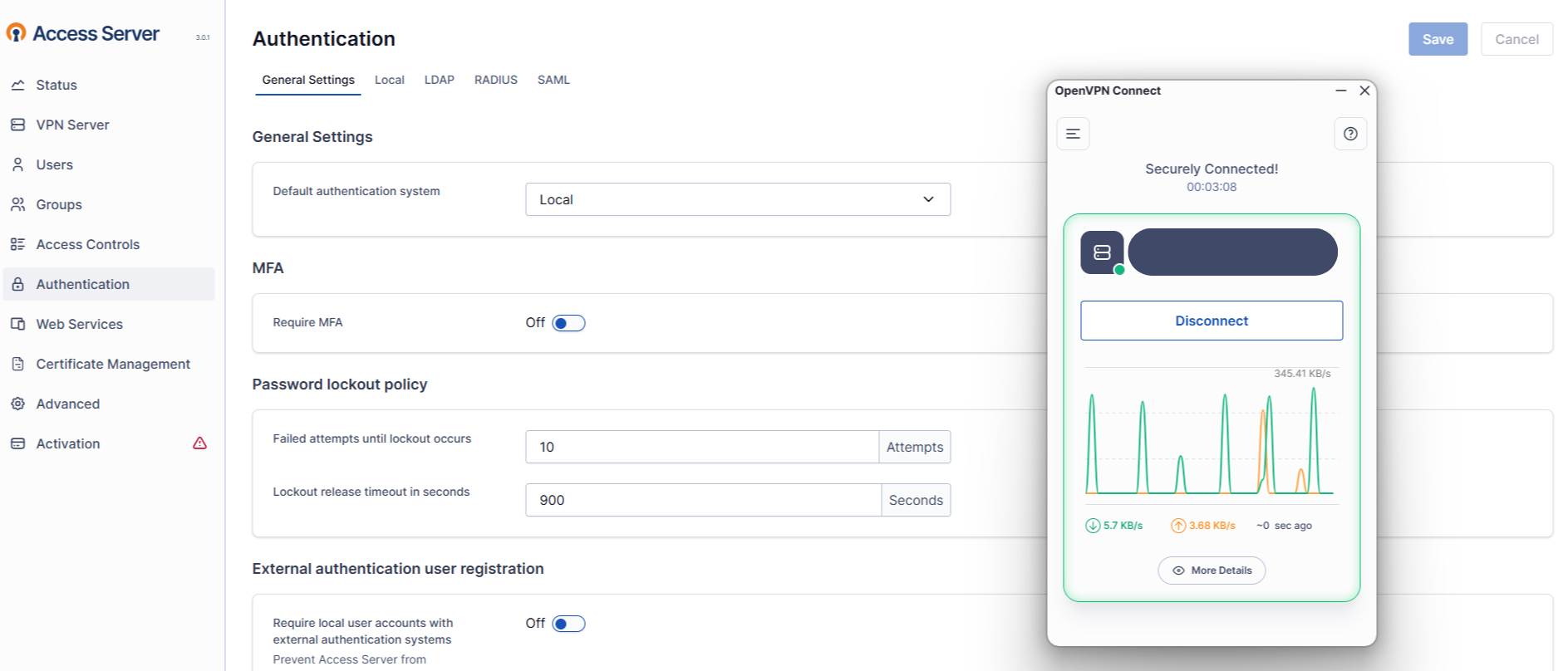
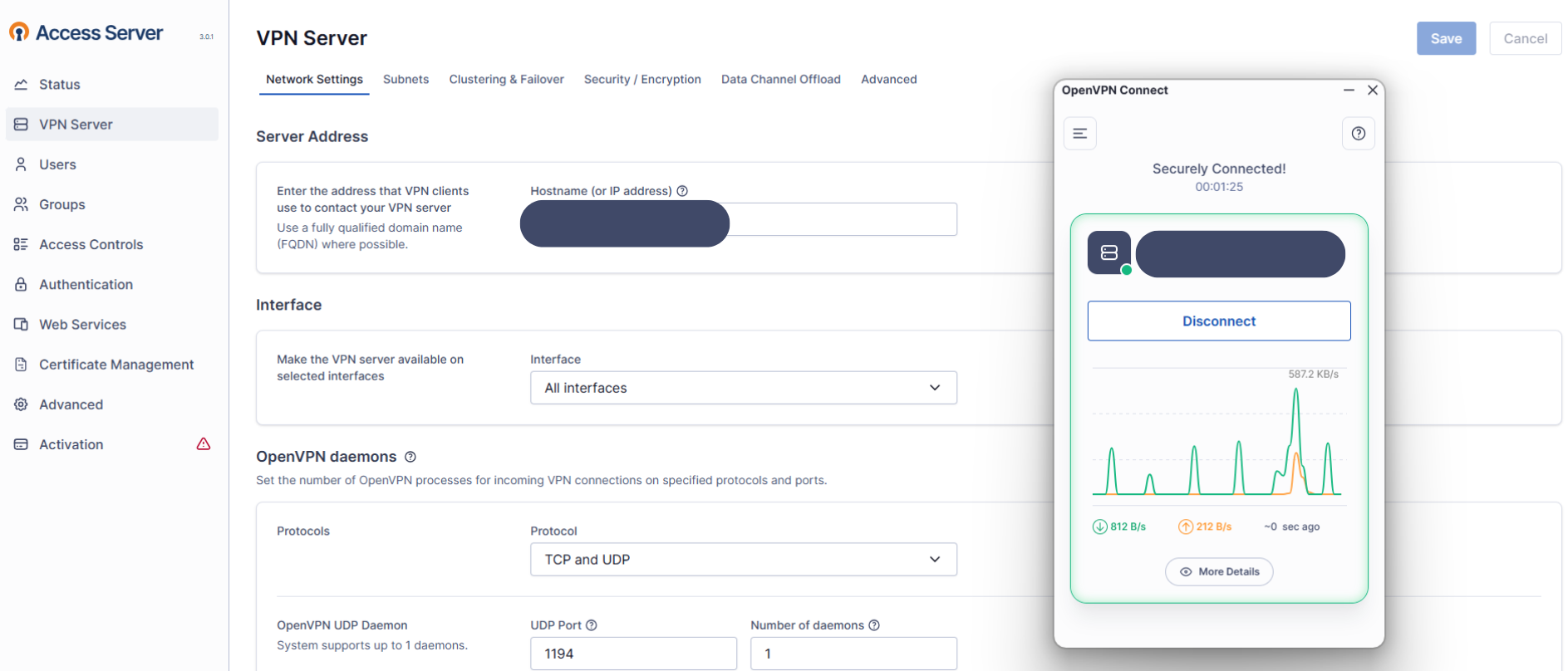
OpenVPN headquartered in Pleasanton allows users to create secure access to a private network in the cloud or on-premise with Access Server. Access Server is available to deploy directly on various cloud platforms like Amazon AWS, Google GCP, Microsoft Azure, DigitalOcean, and also available as ready-to-deploy virtual appliances for Microsoft HyperV and VMWare ESXi. Alternately, OpenVPN Access Server Virtual Appliance is a full-featured secure network tunneling VPN virtual appliance solution…
$27
per month 3 connections (minimum)
Pricing
Cisco Meraki MX
OpenVPN Access Server
Editions & Modules
MX64
$595
per appliance
MX67
$695
per appliance
MX68
$995
per appliance
MX84
$1,995
per appliance
MX100
$4,995
per appliance
MX250
$9,995
per appliance
MX450
$19,995
per appliance
3-99 Connections
$9
per month per connection
2,000 Connections
$3,100.00
per month per connection
Offerings
Pricing Offerings
Cisco Meraki MX
OpenVPN Access Server
Free Trial
Yes
Yes
Free/Freemium Version
No
Yes
Premium Consulting/Integration Services
No
No
Entry-level Setup Fee
No setup fee
No setup fee
Additional Details
—
More connections reduces cost per connection, as does going with an annual plan versus a monthly price.
The Meraki MX lineup is well suited for organizations that need centralized management of multiple locations, as it allows for both quick deployment and simple/easy remote administration all from a single pane of glass. It also works very well for providing VPN access for remote workers and helps monitor end-device uptime. It does, however, fall a bit short in its firewall's customization, compared to traditional appliances (like our WatchGuard Firebox), so perhaps less suited for organizations that need more customization, as the Meraki MX lineup is primarily designed for simplicity and straightforward cloud-based management.
A de minimis incentive was given to thank the reviewer for their time. The incentive was not used to bias or drive a particular response, nor was the incentive contingent on a positive endorsement. TR verified that a representative sample of customers was invited. More Info
If you looking for a reliable, light weight and secure VPN server, than OpenVPN Access Server is the one. Easy to install and manage, OpenVPN will provide secure remote connections, with a very good integration with almost all LDAP directories, for user management. With my experience, I don't see any scenario that OpenVPN won't be able to handle.
A de minimis incentive was given to thank the reviewer for their time. The incentive was not used to bias or drive a particular response, nor was the incentive contingent on a positive endorsement. More Info
The Cisco Meraki MX series is phenomenal at allowing us to remotely manage networks. So the devices usually act as the brain behind our client's networks, which makes it really, really easy for our team to take a look at what's going on in those client network environments, resolve any issues, and make sure that our client's networks are staying secure.
A de minimis incentive was given to thank the reviewer for their time. The incentive was not used to bias or drive a particular response, nor was the incentive contingent on a positive endorsement. TR verified that a representative sample of customers was invited. More Info
A de minimis incentive was given to thank the reviewer for their time. The incentive was not used to bias or drive a particular response, nor was the incentive contingent on a positive endorsement. More Info
Layer seven firewall rules. Just making them more granular. We've been in meetings with Cisco SES where I've said feature requests many times and that's one of the big ones where it's just a little cumbersome to implement layer seven rules right now.
Just making them more granular. We've been in meetings with Cisco SES where I've said feature requests many times and that's one of the big ones where it's just a little cumbersome to implement layer seven rules right now.
A de minimis incentive was given to thank the reviewer for their time. The incentive was not used to bias or drive a particular response, nor was the incentive contingent on a positive endorsement. TR verified that a representative sample of customers was invited. More Info
A de minimis incentive was given to thank the reviewer for their time. The incentive was not used to bias or drive a particular response, nor was the incentive contingent on a positive endorsement. More Info
The simplicity and ease of use for the Meraki Dashboard make it an easy choice for our organization to renew our Meraki Enterprise Agreement. We will likely continue using the Meraki MC67-C, MX450, and other MX models in their catalog until we shift away from Meraki completely
A de minimis incentive was given to thank the reviewer for their time. The incentive was not used to bias or drive a particular response, nor was the incentive contingent on a positive endorsement. More Info
Some features simply aren't there, but the ones that are there are pretty easy to use. Sometimes it is easy to get lost when trying to find the specific device you want to work on, but that's mostly due to how rarely we have to go into the interface.
A de minimis incentive was given to thank the reviewer for their time. The incentive was not used to bias or drive a particular response, nor was the incentive contingent on a positive endorsement. More Info
Whatever console or firewall you are running OpenVPN Access Server, it's configuration is very easy to do. You can create multiple tunnels, with different pourposes and authetication methods. It also has a quick and easy view of the connections opened, with possible actions, such as a very efficient kill switch and reconnect options.
A de minimis incentive was given to thank the reviewer for their time. The incentive was not used to bias or drive a particular response, nor was the incentive contingent on a positive endorsement. More Info
Meraki MX devices support high availability (HA) configurations, which ensures minimal downtime if one device goes offline. This feature has helped us maintain a stable and reliable network, even in cases of hardware failures. ince Meraki is cloud-managed, we've noticed that the cloud infrastructure is generally highly reliable, with minimal service interruptions or downtime. This makes it easier to manage the network remotely without significant availability concerns. Meraki automatically pushes firmware updates and patches, which helps maintain system stability without requiring manual intervention. These updates are rolled out in a manner that ensures minimal disruption to service.
A de minimis incentive was given to thank the reviewer for their time. The incentive was not used to bias or drive a particular response, nor was the incentive contingent on a positive endorsement. TR verified that a representative sample of customers was invited. More Info
The interface is pretty responsive. The lower end devices are easy to overwhelm if you have a lot of throughput. Be sure the model you get is rated for the amount of traffic you will have. Overbuild if possible, otherwise you won't be fully leveraging the connection from your ISP.
A de minimis incentive was given to thank the reviewer for their time. The incentive was not used to bias or drive a particular response, nor was the incentive contingent on a positive endorsement. More Info
I haven't ever had a bad experience with Meraki support. On the few occasions where I wasn't understanding the UI or needed some clarification about what a setting actually would do, I contacted them and they were very quickly able to provide help. Returns are simple and fast, too. We had to return a defective device one time and they shipped the replacement before we had even un-racked the one that was faulty. Unlike many other vendors, they didn't ask use to a do long list of scripted diagnostics, they just took my word for it that the device was broken and sent out a replacement immediately
A de minimis incentive was given to thank the reviewer for their time. The incentive was not used to bias or drive a particular response, nor was the incentive contingent on a positive endorsement. More Info
great when they offered it, really tested your knowledge with hands on and see what your peers from other orgs know. glad to see that we were ahead of the curve of what our peers knew
A de minimis incentive was given to thank the reviewer for their time. The incentive was not used to bias or drive a particular response, nor was the incentive contingent on a positive endorsement. TR verified that a representative sample of customers was invited. More Info
A de minimis incentive was given to thank the reviewer for their time. The incentive was not used to bias or drive a particular response, nor was the incentive contingent on a positive endorsement. TR verified that a representative sample of customers was invited. More Info
Implementing Meraki MX devices in phases—starting with a pilot group or select branch offices—was invaluable. This allowed us to identify potential configuration issues, troubleshoot problems, and refine our setup before rolling it out company-wide. It also helped to get feedback from early users and adjust the deployment strategy accordingly. The SD-WAN capabilities in Meraki MX were essential for optimizing our WAN traffic and ensuring better application performance across various locations.
A de minimis incentive was given to thank the reviewer for their time. The incentive was not used to bias or drive a particular response, nor was the incentive contingent on a positive endorsement. TR verified that a representative sample of customers was invited. More Info
Cisco CVO (MEVO) As previously mentioned we needed to manually configure each one which would take 15-20 minutes per device and needed to be done on-site. These devices can also go down more frequently after power outages and other incidents, and we've seen them not come back online. These devices are also much larger.
A de minimis incentive was given to thank the reviewer for their time. The incentive was not used to bias or drive a particular response, nor was the incentive contingent on a positive endorsement. More Info
OpenVPN had a better UI and usability for our team. It was more straightforward, had better SAML integration, and allowed our team to be on the VPN and on our network in seconds. We had some issues getting Nord to work for our use cases, and have run into pretty much zero issues with OpenVPN.
A de minimis incentive was given to thank the reviewer for their time. The incentive was not used to bias or drive a particular response, nor was the incentive contingent on a positive endorsement. More Info
We started only with the Main Meraki MX85 in our enterprise for our main hub, then we started adding remote sites with Meraki MX 68 and connected to our Main hub. Adding more sites and scaling the network is easy, and improving our connectivity saves time and cost to manage, or adding manpower with only 1 dashboard can manage all applications. Scaling and flexibility to change or expand our network are easy thanks to Meraki MX features
A de minimis incentive was given to thank the reviewer for their time. The incentive was not used to bias or drive a particular response, nor was the incentive contingent on a positive endorsement. TR verified that a representative sample of customers was invited. More Info
From a positive impact? Basically it allows us to set up shop very quickly. It allowed us to add sites to our network very quickly. From a negative perspective, I think the only thing is that I can see from a negative perspective is I have a preference to working with ACLI in terms of how I engage with the youth tool At the moment, the only way to actually engage with a tool is on a gui and sometimes what I'd actually like is more detailed information in terms of actual configuration that you'll actually get out of ACLI.
A de minimis incentive was given to thank the reviewer for their time. The incentive was not used to bias or drive a particular response, nor was the incentive contingent on a positive endorsement. TR verified that a representative sample of customers was invited. More Info
A de minimis incentive was given to thank the reviewer for their time. The incentive was not used to bias or drive a particular response, nor was the incentive contingent on a positive endorsement. More Info