CloudFoundry is a free, open source cloud computing platform supported by the non-profit CloudFoundry. It is not tied to any particular cloud service, but can be self-hosted or run on any cloud service preferred.
N/A
Woopra
Score3 out of 10
Enterprise companies (1,001+ employees)
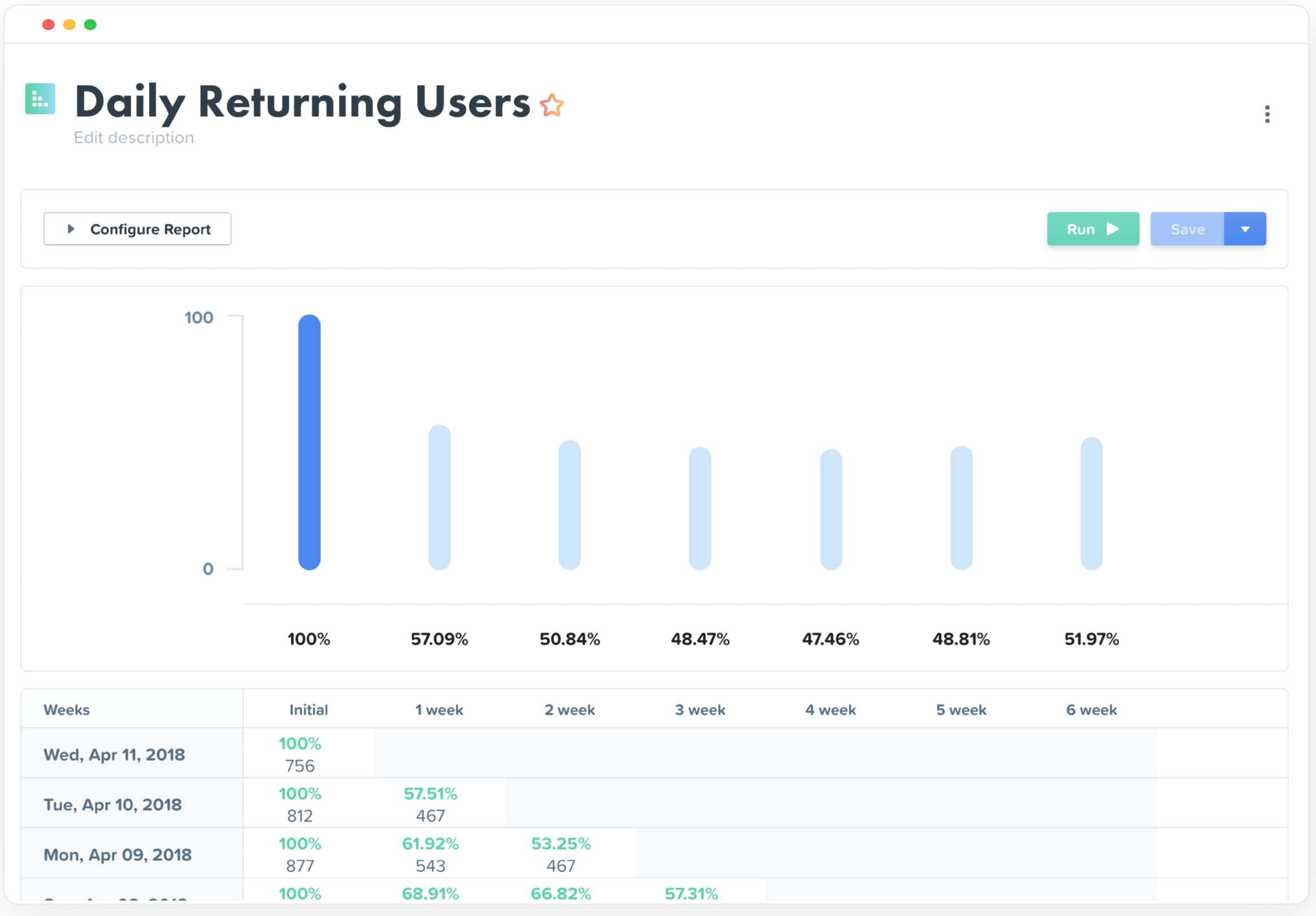
Woopra provides real-time customer analytics. It begins by tracking users across digital touch points (website, mobile app, help desk, marketing automation, etc.) and building a comprehensive behavioral profile for each user. These Customer Profiles are Woopra's building blocks, which are used to generate custom analytics reports, funnel analytics, retention analytics, and more.
$80
per month
Pricing
CloudFoundry
Woopra
Editions & Modules
No answers on this topic
Pro
$999.00
per month
Offerings
Pricing Offerings
CloudFoundry
Woopra
Free Trial
No
Yes
Free/Freemium Version
Yes
Yes
Premium Consulting/Integration Services
No
Yes
Entry-level Setup Fee
No setup fee
Optional
Additional Details
—
—
More Pricing Information
Features
CloudFoundry
Woopra
Platform-as-a-Service
Comparison of Platform-as-a-Service features of CloudFoundry and Woopra
A de minimis incentive was given to thank the reviewer for their time. The incentive was not used to bias or drive a particular response, nor was the incentive contingent on a positive endorsement. More Info
My rating of Woopra is the absolute best possible. I would recommend them to anyone looking for an analytics website that prefers a visual interface and a beautiful design. I have not encountered any problems using their app -- ZERO! Their integration with other marketing software, such as MailChimp, helps our company zero in on our marketing campaigns and gives us the information we need to make better choices. I LOVE Woopra and think they are the best out there! I have used other websites and there is no comparison!
A de minimis incentive was given to thank the reviewer for their time. The incentive was not used to bias or drive a particular response, nor was the incentive contingent on a positive endorsement. More Info
Support for Orgs and Spaces that allow for managing users and deployables within a large organization.
Easy deployment, deploying code is as simple as executing single line from CLI, thanks to build-packs.
Solid and rich CLI, that allows for various operations on the instance.
Isolated Virtual Machines called Droplets, that provide clean run time environment for the code. This used to be a problem with Weblogic and other application servers, where multiple applications are run on the same cluster and they share resources.
SSH capability for the droplet (isolated VM's are called droplets), that allows for real time viewing of the App code while the application is running.
Support for multiple languages, thanks to build-packs.
Support for horizontal scaling, scaling an instance horizontally is a breeze.
Support for configuring environment variable using the service bindings.
Supports memory and disk space limit allocation for individual applications.
Supports API's as well as workers (processes without endpoints)
Supports blue-green deployment with minimal down time
A de minimis incentive was given to thank the reviewer for their time. The incentive was not used to bias or drive a particular response, nor was the incentive contingent on a positive endorsement. More Info
Woopra tracks *individual users and customer accounts*. It cannot be understated how important this is. Google Analytics and other low cost solutions only sample users and provide aggregate data. For enterprise sales, this is critical. Likewise, for product managers trying to segment product usage by types of accounts, this is incredibly useful.
Woopra updates user analytics in real time. This is critical in a sales context as you want to be able to follow up quickly on opportunities. Likewise, it is useful for customer success as they can see usage in real time for an individual they are supporting.
Woopra has the most turnkey integrations of any web analytics solution on the market. By far the most useful are Marketo, SalesForce, and Slack, but there are several more we didn't tap into. While any solution worth its salt has an API, Woopra's integrations usually require a login and/or API key, and you are good to go. Here is the current list: https://www.woopra.com/appconnect/.
Woopra enables B2B product managers to track product and feature usage by revenue, not just clicks. Again, in a B2B context, this is critical, as there are high-value users and low-value users. Knowing the difference is critical.
Woopra's implementation is super simple. We were able to set it up with a couple of hours of one frontend developer and some help from our product intern.
Does not support stateful containers and that would be a nice to have.
Supports showing logs, but does not persist the logs anywhere. This makes relying on Cloud Foundry's logs very unreliable. The logs have to be persisted using other third party tools like Elk and Kibana.
A de minimis incentive was given to thank the reviewer for their time. The incentive was not used to bias or drive a particular response, nor was the incentive contingent on a positive endorsement. More Info
A de minimis incentive was given to thank the reviewer for their time. The incentive was not used to bias or drive a particular response, nor was the incentive contingent on a positive endorsement. More Info
We just really like the tool. There are lots of us using it internally... from Product, to marketing, to customer service, to optimization team, to traffic acquisition, to Executives. Really helps us answer questions about how well things are going, and what is not going well.
The UI and reports are great overall. Creating reports just requires a few too many screens and clicks. Also dashboard tiles can't be resized. Both of these are easy items that are being addressed
Compared to other products, the support was a small effort. We only had part time contributions from a product management intern and front end developer.
While Docker shines in providing support for volumes and stateful instances, Cloud foundry shines in providing support for deploying stateless services. Heroku shines in integrating with Git and using commits to git as hooks to trigger deployments right from the command line. But it does not provide on-premise solution that Cloud foundry provides.
A de minimis incentive was given to thank the reviewer for their time. The incentive was not used to bias or drive a particular response, nor was the incentive contingent on a positive endorsement. More Info
Woopra is much easier to setup and use than Google Analytics. I've spent hours trying to create custom reports in Google Analytics. Woopra does not take this much time to get solid reporting for our site. If you need something that tracks marketing efforts then Google Analytics will likely be a better fit.
A de minimis incentive was given to thank the reviewer for their time. The incentive was not used to bias or drive a particular response, nor was the incentive contingent on a positive endorsement. More Info
Positive impact, since it simplifies the deployment time by a huge margin. Without cloud foundry, deploying a code needs coordination with infrastructure teams, while with cloud foundry, its a simple one line command. This reduces the deployment time from at least few hours to few minutes. Faster deployments promote faster dev cycle iterations.
Code maintenance such as upgrading a Node or Java version is as simple as updating the build-pack. Without cloud foundry, using web logic, the specific version only supports a specific version of Java. So updating the version involves upgrading the version of web logic that needs to involve few teams. So without cloud foundry, it takes at least few days, with cloud foundry, its a matter of few mins.
Overall, happier Developers and thats harder to quantify.
A de minimis incentive was given to thank the reviewer for their time. The incentive was not used to bias or drive a particular response, nor was the incentive contingent on a positive endorsement. More Info
Really helped us begin to segment our users based on their engagement and retention.
Helped increase retention by about 1.5% after about 5 months of implementation (don't shoot the messenger if your team can't implement that quickly).
I felt like it had great potential to create a pipeline between sales and the CSM, but I had trouble getting the sales team to implement it properly as they had their noses deep in calls and emails (they struggle entering notes in SalesForces as well, so it's more a company specific problem).
A de minimis incentive was given to thank the reviewer for their time. The incentive was not used to bias or drive a particular response, nor was the incentive contingent on a positive endorsement. More Info