CommerceV3 is an all-in-one eCommerce platform that will both build and host store platforms.
N/A
Shopify Plus
Score8.9 out of 10
N/A
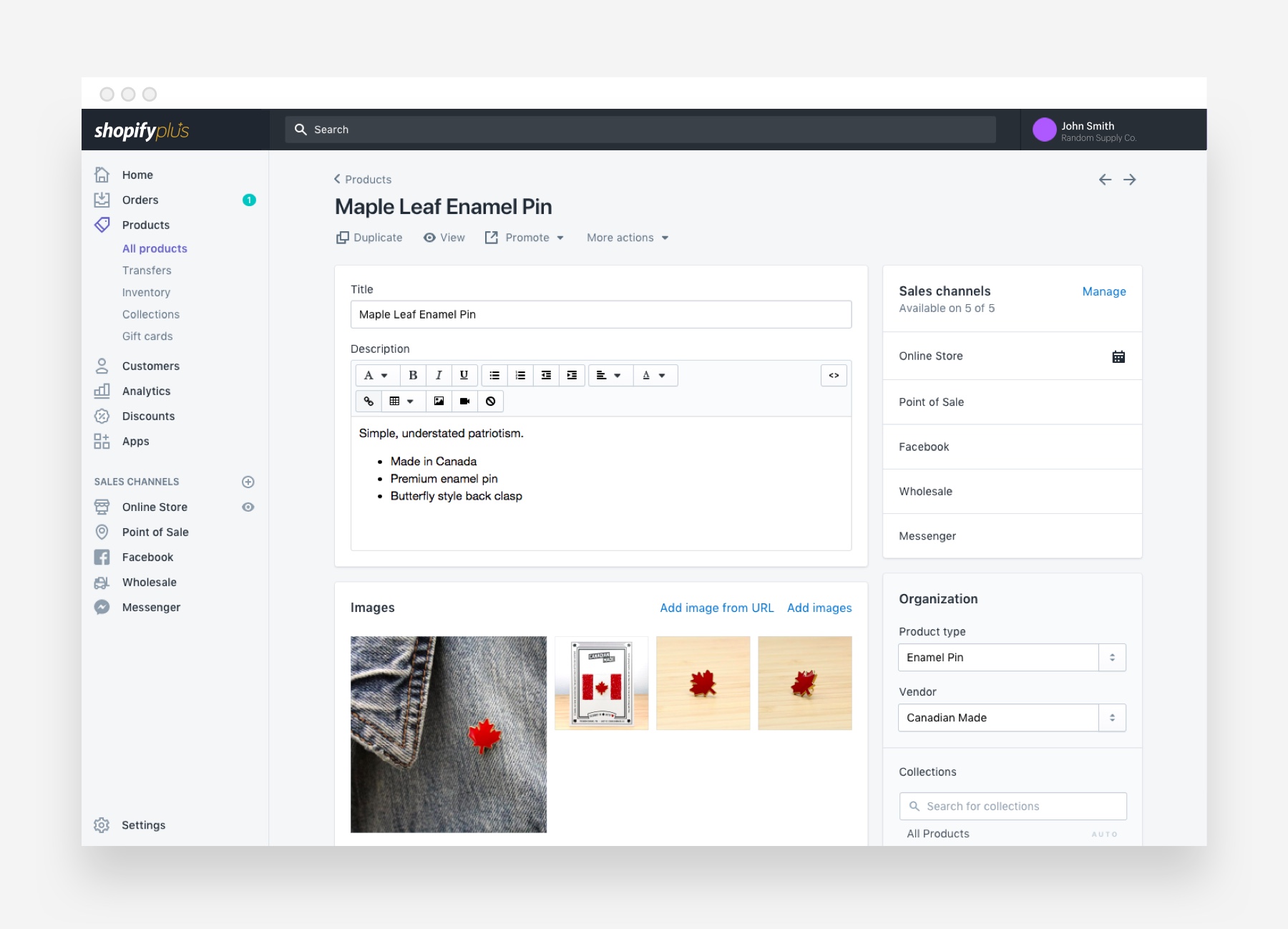
Shopify Plus is an eCommerce solution built for enterprise-level companies that enables them to sell online and offline across social channels like Facebook , Pinterest, and marketplaces like Amazon and eBay.
I believe CommerceV3 (CV3) is best suited for small to mid-level catalog companies. You would want to make sure to integrate CV3 with your back end system or you'll be doing a lot of manual entries or manipulating data for table uploads. You can easily manage the templates in CV3 with a basic knowledge of HTML and work up from there
Shopify Plus makes order management simple and less error prone. Connecting our ERP allows us to seamlessly manage our product listings, fulfill orders, and sync customer data. Limitations to the number of product variants requires attention from our staff to make sure our products sync without issue. Other than being arbitrary, there's really no need to limit the number of product variants.
A de minimis incentive was given to thank the reviewer for their time. The incentive was not used to bias or drive a particular response, nor was the incentive contingent on a positive endorsement. More Info
CV3 provides us a plethora of marketing tools to customize offers and campaigns to our customers. I've used BigCommerce and Shopify and neither comes close to the capability of fine tuning sales, offers, and discounts by product, category, customer and more.
The purpose of partnering with any e-commerce platform is to provide a secure site and stable checkout process for our customers. CV3 has been amazing at keeping our site up and running through peak traffic and attempted hacks. The checkout process has been rock solid and also integrates seamlessly with PayPal. I've used Amazon Payments in the past without incident, but decided to end that option due to Amazon's policies.
CV3's architecture on the back-end is designed to be plain and simple which provides an easy-to-use interface to streamline our work. The template driven structure to manage the front-end will become a favorite for most programmers in no time at all. In fact, I'm not a programmer, but do customization and design changes almost on a daily basis with ease. Any changes made to a template may be viewed on a staging server before pushing live. Templates, as well as other data may be downloaded any time for backups. Exports and imports of product data is simple and powerful allowing me to change massive amounts of data easily.
Customer support is always a contentious issue with most providers, however, CV3 has by far been the best I've encountered in over 30+ years of experience with software vendors. They are very responsive and escalate the issue to the proper person without having the redundancy you experience with so many other companies. They understand the issue the first time, and tell you the truth.
Any e-commerce business is about shipping. CV3 has the most powerful tools to control shipping. It will challenge the most creative minds on how to best merchandise products based on weight, dollar amount, global geographical location, dimensions, category, exception rules, by carrier, all the way down to the sku level which can have it's own set of rules. It gets complicated, but it works great and ties in with the promotional features as well.
A de minimis incentive was given to thank the reviewer for their time. The incentive was not used to bias or drive a particular response, nor was the incentive contingent on a positive endorsement. More Info
An area I'd like to see enhanced is the sku level pricing calendar. You can set specials prices to start and stop at certain dates and times, but it's fixed to certain years. You can't have your chosen items go to seasonal pricing every year at the same time, you have to change the years each year.
There are multiple product setups: basic, parent with children, and sub-products. Each type exports on the same datasheet all intermingled and this can be tedious isolating the different types for editing and re-import.
Vendor and Brand are data points on each item, but they are not controlled by a table. We end up with the same vendor or brand misspelled multiple times.
There is no FTP capability (PCI issue?) and no blog site with the parent domain. These have to be handled using a separate sub-domain.
The shipping calculator for customers should be available anywhere there is a shipping option presented during checkout.
Faster live times. Currently, it takes about 5 to 10 minutes to see template/product changes pushed to the live cdn.
When linking to our communication service some customers have several emails with orders and only one email generates orders. It would be nice if we could combine all of this information into one account.
If a customer has multiple accounts you are also unable to edit the email address as it is already used, another reason merging accounts would be helpful.
Some of the processes in Shopify are too easy to complete. I’m certain scenarios a peony of “are you sure you would like to complete(this action)” would be extremely helpful and avoid mistakes that are not reversible.
A de minimis incentive was given to thank the reviewer for their time. The incentive was not used to bias or drive a particular response, nor was the incentive contingent on a positive endorsement. More Info
It is extremely easy for merchants to get to know how Shopify Plus works. Comparitive to other platforms such as Magento and WooCommerce it is extremely lean and easy to operate, meaning clients who migrate over to it find it very intuitive to use. There is also a lot of guides and up to date information online
A de minimis incentive was given to thank the reviewer for their time. The incentive was not used to bias or drive a particular response, nor was the incentive contingent on a positive endorsement. More Info
A de minimis incentive was given to thank the reviewer for their time. The incentive was not used to bias or drive a particular response, nor was the incentive contingent on a positive endorsement. More Info
In my view, CV3 meets our needs better by allowing us a much easier way to manage the front end the way the templates are structured. BigCommerce recommended using an FTP tool to download, modify, then upload. Shopify has some very sophisticated templates, which, in my mind, required a senior level programmer or lots of outsourcing for even minor changes. Neither of the other systems come close to CV3's marketing capabilities through their promotional tool without any add-ons. Shopify, for example, is stripped down and if you want a certain feature you have to find one of their approved partners, sign-up, integrate the feature and hope it works. To purchase all the features we're currently using in CV3 you'd have quite a list (and expense) of partners. Examples would be enhanced shipping capabilities or the ability to customize a product purchase. CV3 has features specifically geared for a catalog company, like request forms and capturing key codes. Plus, built-in rewards program, wishlist, gift certificates, bulk email, and data feeds for Google Shopper, Channel Advisor and SingleFeed.
Shopify had the quickest go-to-market and most robust API among the products we compared. CommerceCloud required a VERY LONG integration phase that we just didn't have time for. BigCommerce fell short on the number of features and API coverage that we needed. Overall Shopify gave us the most bang for the buck.
A de minimis incentive was given to thank the reviewer for their time. The incentive was not used to bias or drive a particular response, nor was the incentive contingent on a positive endorsement. More Info
One positive impact has been the use of product reviews. This feature has helped us weed out bad products and promote good ones while allowing customers to share their experience.
It's a fixed fee user agreement which favors increasing sales.
The stability of the checkout process has helped conversions and lowered support.
Having integrated inventory with our back end has helped meet customer expectations.
The promotional capabilities of CV3 has allowed us to provide new and different offers keeping customers engaged.
The pricing of Shopify Plus over the regular Shopify Account solution is about 10x if not 20x the cost. But with this cost comes the increased reliability and trust you have in your eCommerce Software solution/website. We still have a great ROI with the Shopify Plus Pricing.
With Shopify Plus, we have been able to drill deeper into a more robust eCommerce experience for our customers
With Shopify Plus, we have been able to customize our Website further with recommended apps, features, and customizations based on our Dedicated Account Reps expertise.
A de minimis incentive was given to thank the reviewer for their time. The incentive was not used to bias or drive a particular response, nor was the incentive contingent on a positive endorsement. More Info