Overview
ProductRatingMost Used ByProduct SummaryStarting Price
Datadog
Score 8.6 out of 10
N/A
Datadog is a monitoring service for IT, Dev and Ops teams who write and run applications at scale, and want to turn the massive amounts of data produced by their apps, tools and services into actionable insight.
$18
per month per host
FortiMonitor
Score 8.0 out of 10
N/A
FortiMonitor is a comprehensive, SaaS-based digital experience monitoring (DEM) platform that helps organizations modernize their performance-monitoring tools. It provides visibility into endpoint application performance and digital experience—no matter where the user resides or where the application is hosted. It is based on Panopta, which was acquired by Fortinet in late 2020.N/A
Pricing
DatadogFortiMonitor
Editions & Modules
Log Management
$1.27
per month (billed annually) per host
Infrastructure
$15.00
per month (billed annually) per host
Standard
$18
per month per host
Enterprise
$27
per month per host
DevSecOps Pro
$27
per month per host
APM
$31.00
per month (billed annually) per host
DevSecOps Enterprise
$41
per month per host
No answers on this topic
Offerings
Pricing Offerings
DatadogFortiMonitor
Free Trial
YesYes
Free/Freemium Version
YesNo
Premium Consulting/Integration Services
NoYes
Entry-level Setup FeeOptionalNo setup fee
Additional DetailsDiscount available for annual pricing. Multi-Year/Volume discounts available (500+ hosts/mo).Our simple, usage-based pricing model is ideal whether you have five servers, or 500 hundred. You’ll be charged monthly per the number of instances monitored, and any additional features you’re using, such as CounterMeasures and synthetic checks. Standard Instances - $6/Instance Network Devices - $9/Device Containers - $2/Container
More Pricing Information
Community Pulse
DatadogFortiMonitor
Best Alternatives
DatadogFortiMonitor
Small Businesses
InfluxDB
InfluxDB
Score 8.8 out of 10
SolarWinds Pingdom
SolarWinds Pingdom
Score 9.5 out of 10
Medium-sized Companies
Sumo Logic
Sumo Logic
Score 8.8 out of 10
Cisco ThousandEyes
Cisco ThousandEyes
Score 9.0 out of 10
Enterprises
NetBrain Technologies
Score 9.2 out of 10
Nexthink
Nexthink
Score 7.3 out of 10
All AlternativesView all alternativesView all alternatives
User Ratings
DatadogFortiMonitor
Likelihood to Recommend
9.4
(55 ratings)
8.0
(1 ratings)
Usability
9.2
(34 ratings)
-
(0 ratings)
Support Rating
8.9
(6 ratings)
-
(0 ratings)
User Testimonials
DatadogFortiMonitor
Likelihood to Recommend
Datadog
As per my experience, Datadog is best suited for complex, cloud-native environments where unified observability is critical, as it integrates seamlessly with AWS and Azure. Moreover, it provides deep visibility into latency and error rates. Datadog pricing is less appropriate for Startups with a tight budget and for organizations needing advanced incident management.
Read full review
Fortinet
It is great for monitoring internet connections.
The agent installed on Windows works efficiently and takes up little resources. The method of settling costs is not very clear.
There should also be a table with the current list of costs visible.
Read full review
Pros
Datadog
  • The thing which Datadog does really well, one of them are its broad range of services integrations and features which makes it one step observability solution for all. We can monitor all types of our application, infrastructure, hosts, databases etc with Datadog.
  • Its custom dashboard feature which helps us to visualize the data in a better way . It supports different types of charts through those charts we can create our dashboard more attractive.
  • Its AI powered alerting capability though that we can easily identify the root cause and also it has a low noise alerting capability which means it correlated the similar type of issues.
Read full review
Fortinet
  • Monitoring from several locations
  • Fast notification
  • Push notifications, SMS and calling
Read full review
Cons
Datadog
  • In my experience, .NET Tracing Agent caused severe and untraceable performance issues
  • In my opinion, usage and billing structures were opaque and surprising
  • In my experience, documentation was incomplete, contradicting or sometimes completely wrong, even for common infrastructure (AWS Fargate)
  • I feel support was unhelpful at times, and bounced us back and forth to other teams
  • In my opinion, multiple methods of sample rate control were ineffective, adding to excessive usage and cost
Read full review
Fortinet
  • Simplifying the interface
  • Simplification of the process, e.g. notifications to Slack
  • Dark mode for panel and dashboard
  • Push notification - should contain more detailed information
  • A nicer looking dashboard
Read full review
Likelihood to Renew
Datadog
Definitely will not revisit after our issues and, in my opinion, poor support.
Read full review
Fortinet
No answers on this topic
Usability
Datadog
There are so many features that it can be hard to figure out where you need to go for your own use case. For example, RUM monitoring us buried in a "Digital Experience" sidebar setting when this is one of our key use cases that I sometimes struggle to find in the application. It appears that ECS + Fargate monitoring was recently released which is great because we had to build a lambda reporting solution for ephemeral task monitoring. But this new feature was never on my radar until I starting clicking around the application.
Read full review
Fortinet
No answers on this topic
Support Rating
Datadog
The support team usually gets it right. We did have a rather complicate issue setting up monitoring on a domain controller. However, they are usually responsive and helpful over chat. The downside would be I don’t think they have any phone support. If that is important to you this might not be a good fit.
Read full review
Fortinet
No answers on this topic
Implementation Rating
Datadog
Documentation was difficult to work through, rollout was catastrophic (completely outage)
Read full review
Fortinet
No answers on this topic
Alternatives Considered
Datadog
Our logs are very important, and Datadog manages them exceptionally well. We frequently use Datadog services for our investigations. Use case: Monitor your apps, infrastructure, APIs, and user experience.


Key features:


Logs, metrics, and APM (Application Performance Monitoring)


Real-time alerting and dashboards


Supports Kubernetes, AWS, GCP, and other integrations


RUM (Real User Monitoring) and Synthetics


✅ Best for backend, server, and distributed systems monitoring.
Read full review
Fortinet
Panopta management from the cloud (remote panel).
Easy work on installation.
To monitor servers, it is enough for the server to have contact only with the Internet.

Multiple channels for sending notifications.
Read full review
Return on Investment
Datadog
  • Saved us (time & money) from developing our own monitoring utilities that would pale in comparison
  • Alerts allow us to remedy issues before our customers even know about them
  • Tracking resource usage over time allows us to better plan for future needs, before it becomes a pain-point.
Read full review
Fortinet
  • Provides high availability of services
Read full review
ScreenShots

Datadog Screenshots

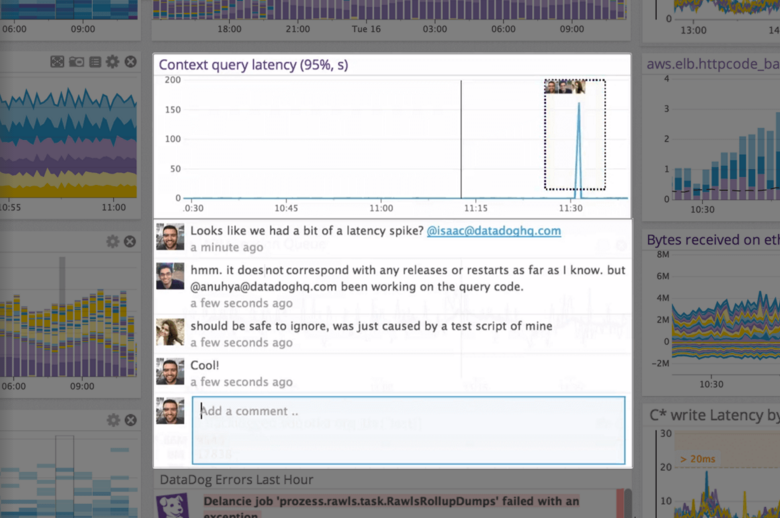
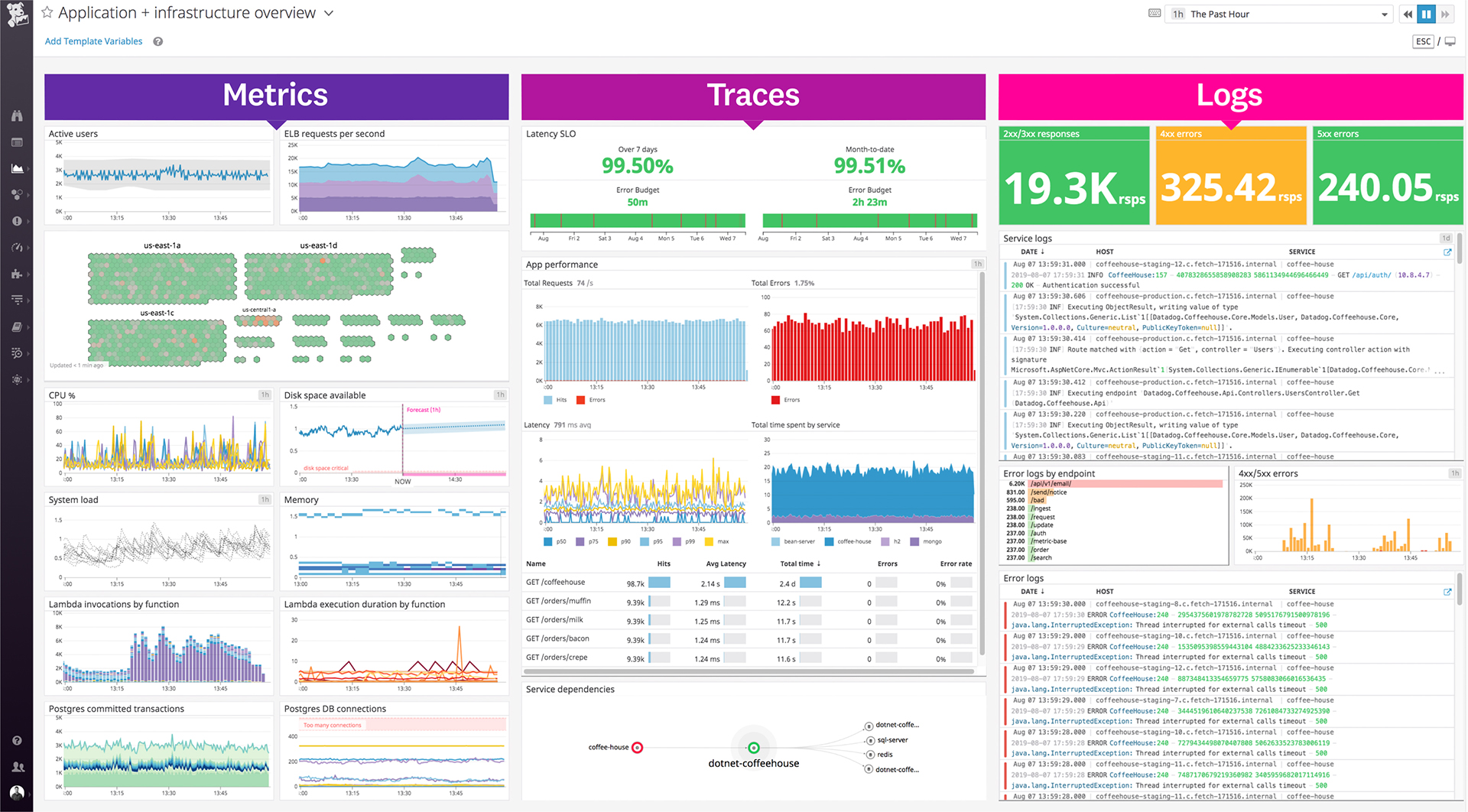
Screenshot of the out-of-the-box and customizable monitoring dashboards.Screenshot of Datadog's collaboration features, where users can discuss issues in-context with production data, annotate changes and notify their teams, see who responded to that alert before, and discover what was done to fix it.Screenshot of where Datadog unifies traces, metrics, and logs—the three pillars of observability.Screenshot of some of Datadog's 400+ built-in integrations.Screenshot of Datadog's Service Map, which decomposes an application into all its component services and draws the observed dependencies between these services in real timeScreenshot of centralized log data, pulled from any source.

FortiMonitor Screenshots

Screenshot of Customizable dashboards offer a wide variety of widgets so you can easily adjust them to your workflow and track the health and performance of your deployments.Screenshot of Automate diagnostics and remediation. Whether it’s running a complex synthetic test or automatically restarting a system so that it will come back online, leave those tasks to us while your team gets back to what matters.Screenshot of Incidents include metrics and meta-data so engineers can begin working on the incident as soon as they’ve received an alert.

Integrating your alerting and and incident management creates a seamless, easy-to-use experience.  

Engineers can quickly acknowledge alerts, both from Panopta and the mobile app, making it easy for their teammates to see which incidents still need to be addressed. 

With customizable alerting workflows, creating alert policies which suit your team is simple and intuitiveScreenshot of Alert Timelines automatically escalate incidents if they remain open.

Assign leads to incidents, making delegation and keeping team members in the loop easy.

By running diagnostics using CounterMeasures, teams can quickly determine whether an admin is necessary to resolve the issue
Review and approve CounterMeasures to enrich incidents with more context.Screenshot of Know which incidents are being worked on at-a-glance.

Engineers can easily escalate an incident if they need a senior team member to resolve the issue.

Integrates with popular communication and ticketing tools like Slack and JIRA.

Stay connected with your team using the mobile app, or take quick actions like acknowledging, scheduling maintenance, or approve a CounterMeasure so your team knows you’re on it.Screenshot of Incidents are enriched with diagnostics and metrics, and include streamlined views of all related events that make it easier to diagnose and resolve incidents.

Engineers are able to see the full context of an incident before logging into any systems.

CounterMeasures provide an automated way to diagnose and resolve incidents, allowing engineers to focus on more valuable activities.

Metrics and data from incidents can be elevated to the incident summary, providing an easy way for teams to reference what they’d done to fix similar problems in the past.