Hire, by Google, was a recruiting app for G suite customers. The product includes functionality for applicant tracking, candidate relationship management, and candidate sourcing. Google sunsetted the product in late 2020.
N/A
Brassring
Score 7.3 out of 10
N/A
Brassring, formerly from IBM and part of the Kenexa Talent Acquisition Suite, and now sold by Infinite Computer Solutions, is an enterprise grade ATS and onboarding solution. It allows companies to find the right talent, track and manage candidates, and use candidate data to spot trends within the applicant pool.
N/A
Paradox Conversational ATS
Score 7.1 out of 10
N/A
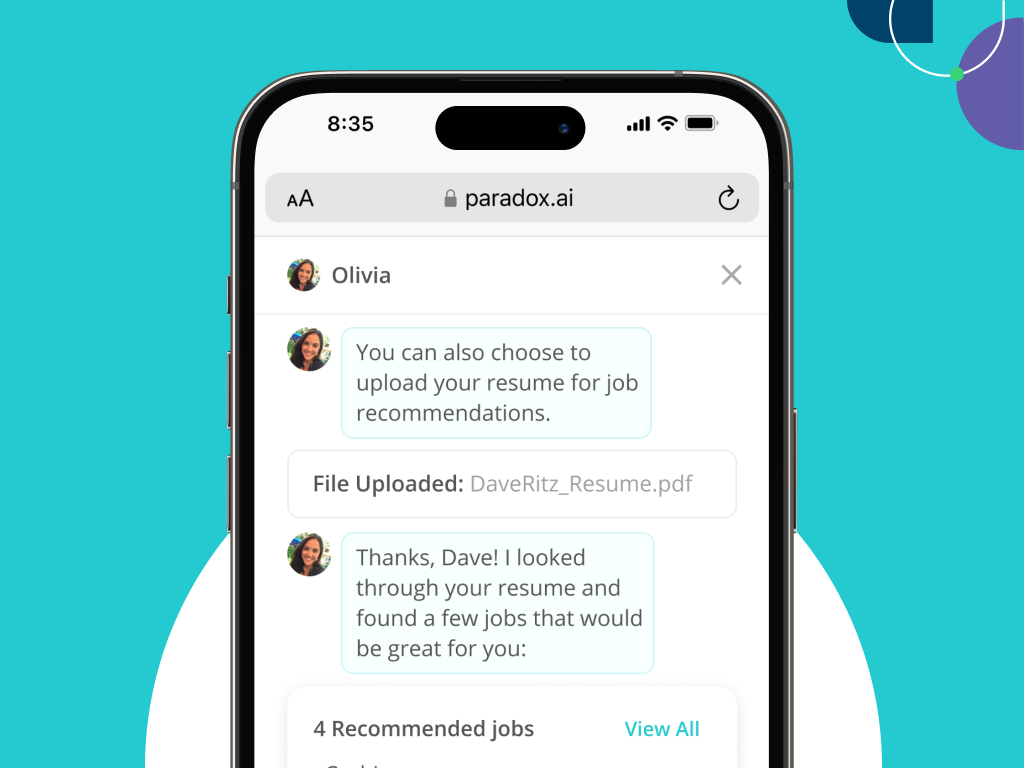
Paradox (Paradox.ai) in Scottsdale, offers Olivia, an AI recruiting assistant focused on improving and reinventing the candidate experience. Olivia helps companies capture and screen candidates, improve conversions, and answer all candidate questions. She delivers one-to-one candidate experience at scale, and even handles interview scheduling.
N/A
Pricing
Hire by Google (discontinued)
Brassring
Paradox Conversational ATS
Editions & Modules
No answers on this topic
No answers on this topic
No answers on this topic
Offerings
Pricing Offerings
Hire by Google (discontinued)
Brassring
Paradox Conversational ATS
Free Trial
No
Yes
No
Free/Freemium Version
No
No
No
Premium Consulting/Integration Services
No
No
No
Entry-level Setup Fee
No setup fee
No setup fee
No setup fee
Additional Details
—
—
—
More Pricing Information
Community Pulse
Hire by Google (discontinued)
Brassring
Paradox Conversational ATS
Features
Hire by Google (discontinued)
Brassring
Paradox Conversational ATS
Recruiting / ATS
Comparison of Recruiting / ATS features of Product A and Product B
Google Hire is very good at doing the basics well. I believe for most internal HR departments at small companies, this is all you need. It also works well for small to medium-sized staffing companies that just want something reliable and easy to use. What Google Hire doesn't do very well is be flexible. They don't have custom options, they don't have a ton of settings, and their development cycle is slow. As a result, it's pretty much what you see is what you get.
Kenexa is is well suited for any organization that has more than 3000 employees globally. I would not recommend this to startups or a growing organization with less than 3000 employees. But once you cross this number, Kenexa becomes useful and is a brilliant tool for global operations - recruiting. I would recommend this tool to any organization that has offices in many countries/geographies as well.
While my company is not in the high volume hiring space, it appears to be built very effectively to support high volume hiring positions and companies, reducing recruiting efforts around the initial stages of the screening process. The paradox is good at quickly integrating into your Mail Server System (like Outlook) to get their scheduling product up quickly as a baseline.
Google does search well so when I search through our database for candidates, I'm confident that I'm pulling up all the right people from what we have.
They have a modern and nice user interface - this is one of the biggest reasons to use it over other systems, as most ATS' are pretty ancient looking and not very pleasant to use.
Their support is very good at answering and addressing questions.
Their pricing is incredible. I'm sure at some point it will change, but for small companies paying 100+ per user for other ATS' - it's incredible to pay 100/month for the whole company.
Kenexa allows Boolean key word search within a particular requisition so it makes sifting through a high number of applicants manageable and effective
Kenexa can be tailored to meet individual business needs. During the time we’ve had Kenexa here I’ve used it in support of a few different business segments and for each the way the system was used to “position” candidate statuses have varied based on the individual need of the business. One example is when interviewing a high volume of applicants internationally, we were able to send qualified applicants through to the “event manager” and it would enable the candidate to select his/her interview date/time based on previously submitted options inputted by our Kenexa users.
Kenexa allows one to customize and score questions for each open requisition that applicants complete as they apply. The system then sorts applicants according to the score of candidate answers allowing for easy sorting of top qualified candidates.
Despite many many months of requests, Google still hasn't implemented ANY custom fields. This makes it tough for an external recruiting firm to track what they want (most importantly: desired salary).
The job board integration is not great for external recruiters, mostly at the fault of Indeed. Indeed flagged us as a recruiting firm and so none of our jobs actually go live. While I know this is an Indeed problem (we had the same problem when using Bullhorn), Breezy ATS never has that problem for us so I don't know what they're doing differently.
Their development cycles are quite frankly very slow. I've requested some features, and while support is great about telling me it's coming or in the pipeline, I honestly don't really see a difference in the product since we started using it. It's still great to use, and we still love the software, but there haven't been too many visible improvements that make any difference to our work.
Being Google, it can sometimes be frustrating that one arm doesn't talk to the other. For example, they announced a Gmail for Works App/Extension integration, but for some reason when they launched it, admins of a domain couldn't install it. Google Hire pointed to the Google for Works team, and it took literally months to fix. Not the end of the world, but just very silly considering they're the same company.
BrassRing's application system for candidates is prone to freezing and crashing in the middle of the application causing potential candidates to lose all progress. I filled out the application myself and witnessed these issues first hand, on top of several complaints I received via phone and email from candidates attempting to apply via the BrassRing service. Also, the Parsing system within the application is not capable of pulling any meaningful information out of text documents.
Each user must be added to each job in order for that job, and the candidates in it, to show up in relevant searches. This becomes a problem when a new team member joins the account and needs access to all of the previous openings just so that they can find candidates already in the system. The account I was working on involved literally hundreds of new openings a month, meaning that any movement of personnel on or off the account would mean having to update potentially thousands of old positions just to allow them to be able to mine the ATS for candidates. I don't see any particular reason why someone with access to the system should have to be given access to each individual job. If a particular position needs to be kept confidential for whatever reason then that individual position should be able to be set to only show to authorized recruiters. The rest of the positions should automatically be searchable by anyone with appropriate access to the ATS to allow for basic level candidate mining and movement.
UI - Their UI is very mobile-focused; we are not a mobile-first company when it comes to our candidate's experience. It would be great if the experience was just as seamless and welcoming for the desktop as it was for mobile.
Adding interviewers is not intuitive; it usually is a pain point for new users.
I am confident that the Kenexa product will continue to evolve to meet the needs of our business in an ever changing work environment. The affiliation with IBM also plays a factor as we have a long standing successful relationship with IBM products. We will be looking to integrate other Kenexa products in the near future to streamline our HR processes.
I feel like I am pretty decent with computers and systems. It was fairly easy to use it after about a week or two . But I have seen people struggle with it as well as some people not use it at all. It can be slow at times and not work at times. But Its a fine system.
It is a very basic system. It may be OK for entry level positions only. The practice of removing CVs while the recruitment process is ON is disturbing and there is no one to explain or to inform why it is being done. Even a routine mail is not sent to the client/consultant. I am surprised how this system is continuing without too many complaints.
I picked Google Hire after spending about 3 months on Bullhorn. I found Bullhorn to be terrible. It's WAY more customizable and theoretically powerful, but it's also a pain to set up and maintain. Even just getting your job page set up on your own site required tech support. Getting it eventually to what you want could be a great benefit, but Google Hire does great right out of the box and is a lot cheaper. Breezy HR is a great system. It's a bit more expensive than Google Hire for multiple job postings, but their system is equally easy to use and straight forward. However, we are all in on Google Products, so it was just a no brainer to go with Hire for a better price and most likely a better search function.
SF ATS was not available at the time and Taleo was thought to be too expensive. In retrospect, given the amount of customization and leveraging of other vendor technology for things like analytics I suspect any cost advantage we realized evaporated
Google Hire makes, unfortunately, a very little impact on our ROI, but I think in the ATS world that's a good thing. It simply acts as a record that we can put everything in and easily reference, and the fact that it works overall makes it a positive software product in the long run.
While the search works great, I don't know that I've ever specifically found a candidate and placed them due to it. That could be a result of our job reqs though.
The biggest most obvious impact is really just the price. We needed a tool that does what Google Hire does, reliably. Most other companies charge at least 150 or so for 2 people, whereas Google Hire is 100/month for many users. It gives us flexibility for the future and helps minimize what could be a big expense. That definitely helps our bottom line.