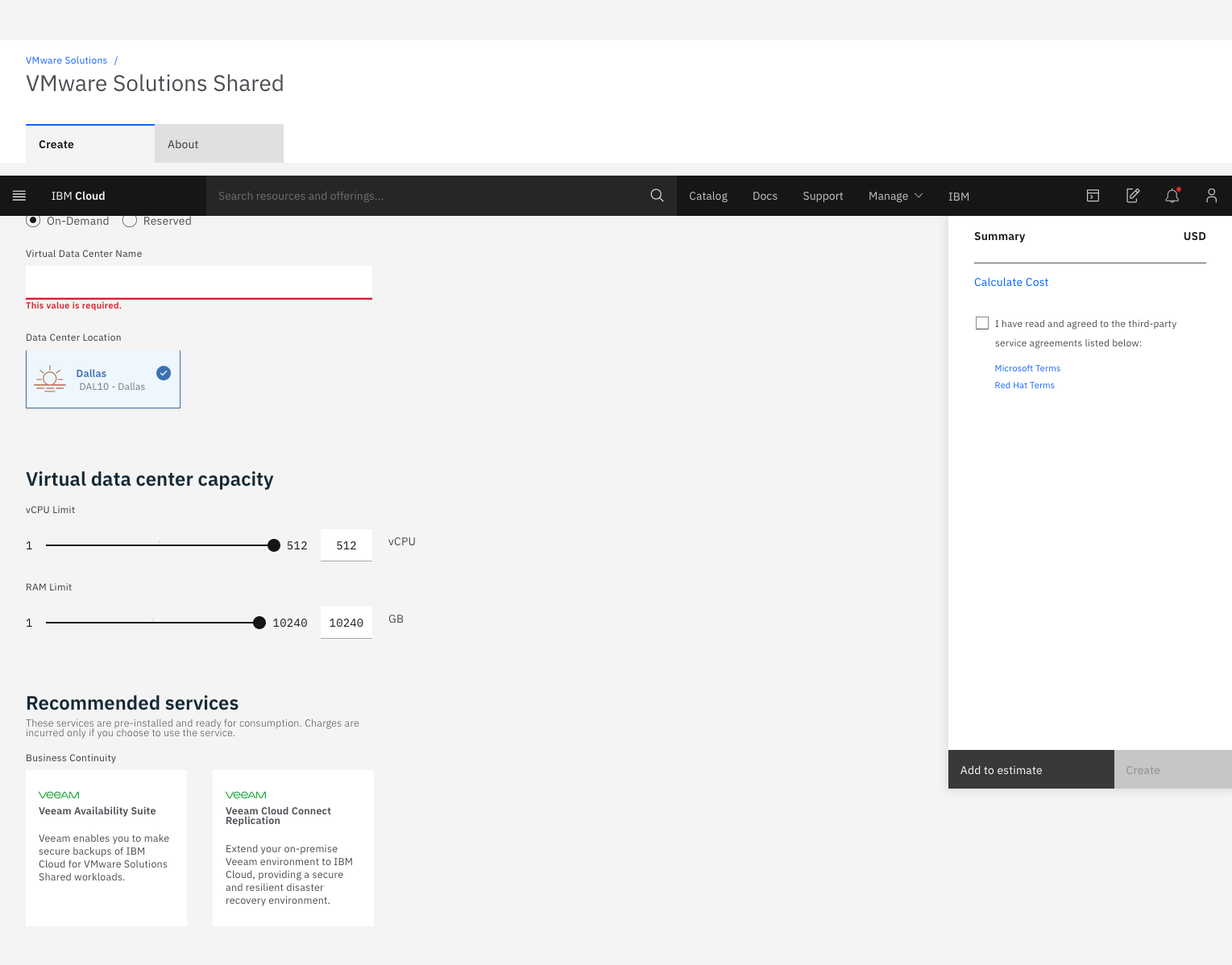
IBM Cloud for VMware
Solutions is designed to make cloud adoption easier, allowing the user to optimize the
value of existing on-premises infrastructure, while leveraging the
same tools, technologies and skills in the cloud. The solution provides rapid scalability,
deployment in 35+ global data centers and access to disaster
recovery, backup, security and compliance solutions from an array of ecosystem
partners. To address varying workload needs, IBM Cloud…
$0
IBM Cloud Object Storage Cross-Regional Smart Tier 1 GB (hourly)
Oracle VirtualBox
Score 8.8 out of 10
N/A
Oracle VirtualBox is an open source, cross-platform, virtualization software, enables developers to deliver code faster by running multiple operating systems on a single device.
$0
per month
Pricing
IBM Cloud for VMware Solutions
Oracle VirtualBox
Editions & Modules
Add-on
$0
IBM Cloud Object Storage Cross-Regional Smart Tier 1 GB (hourly)
On-demand
$0
0.25 IOPs 1 GB
Reserved (monthly or 730 hours)
$0
0.25 IOPs 1 GB (Per gigabyte of storage (hourly))
Add-on
$0
IBM Cloud Block Storage 1 GB (hourly)
On-demand
$0.01
Per vCPU (hourly)
On-demand
$0.09
Per gigabyte of network and bandwidth egress (monthly)
Reserved (monthly or 730 hours)
$0.09
Per gigabyte of network and bandwidth egress (monthly)
We believe IBM Cloud for VMware Solutions really stood out from Nutanix and Oracle VM VirtualBox. We really liked that the solution was a one-stop shop where IBM could provide all the required elements. We also trust IBM to provide the best-in-class solution to our problems …
VMware Cloud Foundation for Disaster Recovery environment, when the client needs to deploy a pay-as-you-go service or if they need to migrate SAP workloads, you can use VMware Cloud Foundation for Classic and VPC. We are the unique SAP-Certified VMware cloud service provider.
It is best suited when you want to have different operating systems on your laptop or desktop. You can easily switch between operating systems without the need to uninstall one. In another scenario, if you expect some application to damage your device, it would be best to run the application on the VM such that the damage can only be done to the virtual machine. It is less appropriate when time synchronization is very important. At times the VMs run their own times differently from the host time and this may cause some losses if what you doing is critical. Another important thing to take note of is the licensing of the application you want to run your VM. Some licenses do not allow the applications to be run on virtual servers so it is not appropriate to use the VM at this time.
The presentation is first rate. Our on-prem climate was continually experiencing slack and general languor. With IBM running everything, it's much smoother.
Start another group as little as one ESXi worker or scale a current bunch.
I have had issues in the past when it has come to resizing VM disk storage. The issue is entirely detailed here: https://www.virtualbox.org/ticket/9103 -- the problem was caused because of having existing snapshots (which error message output was not detailing). I haven't had to deal with the issue due to my dynamic disk sizes not being small from the start anymore (this is mostly an issue for my Windows VMs where the base disk may need significant size for the OS). It looks like, for a resize, that a merge of all snapshots has to occur first -- one user on that list details a workaround to maintain snapshots by cloning the VM. (Note: 5.2 was just released a few weeks ago, and looks like it should prevent the problem happening in the future by properly informing users that it isn't possible with snapshots).
Certain scenarios, like resizing disks, required dropping into a terminal as there were no options to previously do so via the GUI. According to some recent posts, I've seen that v5.2 has added disk management stuff like that to the GUI (or will be adding it). I'm comfortable with dropping into the terminal, but in a teaching scenario or when evaluating the learnability of the tools, it complicates things.
It is easy to use and setting it up is simple. The only con is that the pricing is a little bit high as well as documentation is a little low; so we had to do some personal learning to be able to fully utilize the product, or hop on the phone with someone.
I love using the Graphical User Interface. The VirtualBox Manager is very easy to understand and use. You can quickly create, configure and manage all your virtual machines in one window. It makes operating virtual machines easy and simple. When using VBoxManage it gives the user comprehensive control over VirtualBox so that you can use automation and scripting at the command-line interface
Overall, just a great experience here. No one in my opinion gets a perfect 10/10 rating (no one is ever perfect), so 9/10 is probably as good as it gets! From initial planning to post implementation support, the IBM Cloud and professional services has been there for my group as much as we have needed them. Great job!
IBM professional services helped us plan and implement the project with great success. They guided the project from planning, scoping, pre-implementation, testing, roll-out, then production and post-production support. We were very impressed with their knowledge of VMware and really appreciated their desire to make our project a success. I would highly recommend them!
IBM Cloud for VMware Solutions stacks up against them, we fully agree there are so many features in IBM cloud for VMware Solutions that make it unique and different. The system provides us hypervisor security level and the system even has live backup and storage capacity of data. This system provides us with accuracy that helps us to reduce errors and vulnerability.
VirutalBox is very similar to using Vmware with the slight difference in appearance and what might be considered a less polished look. However, what it lacks in polish and looks it makes up for in functionality, easy of use and the wide range of operating systems and features it supports without the need of buying the full professional edition
The only problem I have found is that the deployment is dependent and intrinsically linked to the Host OS. This is different from bare metal solutions which remove that dependency on a Host OS. The latter is more reliable and removes a layer of potential failure.
It has a positive impact on the cost required to maintain our vSphere environment by allowing us to get rid of our vsphere hardware and not worry about maintenance either.
There have been very few negatives, but one would definitely be the open-ended cost associated with cloud products in general.
Minimal-to-no support needed from the DevOps team.
Provides a direct and an easy way to access multiple VMs inside the same machines which enables performing various testing and QA tasks without the need to switch hardware.
Automatic provisioning using tools (esp. Vagrant) which enables developing a base image once, and allows for exporting/importing anywhere across the developers team.
Very cost-effective (no fees or monthly subscriptions).