Instana, an IBM company since the December 2020 acquisition, provides APM services for SOA, microservices, containerized applications and Kubernetes, and cloud native applications, as well as discovery and monitoring for IT assets.
$75
per month per Managed Virtual Server (MVS)
Nexthink
Score 7.4 out of 10
N/A
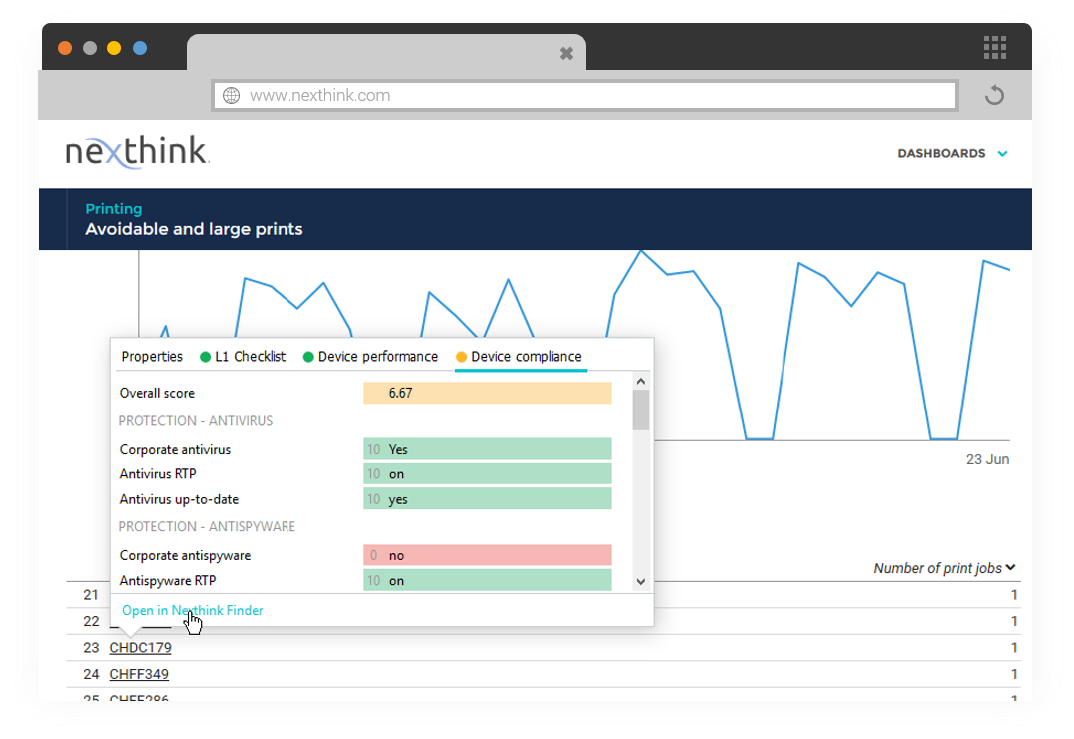
Nexthink Workplace Experience is a cloud-native platform allowing IT teams to manage the Digital Employee Experience (DEX) by providing insights across devices, applications, users, operating systems, locations and organizational units.
Well-suited for an org with a large application base, where many microservices are created and destroyed daily. IBM Instana doesn't require any manual configuration, so deploying the Instana agents takes very little time. Data capture from IBM Instana is highly granular and can detect even short spikes lasting a few seconds. Not suitable for legacy applications where there will be rarely any changes. They can use a simpler monitoring mechanism. Also, highly dense data capturing can sometimes overload the information.
I've been managing desktops for 20+ years and Nexthink was the missing tool out of my toolbox. Just to give some perspective, if you were building and maintaining a house, Nexthink would be comparable to switching up from a hammer and nails and to full blown using a nailgun. Nexthink is a solution accelerator and a well thought out toolset to give you the customer experience at a glance. It allows for so much more visibility just with the default set of data points the Collector (agent) gathers, which is A LOT, and grants you the ability to gather even more data with remote actions. All of this evidence cuts how the "it could possibly be this" and "maybe it's that" discussions when you're troubleshooting an issue. It may not provide the exact answer all the time, but it gives you a "compass point" on where you need to start looking to resolve the issue. Also the service monitoring, activity monitoring, and critical event thresholds really empower the teams to know when a problem is happening and they can get ahead of it before the first call even reaches the Help Desk. Nexthink is a cornerstone tool in our environment for end user experience and I'm excited to see where the go next.
Can monitor application(s) and system(s) with very large throughput of transactions by the second ( it gets everything !!!)
Provide strong drill down for your applications and will tell you where the points of failure of an application's is ( servers , network , Databases , etc you name it )
Very easy to set up and have it up and running when using the SaaS solution. There's an on premise solution which works just as well but requires more effort and preparation from an infrastructure point of view for your teams to implement.
Continuously improve their features and their agents auto-update and keep up. All while not interfering with your applications.
Let's you create your own dashboards and visualizations that can be tailored for different kind of users with the data collected.
Create your own events and smart alerts so you can know on the spot if something is happening or is likely to happen that needs addressing on your applications / systems
It's very difficult to create custom dashboards, only a handful of scenarios can be visualized to dashboards.
Extracting information from Instana to further analysis into excel for example is something that can be improved. Using an API to get data is very limiting.
Open telemetry features which allow to send application data to Instana is not working as documented.
The on-premise solution can be slow at times and resource-demanding even on newer laptops. (This isn't the case with the cloud offering.)
Some useful features are only available to cloud customers.
Library pack configuration could be made easier, often these packs require some customization and it's not always clear how to get them up and running after importing.
Instana has been able to fulfill our all requirement and provide out of box solution for multiple component like AWS RDS Monitoring and real time alerting setup on basis of that. it is also easy to integrate with other open-source alerting and monitoring tools which makes it easier to incorporate into our solutions
IBM Instana totally alters our monitoring approach since it increases the stability of the system and simplifies the process of problem solving. And since it helps to lower the degree of alert exhaustion that we experience, it is a total game changer for us.
Instana is much more robust and modern compared to our previous product which was AppDynamics. We compared Dynatrace and Datadog and they were very similar in many aspects. The licensing simplicity with Instana and our existing relationship with IBM made it a much more enticing option and accelerated the adoption timeline
Nexthink had better integration and a better user interface. 1E did not have the engagement capability which is so critical to many of the actions we complete using Nexthink. Nexthink had better trending data capabilities. 1E did not capture and hold data the way Nexthink does so all data assumes you are able to pull information from all systems at any time. with remote systems it is unlikely you will capture all systems at the same time so it makes any actions less effective. this review was performed 4 years ago so 1E may have addressed some of these limitations but Nexthink has also grown and continues to add and improve on their industry-leading capabilities.
SCCM proactive remediation: Automatically resolving hundreds of SCCM issues per month
Hardware: Identification of over $5m cost avoidance by seeing a lack of usage for 128GB SSDs - no need to upgrade to 256GB... coupled with OneDrive migration packs in the Nexthink library this is valuable.