WebSphere Hybrid Edition from IBM is a collection of WebSphere application runtimes and modernization tools that provides support for on-premise and major public cloud deployments, in virtual machines, containers and Kubernetes. The user can choose any WebSphere edition and deploy Liberty and application modernization tools to help move to a cloud-native architecture, modernize existing applications and support an existing WebSphere estate.
$88.50
per month
OCI
Score 8.2 out of 10
N/A
Oracle Cloud Infrastructure (OCI) is Oracles's infrastructure-as-a-service (IaaS) platform which combines the utility of public cloud with the granular control, security, and predictability of on-premises infrastructure.
N/A
Oracle WebLogic Server
Score 7.0 out of 10
N/A
Oracle WebLogic Server is a unified and extensible platform for developing, deploying and running enterprise applications, such as Java, for on-premises and in the cloud. WebLogic Server offers a scalable implementation of Java Enterprise Edition (EE) and Jakarta EE.
N/A
Pricing
IBM WebSphere Hybrid Edition
Oracle Cloud Infrastructure
Oracle WebLogic Server
Editions & Modules
Application Server
$88.50
per month
No answers on this topic
No answers on this topic
Offerings
Pricing Offerings
IBM WebSphere Hybrid Edition
OCI
Oracle WebLogic Server
Free Trial
No
Yes
No
Free/Freemium Version
No
Yes
No
Premium Consulting/Integration Services
No
Yes
No
Entry-level Setup Fee
No setup fee
Optional
No setup fee
Additional Details
—
—
—
More Pricing Information
Community Pulse
IBM WebSphere Hybrid Edition
Oracle Cloud Infrastructure
Oracle WebLogic Server
Considered Multiple Products
IBM WebSphere Hybrid Edition
Verified User
Technician
Chose IBM WebSphere Hybrid Edition
Websphere Liberty has a cloud ready runtime, embebed with a Developlment standards like spring, ee standards
IBM WebSphere Hybrid Edition has a native connections to IBM products, so when you have a IBM Environtment it the best way to get all IBM Beneffits
Verified User
Engineer
Chose IBM WebSphere Hybrid Edition
IBM Websphere was better suited for our needs as we are a primarily Java shop, and it provided better customization and potential ROI. It also requires less downtime, and support is easier than Weblogic. Also, Websphere is better suited for a hybrid environment.
IBM and weblogic are equally robust and support JVM's very well but where IBM is better is its out of the box integration with active directory that makes it easier to manage access control and security posture. In addition, the licensing model for IBM is lot more flexible for …
WAS is an IBM product and gels with IBM database product. So, we have decided to go with IBM WAS. WAS supports more data sources than Oracle web logic. So, ideally it can be used with multiple databases.
IBM support is better than Oracle, from past experience. Weblogic and WebSphere Application Server are somewhat similar versus the open source JBOSS. For many applications we had selected WAS to have a supported platform and used some of the competitors in other various use …
I have worked on JBOSS and WEBLOGIC Application servers apart from Websphere application servers. WebSphere Application Server has a more user friendly admin console GUI. I believe WAS administration and maintenance activities are more easy and effective as compared to other …
Websphere Application Server supports enterprise Java open standards, streamlines deployment, has very flexible management capabilities and better reliability and availability.
Oracle Cloud infrastructure is better for another Cloud provider in Oracle Database technology because Only Oracle Cloud infrastructure provides Real High availability solutions, this is very important, in order to reduce Service Disruptions. Oracle Provides Oracle Zero …
I have only used WebSphere for an evaluation period but I felt it was even harder to learn and it's cost was going to be bigger in the long run. Oracle WebLogic Server was more like the middle ground for what we needed at the time, both in terms of costs and learning curve.
My manager considered switching a few years ago to other application servers like JBoss or IBM WebSphere. The big reason behind the idea was cost. We all knew that WebLogic Server was suited to do the jobs very well. Oracle sales representatives worked well with my manager to …
WebSphere is another major contender and they have pitching and are more updated/streamlined. I still prefer WebLogic from an administrator standpoint. Support is much better and there are more options for finding answers to issues or new features.
Oracle WebLogic Application Server and IBM WebSphere Application Server provide an enterprise-level well-supported platform for robust architecture solutions. They provide tools for management, monitoring, and interaction with multiple other platforms in the market. JBoss is …
IBM WebSphere Hybrid edition is well-suited for the development and deployment of large enterprise-level applications such as Electronic Health Records that are used in our organization. IBM WebSphere is appropriate for organizations that require strong security and compliance as it provides a high level of security and compliance features. This works well with organizations that are subject to strict regulatory requirements, such as hospitals.
As per our usage Oracle Cloud Infrastructure for almost 6 years hosting 500 + customers I can say its well suited application for any small scale to larger scale application as it can handle that capacity and provide more reliable cloud service only if you need any messaging service like pub/sub or sqs better to consider other services.
If you need to have complex options in place you can count on Weblogic to be a robust Applicational Server you can rely on. But you would need to keep an eye on maintaining the framework updated quite frequently to avoid security breaches and subsequent severe situations. If you don't have other infrastructure for test purposes, I wouldn't advise you on having devs and QA installing this heavy application in their local machines, there are other lightweight solutions that would be a better fit for that.
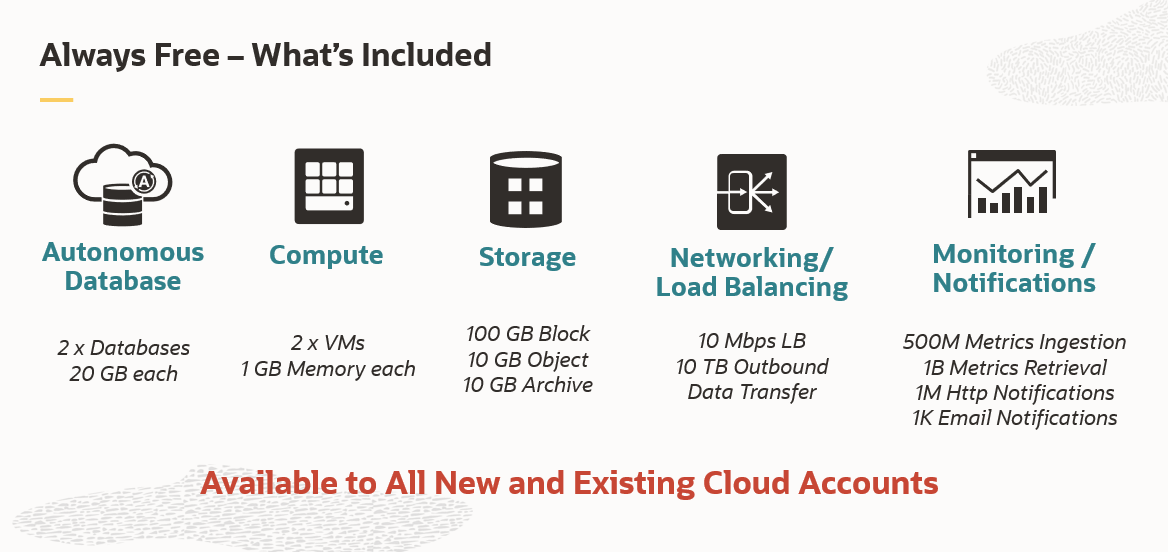
Oracle Cloud Infrastructure has a generous free tier, moreso than other hyperscalers, with an always-free tier that guarantees certain products are always free
Oracle Cloud Infrastructure allows you to size VMs with differing combinations of CPU and RAM, which is contrary to other hyperscalers that have specific pre-defined combinations only
The brand relation between Java and WebLogic Application Server usually provides a quicker access to programming features and their availability for the applications deployed.
The access to centralized configuration both from console and command line WLST eases the implementation of changes major or not in an organized and expedite way.
The maturity of the product is also visible in the available tools provided by the product itself, for both monitoring of resources and alerting for availability and thresholds
Ease of use in terms of deployment, give simple interface to do simple stuff like Tomcat, JBoss or GlassFish.
Takes long time to start the server.
The Liferay wars need to be decorated and then deployed. Perhaps we could simplify that.
Some of the concepts are good for complexity that WAS can handle but could be simplified and better documented, like concepts of well and profile, context, etc.
A Liferay war file created using Liferay Developer studio runs fine in Tomcat, however that may not run in WAS 7.x because it needs to be decorated. I had one war for a Liferay portlet with a simple cron job, and had hard time running to WAS server. It was running on the latest free download done on my friends m/c. Other times I have seen that there are issues running a war file that runs on Tomcat but runs on WAS after lot of customization for WAS.
The corporations like this however, the product may need better vibrant community of users where issues can be discussed.
Navigating the UI takes lots of getting used to. It reminds me of older GCP (just to get used to where everything is).
Permission for different things always seemed to be more difficult than it really needed to be. Once you got them set up you were good but updating anything or creating new permissions for just about anything took longer than I thought it should.
Based on how the buttons were laid out, it was pretty easy to delete all of your DNS records, and backing them up was not as intuitive as I'd like with the UI, but it was easy to do using a script.
Debugging issues has been difficult sometimes, the documentation is too dense and finding the the root cause for an specific issue takes time.
The Oracle WebLogic Server console UI feels old and gives a sense of lack of innovation even though it provides so much functionality.
I'm not sure if Oracle WebLogic Server supports more modern frameworks, but it feels more like a Java EE specific, maybe there's an opportunity there to appeal to newer application platforms
Mostly we will be renewing unless the strategic direction changes drastically or there are other complelling external circumstances. We've been on a multi year project to modernize our legacy applications and that effort will continue for the foreseeable future.
Reliability: Very dependable and stable OCI services have been for the business operations.Performance: The speed and efficiency of OCI in meeting their computing and storage needs.Scalability: The ease and effectiveness of scaling resources up or down to accommodate changing demands.Security: The robustness and effectiveness of OCI's security features in protecting their data and applications.
WebSphere Application Server is used across our organization. Most projects use this for Java products and applications. Being robust and scalable makes it even more usable. We love using WebSphere Application Server due to its configuration management ability made simple and vast across all java related parameters. It is dependent on the features and upgrades and IBM releases some great upgrades to WebSphere Application Server.
The services & products in Oracle Cloud Infrastructure needs more improvement to beat other Cloud service providers. The price is good & Security processes are good. We are requiring to put more effort in supporting this Oracle Cloud Infrastructure than other Cloud service providers. Probably better ways are there but is not super easy to find or not super available
Oracle WebLogic Server has so many features that sometimes it's hard to find the right place to setup things, I think the dated user interface does not help with that either. This has a direct impact when deciding to use it as your application server, you'd need to have the right people and invest the time needed to master it. If you're application justifies it then it will definitely be a great choice in the long run.
Yeah sometimes we had to face unplanned outages due to underlying infrastructure issues, so not every time,e but once in a while we face issues with availability. But the good thing is we have redundancy with DR setup and multi region so we can manage.
From the start, I was surprised by response times and image quality accessing windows VMs with RDP. GCP, Azure and -many offerings in AWS- don't perform this speed. Also, that's evident in the quality of Infrastructure Management Team, because I just received one warning regarding a region failure, what confirms that's a mature platform.
IBM was quick to respond when we had an issue with our specific infrastructure. We raised a PMR, which they picked up quickly and updated us about every step of the way. We had an appropriate fix for quite a business critical issue within a fortnight, which was impressive!
Overall it is amazing, there is always room for improvement. We have weekly updates that tend to slow the program used more and more. We had to change some reports within Oracle because the others wouldn’t load. This is tied to our payroll and the delays are causing many time constraint issues and panic. We have to create a new report when one breaks. Otherwise awesome!
Cleo Integration Clould has many bells and whistles; however, when we added more maps and trading partners, it really slowed down. We found that the Cleo support was very slow to respond and there was a language barrier. IBM Websphere had better customer support and its processing was much faster than Cleo Integration Cloud
We used Microsoft Azure and Docker earlier and faced some difficulties like Microsoft Azure and Docker. Occasionally, the generation of large images can delay deployment. It is also necessary for me to admit that Microsoft Azure and Docker have a somewhat steep learning curve. Proper paperwork needs to be there. Docker has issues with performance on a number of platforms. On the other hand, OCI is easy to deploy and easy to understand.
I believe the Oracle WebLogic Suite is probably a better all encompassing suite of development tools for the IT department. [It] is probably a bit more expensive than other competitors like Apache Tomcat or NGINX, but is worth the investment if you consider the savings from time to get code into production.
was not part of initial purchase team. Anyways, i think unit pricing and billing frequency is good compared to other Cloud service providers, when it comes to Cloud Capital expenditure & Operational expenditure. Would be more interested in exploring more options where customers can get more cost relaxations on trying out new cloud services in Oracle Cloud Infrastructure for example a new App or a feature
We have hosted around 500 + customers on this cloud so till day not faced any major issues, so we can use it for any kind of products and it can hold the load and easily scale based on need.
Services & Infra wise is ok to use & host applications & services. Security wise also good for a Cloud service provider. It is a interesting area to explore & using it for day to day needs can be further improvised in future probably. Modern day Services like AI and Machine learning could be improved
Continuous uptime of the business applications we manage
It's now much simpler for me to build and deploy cloud-native applications.
Because it can offload for me management and maintenance of the application server to IBM I can focus on the development, deployment and testing of the applications which is more important
WebLogic Application Server definitely had a positive ROI since all the applications are deployed on a single platform and making maintenance extremely cost effective.
Since all major cloud vendors support and maintain WebLogic, it gives us an opportunity to explore possibilities to move the organizational infrastructure on to the cloud without too much effort.