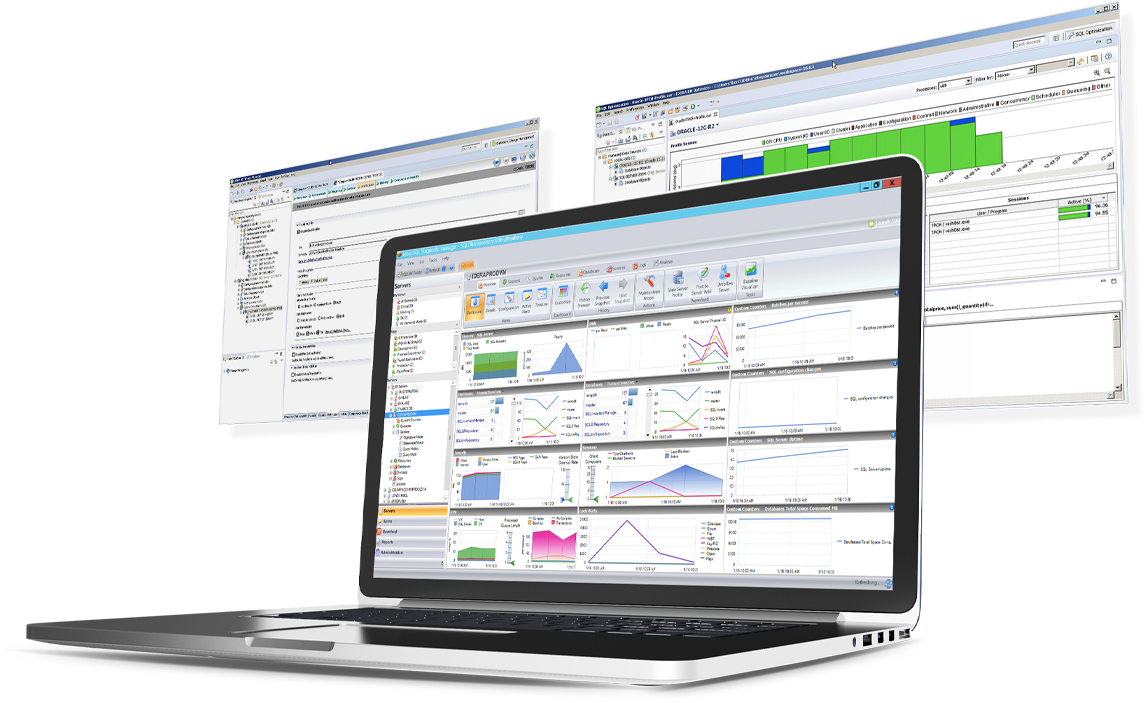
SQL Diagnostic Manager for Microsoft SQL Server helps database administrators to find and fix Microsoft SQL Server performance problems in physical, virtual, and cloud environments. Unlike its competition, it provides effective scalability, advanced SQL query analysis and optimization, prescriptive analysis with corrective SQL scripts, powerful automated alert responses, broad PowerShell integration, complete customization, and extensive support for current and legacy Microsoft SQL Server and…
$1,996
per instance with first year maintenance included
Pega Platform
Score 8.2 out of 10
N/A
Pega Platform is a combined business process management and robotic process automation (RPA) platform with advanced workforce analytics from Pegasystems.
$35
per month per user* (or $0.45 per case**)
Pricing
IDERA SQL Diagnostic Manager
Pega Platform
Editions & Modules
Standard via eCommerce
1,996.00
per instance with first year maintenance included
Low-code Factory Edition
$35
per month per user* (or $0.45 per case**)
Standard Edition
$90
per month per user* (or $0.80 per case**)
Enterprise Edition
Custom Quote
Offerings
Pricing Offerings
IDERA SQL Diagnostic Manager
Pega Platform
Free Trial
Yes
Yes
Free/Freemium Version
No
No
Premium Consulting/Integration Services
No
No
Entry-level Setup Fee
No setup fee
No setup fee
Additional Details
—
*500 named user minimum. Additional users available in blocks of 100. Billed annually. Based on a 3-year term.
**350,000 cases / year minimum. Additional cases available in blocks of 150,000.
More Pricing Information
Community Pulse
IDERA SQL Diagnostic Manager
Pega Platform
Features
IDERA SQL Diagnostic Manager
Pega Platform
SQL Performance Monitoring
Comparison of SQL Performance Monitoring features of Product A and Product B
IDERA SQL Diagnostic Manager
8.0
7 Ratings
5% below category average
Pega Platform
-
Ratings
Performance dashboard
9.07 Ratings
00 Ratings
Intelligent alerting
8.07 Ratings
00 Ratings
Top SQL
9.07 Ratings
00 Ratings
Historical trend data
9.06 Ratings
00 Ratings
Virtualization support
5.06 Ratings
00 Ratings
Reporting & Analytics
Comparison of Reporting & Analytics features of Product A and Product B
IDERA SQL Diagnostic Manager
-
Ratings
Pega Platform
8.8
62 Ratings
11% above category average
Dashboards
00 Ratings
9.061 Ratings
Standard reports
00 Ratings
8.661 Ratings
Custom reports
00 Ratings
8.660 Ratings
Process Engine
Comparison of Process Engine features of Product A and Product B
IDERA SQL Diagnostic Manager
-
Ratings
Pega Platform
7.8
65 Ratings
6% below category average
Process designer
00 Ratings
8.064 Ratings
Process simulation
00 Ratings
6.056 Ratings
Business rules engine
00 Ratings
9.064 Ratings
SOA support
00 Ratings
9.050 Ratings
Process player
00 Ratings
9.447 Ratings
Support for modeling languages
00 Ratings
5.46 Ratings
Form builder
00 Ratings
9.658 Ratings
Model execution
00 Ratings
6.055 Ratings
Collaboration
Comparison of Collaboration features of Product A and Product B
IDERA SQL Diagnostic Manager
-
Ratings
Pega Platform
9.0
50 Ratings
7% above category average
Social collaboration tools
00 Ratings
9.050 Ratings
Content Management Capabilties
Comparison of Content Management Capabilties features of Product A and Product B
SQL Server [Business Intelligence] Manager is useful for tracking performance across SSIS, SSRS and SSA and have the data represented in dashboards. It helps improve performance and helps end users. However, several features are redundant for smaller organization that can use the tools that comes with existing Microsoft products. These features also takes time to learn and use.
Pega Platform has introduced the low code feature, using app studio seasonal and professional developer can develop application easily and quickly. The initial application can be build by Business analyst and product owner who has less knowledge of Pega Platform, further application can be enhanced/extended by professional developer. We can develop end to end application and promote to higher environment. Easily we can perform parallel development using branch.
SQLdm does a good job of providing information at a high level, but also allows me to drill down to specific queries and events if needed. I don't always need to sift through tons of details to get the information I need. It also gives a very wide range of information from SQL specific metrics, to OS metrics, to VM metrics, all the way up to host server metrics.
I like how the alert and notification system can be customized. For example, if you know a certain server regularly has long-running queries, you can adjust the alert to not fire unless a query has been running for 30 minutes while the rest of the servers fire after 30 seconds. That is very helpful in not being bombarded at dinner with alerts from a server similar to, "I've been at 90% cpu for 26 milliseconds!!!!!!!...and now it's back down to 30%" Good information to know, but not something you need to literally lose sleep over.
I like how you can configure different servers to be monitored differently. For example, you can have a group of servers called DEVELOPMENT that you can turn on heavier monitoring on so you can test how changes in applications might affect the SQL environment, but in the PRODUCTION group, you may only want to enable the heavier analysis and logging when performance issues are actively being reported.
Quick development time. Much of the Pega "rules" are easy to configure and implement.
Visually friendly and modern. Much of the UI/UX elements in the system are continuously supported and updated, giving a nice feel to the apps.
Many of the configurations and rules Pega gives to the developers can also be delegated to business users. The organization and structure of the client's business can easily be adapted in the Pega platform.
Windows client has some issues. When you have small time intervals for your data collection, it can cause the client to become unresponsive and require you to restart it.
It takes more time to get the web client running than it does to get the windows client running.
The visualizations have been the same for the last eight years--could use a little bit of a refresh.
Pegasystems has continued to demonstrate a strong partnership with our organization and investment in their product that aligns with our overall vision and need. Pegasystems has engaged us at every level, with the assistance of minor defects to the overall roadmap planning and alignment of our goals
Pega Platform is enhancing its product and launching new features day by day which help to achieve customers needs. If I talk about the earlier version of Pega Platform (i.e. pega v5 and 6.3) there were many numbers of limitations in Pega Platform and if we need to do some customization then needed to write custom java and jave scripts to achieve the functionally. Now I can say Pega Platform is running with market trends and demand. Pega Platform is giving all the options which support the current technologies like decisioning capabilities, real time processing, mashup, process fabrics etc..
It’s very slow sometimes, but that may be our servers. Also the Knowledge Library needs some work - again, not sure if it’s our setup or what- but I’m unable to search the body of an article for content, so I have to be very intentional with tagging, but it’s not ideal.
IDERA SQL Diagnostic Manager for SQL, Redgate SQL, and MonitorLogicMonitor are similar products to each other. We decided on IDERA SQL Diagnostic Manager for SQL because our experience with locating heavy queries has been very good and it provides real-time monitoring of all servers and databases. It also allows you to have a large volume of historical data which allows you to analyze trends in the databases.
We did evaluate multiple products offerings with Pega Platform capabilities and observed that Pega PRPC rules engine and case management capabilities are better over so many BPM Tools. We also conducted a detailed study with developers to identify the best products out of Suite of BPM products. It's observed that Rules engines integration is very streamlined with forms in Pega whereas other tools multiple have powerful data model capabilities but lacks the ease of creating business rules.
For one of the applications we worked on, we were able to reduce the processing time on a case from 2 days to 20 minutes by utilizing Pega
We were able to resolve the issue of the routing of cases to users based on a specific algorithm by use of Pega
Pega case management feature was extensively used in one of the application to establish a parent-child relationship which was very helpful for all the business users