Red Hat JBoss SOA Platform drives business execution, responsiveness, and flexibility in an open platform. It delivers what the vendor describes as an easy-to-consume service-oriented architecture (SOA) integration suite that lets users build, deploy, integrate, and orchestrate applications and services.
N/A
Red Hat JBoss EAP
Score 8.4 out of 10
N/A
N/A
N/A
Splunk Observability Cloud
Score 8.4 out of 10
N/A
Splunk Observability Cloud aims to enable operational agility and better customer experience through real-time AI-driven streaming analytics allowing accurate alerts in seconds. It is designed to shorten MTTD and MTTR by providing real-time visibility into cloud infrastructure and services.
JBoss Enterprise SOA Platform is great when you are looking at building more or less pure Java applications and SOA micro-services that may integrate with multiple external data sources. It is less useful when you are looking to build simple SOA applications that are simple in nature since the overhead associated with deploying as well as learning BPEL.
JBoss EAP is subscription based/open source platform. It's very reliable and great for deploying high transaction Java based enterprise applications. It integrates well with third party components like mod_cluster and supports popular Java EE web-based frameworks such as Spring, Angular JS, jQuery Mobile, and Google Web Toolkit.
Its great if you need real-time visibility across complex or regulated environments. Also strong for hybrid or multi-cloud setups where uptime, observability and fast IR are required. It’s probably overkill for smaller teams or environments that don’t have constant changes or compliance reporting needs. It's expensive and has a steep learning curve. Also, in my opinion, do not get yourself into a consumption based model. Costs can certainly get out of control quickly.
JBoss is open source so the cost overhead to deploy and build application is very low.
JBoss Enterprise SOA Platform and its parent Redhat are reputed and well adapted in the industry so it is easy to find best practices documentation for complex deployments of JBoss middleware.
MOD_CLUSTER integration. JBoss EAP integrates pretty well with mod_cluster. This is an intelligent load balancer especially useful in highly clustered environments.
Supports enterprise-grade features such as high availability clustering, distributed caching, messaging etc.
Supports deployment in on-premise, virtual and hybrid cloud environments.
The first one is its Kubernetes container monitoring.
I really like this features because as we know how much K8s is vast and to manually monitor each part of the Kubernetes it takes so much time but Splunk Observability Cloud makes it easier. And even once we integrate K8s with Splunk Observability Cloud it gives us some prebuilt dashboards which gives holistic view of our Cluster and its nodes, pods, etc.
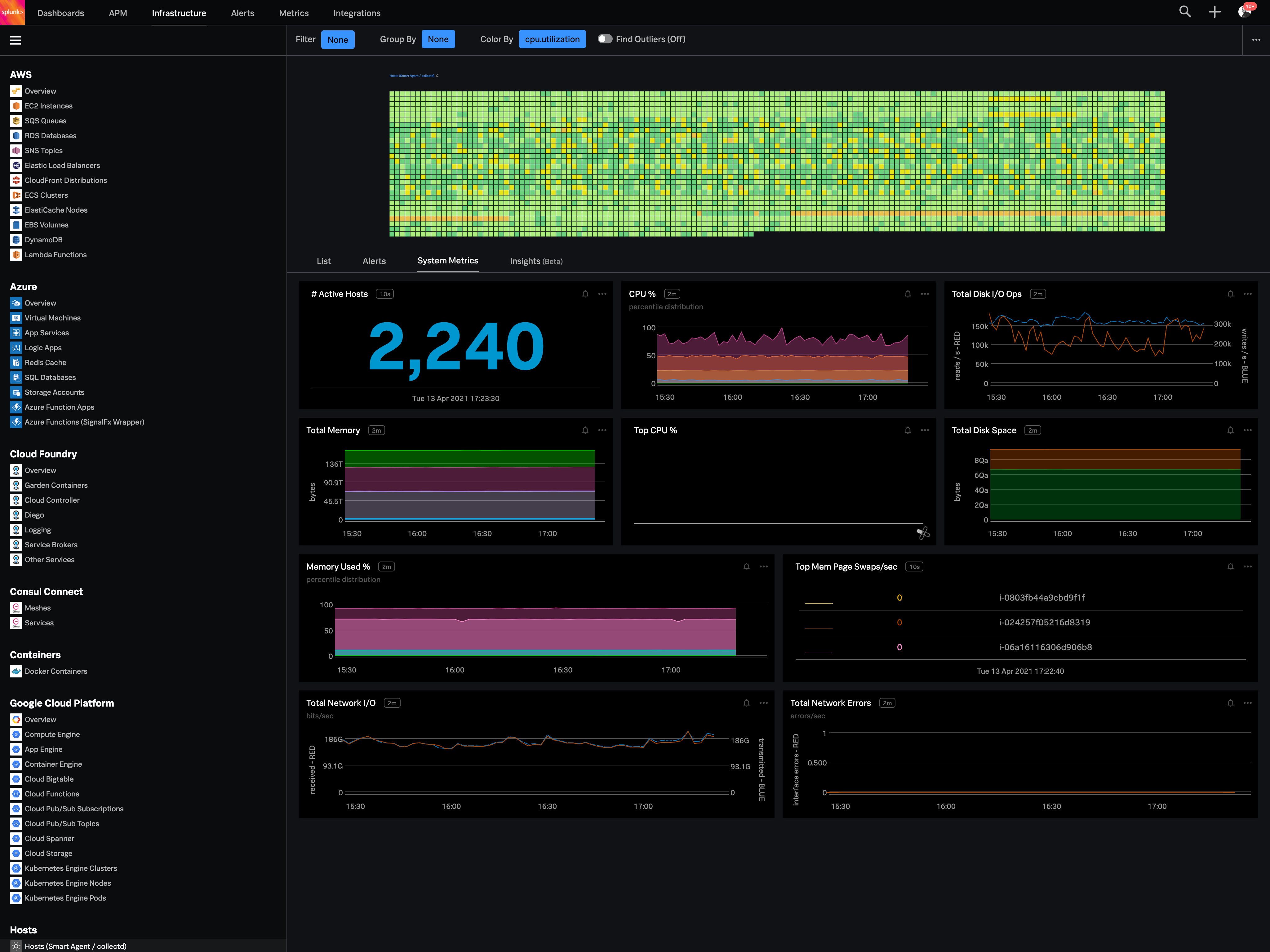
The dashbaord feature of Splunk Observability Cloud, it gives us full flexibility to customize our dashboard with a wide range of predefined chart types.
Now it also supports OTEL, which is a plus point for observability. As now everyone is moving towards Otel and in current market there are only few tools who supports OTEL based integrations, Splunk Observability Cloud is one out of them.
JBoss Enterprise SOA Platform is dependent and build for JEE/Java application so using a different programming paradigm will be much harder.
There is still a learning curve to get familiar with BPEL making it harder to get an SOA micro-service up and running compared to a fully cloud-based service
You can use table-like functionality to generate dashboards, but these queries are heavy on the system.
It could be easier to give insight into what type of line parsing is used for specific documents in a company-managed environment and/or show ways to gain the insights needed.
I would like to see ways to anonymize specific data for shared reports without pre-formatting this in a dashboard on which reports could be based.
Good: Stable system with low error rate Easy to use for simple use cases Bad: UI is not very clear for complex usage Mobile view (when logged in from phone) is bad No library for .net
When there is an issue, it’s a win if one can easily identify the root cause. To do the same, it should allow the user to dig deep with multiple data points and compare the data and identify the anomaly. In this use case, it’s good to drive from Splunk 011y.
JBoss EAP is lightweight and doesn't really consumes much physical resources. It's high performing and suites well for high transaction Java enterprise applications. The out of box performance settings are not really great and you will have to configure the settings to suite your environment to leverage it's full benefits.
Redhat support generally is great and that is true for the JBoss Enterprise SOA Platform as well. Even if you do not buy support from Redhat, you can reply on the discussion board and bug fixes via the open-source JBoss without much trouble.
Oracle SOA Suite (Oracle BPM + Oracle BPEL + other components) and IBM WebSphere middleware is most costly and suited if you are already using applications and other middleware components from these vendors. Mulesoft (Salesforce Mule ESB) is best when you need deep integration with one of Salesforce's existing products. JBoss and Apache Web Server are best when you do not want to invest infant CapEx/OpEx on license fee. Apache Web Server based middleware is best for simple SOA applications.
Splunk Infrastructure Monitoring provides far superior options for anybody using a complex hybrid multi-cloud environment and allows both your SOC and NOC to work together on the same data while driving their own insights. We found other products are still in the old world view of servers and agents residing together within a single data centre, but modern apps are no longer like this.
Jboss EAP is easy to deploy and configure. This lead to lower cost and faster delivery.
Even though we have large number of machines running JBoss, we have only two Jboss Administrators. It doesn't requires too much administration and maintenance on daily basis and reduces number of administrators required for large implementations.