Jirav, headquartered in San Francisco, aims to deliver smarter financials and faster insights, helping to understand where a business has been and predict where it will go. The system joins cloud-based Accounting, HR, CRM and billing data to automatically surface an interconnected model that is unique to a business. The solution helps eradicate spreadsheet errors, produce monthly reports that occur in real-time, and connected data enables teams to collaborate on multiple scenarios – bookings,…
$10,000
per year
MIP Fund Accounting
Score8.8 out of 10
N/A
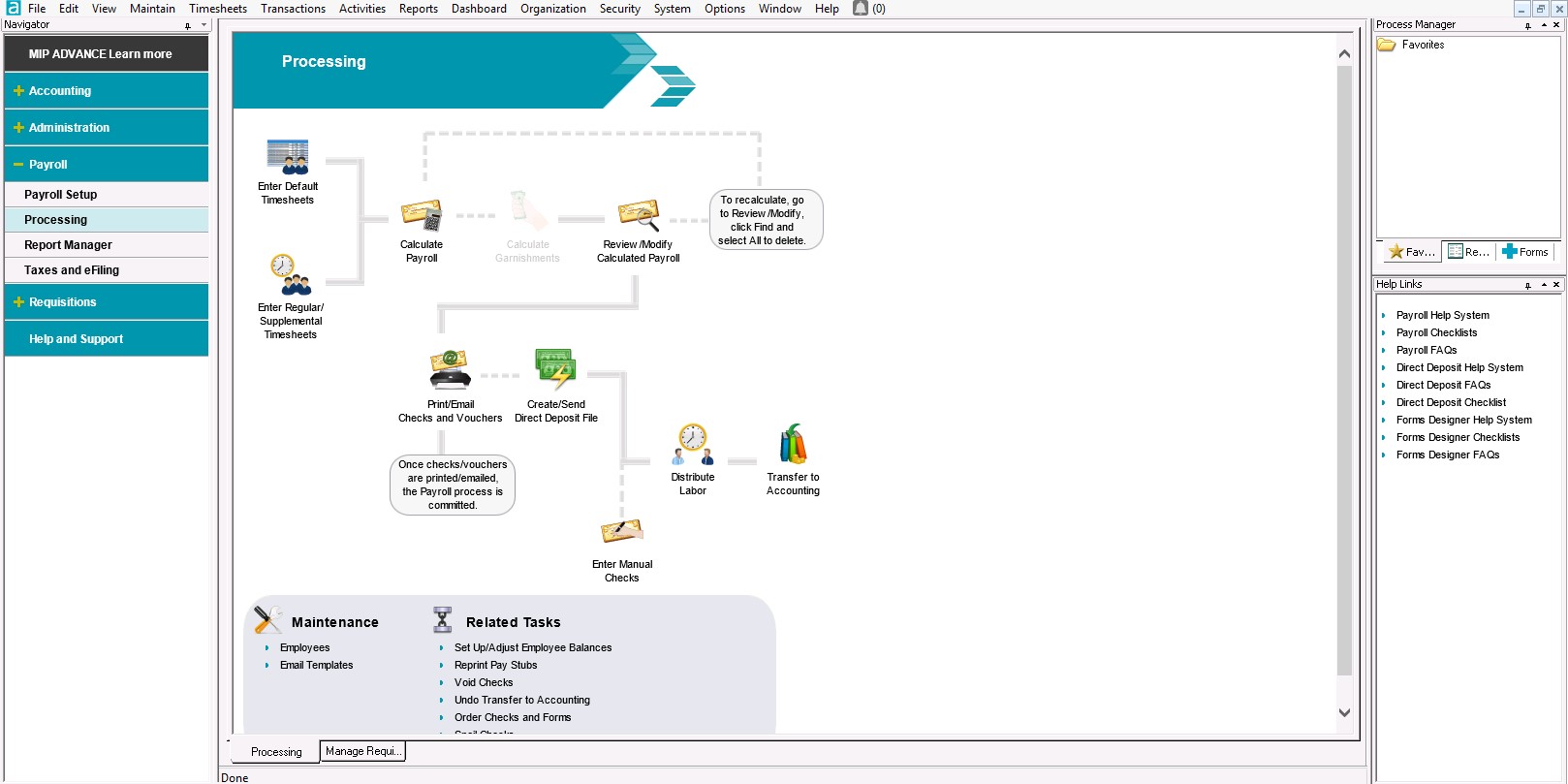
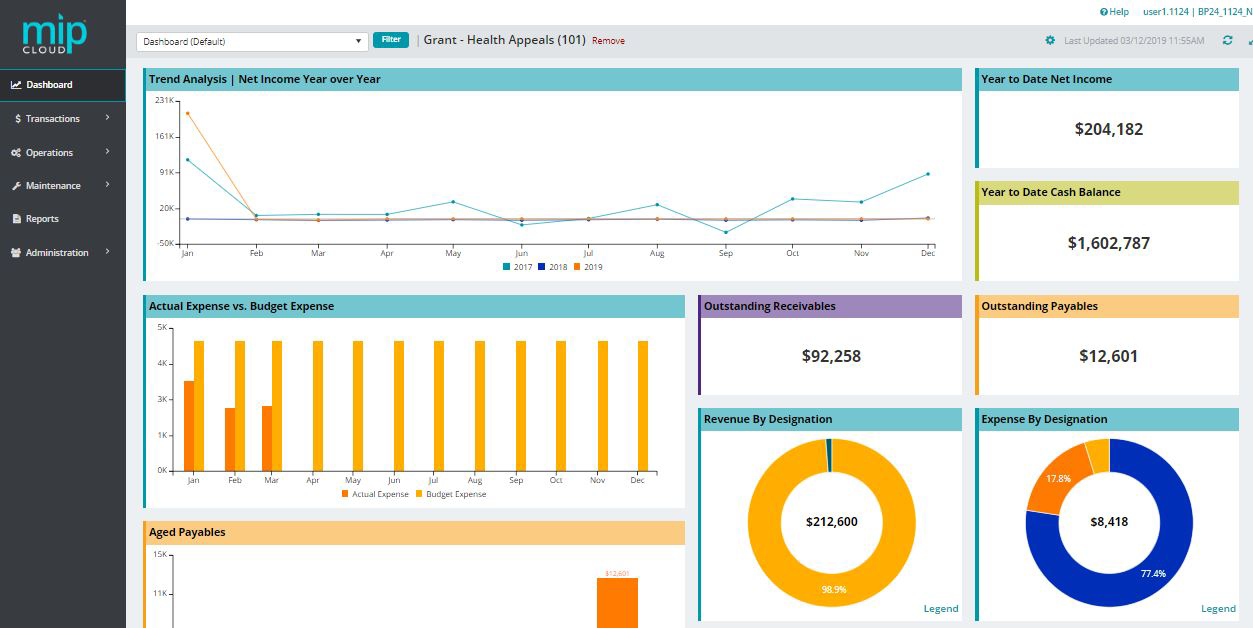
MIP Fund Accounting™ is a configurable fund accounting solution. The solution includes functionality for fund accounting, procurement, budgeting, payroll, human resources, timekeeping, fixed asset management, grant management, and dashboards for nonprofits and government agencies.
I feel that Jirav would be best suited for companies with less than 75 employees that need a more robust software than Fathom (Quickbooks Onlne integrated FP&A tool based in Australia) that is very customizable, with simple revenue modeling, few personnel changes every month, few departments, no multi currency, and need collaboration only with top-level personnel. I think Jirav is a product that is being highly recommended in the accounting industry for outsourced accounting firms, but accounting only looks at historical information and there needs to more finance industry influence, approval, and input so they can improve their product.
MIP Fund Accounting works very well for general fundraising. The form creation process is easy and allows you to set parameters and add fees, quantities, images, etc. This process is smooth on the customer (forward-facing) side as well. Reports are generated once the transactions have gone through, making tracking and reconciliation with accounting easy.
A de minimis incentive was given to thank the reviewer for their time. The incentive was not used to bias or drive a particular response, nor was the incentive contingent on a positive endorsement. TR verified that a representative sample of customers was invited. More Info
Jirav integrates well with Quickbooks Online (QBO), and I like how you can easily customize the reporting presentation by combining GL accounts and showing more or less details as needed for managerial reporting
I like that Jirav is browser-based and that I can easily share reports with internal and external parties for comments
I feel more confident using Jirav than I do with Excel because there is more data validation, and some notifications will appear if there are errors in the model
The sales capacity model and ramping employees schedule that their implementation / professional services team built for us works well overall (with some limitations)
Ideally, having a direct integration into Jirav would be great for all our data. However, some of our software didn't have a direct integration, so I was glad that Jirav offered the ability to use a connected Google Sheet that lets me input data that can be imported directly into the system
A de minimis incentive was given to thank the reviewer for their time. The incentive was not used to bias or drive a particular response, nor was the incentive contingent on a positive endorsement. TR verified that a representative sample of customers was invited. More Info
At times, I feel that Jirav is too customizable. It would be great if they could tailor the system to be more industry-specific. For example, if the system could provide standard formulas for SaaS industry metrics already within the system, then that would have saved me a ton of time with having to create the metrics myself. The formula creation for metrics is quite tedious as well because you can only do simple calculations, such as A + B or A x C. You cannot do A + B + C or A x B x C.
I struggle with the way they have their staff planning set up because I have to reimport an Excel every month with all the changes (new hires, terminations, pay changes), and the changes appear to be retroactive on reports, which doesn't make sense if someone receives a raise or pay change during the year. It would be much easier for planning for bookings if they could add a column for quota by salesperson.
If there are notifications of errors in the model, then the notifications will continue to present themselves after I resolve the issue. It would be nice if I could clear out notifications I know are not relevant anymore. I also still find errors in the system that I would have expected the system to notify me about, such as Assumptions that are set up but they are not included in any formulas, so I should delete that assumption to prevent anyone from thinking changing that assumption will impact the model.
There is some functionality for sharing reports and information, but there is not enough granularity in security settings to allow me to share certain information easily. For example, if I want to share information with managers to manage their departments' budget, but also not see their boss' compensation, then it takes some work to set that up. Or, if I want to share a report with a recruiter of planned headcount and salary, then I need to export it to Excel first and delete Actual headcount and salary, so they don't see current employees' compensation (including the person's boss' salary).
Customer and vendor names do not import, only the totals, so if you look at Actuals vs Plan, the actuals will show a total figure and the plan will show detail, creating the need for an external and manual reconciliation
There is no multi-currency available
Scenario analysis can be difficult to do quickly. For example, if I want to see the plan with planned hires and without planned hires, then I would need to create two separate plans, individually select and delete the planned hires in one plan and keep then in another plan, which is time-consuming
Using Google Sign-In causes the system to time-out frequently for me, so I get kicked out of the system and have to log back in. If I have multiple tabs of Jirav open, then re-logging in sometimes doesn't bring me back to where I was originally at.
You can export reports to Excel, but there are no formulas of the calculations, which makes it more difficult to understand how calculations are being performed unless you look in the browser and dig into the calculations. This also might make it more difficult if you decide to go to another software in the future since you may need to start from scratch in the next software
Seasonality has been difficult to model. For example, the way our model is set up, I can use an assumption for Q1, Q2, Q3 and Q4. However, if I update Q3 for this year, then it also updates Q3 of all subsequent years, which I don't want. A more complex model and additional maintenance would be needed to accomplish more accurate seasonality planning
With the payroll process, if there is an error in sending the stubs through email, there is no option to resend without a restore. That really needs to change.
Being able to void encumbrance at the same time as a PO would be an incredible time saver.
A de minimis incentive was given to thank the reviewer for their time. The incentive was not used to bias or drive a particular response, nor was the incentive contingent on a positive endorsement. TR verified that a representative sample of customers was invited. More Info
I give MIP a 10 because Our organization use MIP Fund Accounting ever since I've been there and that's been for over 20 plus years for all of our accounting and payroll. MIP has stayed on the cutting edge of technology, ever evolving to meet the needs of the times, especially post pandemic, while many are working remotely! MIP support staff are very knowledgeable and efficient. Even new users can get up to speed quickly with MIP Fund Accounting.
A de minimis incentive was given to thank the reviewer for their time. The incentive was not used to bias or drive a particular response, nor was the incentive contingent on a positive endorsement. TR verified that a representative sample of customers was invited. More Info
I have used this system for about 12 years now and I still learning how to use it. It always surprises me how there is another report to learn to achieve my data reporting goals. It is great to have a system that you have used long enough to feel comfortable with but also a system that allows you to learn new ways to report and enter data into the system
A de minimis incentive was given to thank the reviewer for their time. The incentive was not used to bias or drive a particular response, nor was the incentive contingent on a positive endorsement. TR verified that a representative sample of customers was invited. More Info
I have rarely encountered any issues accessing MIP Fund Accounting over the years. On the rare occasions when availability was interrupted, the reasons were always found in-house when using the on-premises version. Since we have migrated to the MIP cloud, we have had no issues with availability. Any maintenance or updates are always communicated to us and are usually done outside of business hours.
A de minimis incentive was given to thank the reviewer for their time. The incentive was not used to bias or drive a particular response, nor was the incentive contingent on a positive endorsement. TR verified that a representative sample of customers was invited. More Info
We have 18 programs and the CFO has the ability through MIP Fund Accounting to generate separate and/or collective reporting for those programs. Each program has its own grant or funding source. Each has its own reporting guidelines that must be met so the ability to run reporting separately or collectively is a plus.
A de minimis incentive was given to thank the reviewer for their time. The incentive was not used to bias or drive a particular response, nor was the incentive contingent on a positive endorsement. TR verified that a representative sample of customers was invited. More Info
I have not reached out to MIP for technical support; however, their website offers great help resources so I can solve an issue on my own. Another team member reached out to MIP for support and was helped quickly. The transition process took longer than expected due to a lag in communication.
A de minimis incentive was given to thank the reviewer for their time. The incentive was not used to bias or drive a particular response, nor was the incentive contingent on a positive endorsement. TR verified that a representative sample of customers was invited. More Info
There are no specifics on what happens if you make one choice or another to know which is the best selection. This is true for JVs and AP. In training we were not given specifics of what happens when one possibility is selected over another.
A de minimis incentive was given to thank the reviewer for their time. The incentive was not used to bias or drive a particular response, nor was the incentive contingent on a positive endorsement. TR verified that a representative sample of customers was invited. More Info
Denise O'Malley provided training for the HR module when we added it to our system. Denise also gave us a demo of the EWS module which we were able to see that it would not meet our needs. She was very kind about and understanding regarding the functions we needed with a time clock system.
A de minimis incentive was given to thank the reviewer for their time. The incentive was not used to bias or drive a particular response, nor was the incentive contingent on a positive endorsement. TR verified that a representative sample of customers was invited. More Info
Don't waste your time with MIP. There are plenty of other softwares out there that will do the job better. Do your homework. Get references from actual users. Make sure that what you choose will truly integrate. Make sure that there is local support. Get training. You will be glad that you passed this one by. Trust me.
A de minimis incentive was given to thank the reviewer for their time. The incentive was not used to bias or drive a particular response, nor was the incentive contingent on a positive endorsement. TR verified that a representative sample of customers was invited. More Info
Fathom was the cheapest and most basic as an add-on directly to QuickBooks Online Plus, but you lose functionality with Fathom if you use QuickBooks Online Advanced (QBOA). The main loss of functionality for me was the lack of multiple department reporting, which was absolutely necessary for my analysis. Jirav was half the price of Moscaic.tech, but I've heard Mosaic has standard metrics for the SaaS-industry, which is appealing after going through the tedious process of setting up metrics in Jirav. QBOA has additional reporting than QBO Plus, but not enough robust features for planning and modeling. PlaceCPM is Salesforce-based and a I felt having a strong Salesforce admin that can great reports made their unnecessary, and I feel like most of the time you need a Salesforce admin just to run Salesforce. Cube, Vena and OnPlan are spreadsheet-based, but I don't want to use spreadsheets. Prophix, Board and Anaplan seem outdated. Workday was more than what I needed
I've utilized other ERP accounting software like Infor, NetSuite, and MS Dynamics, to name a few. MIP Fund Accounting offers flexibility and room for growth while not being overly heavy on your team to maintain it. And, we're now learning more about the add-on's and more advanced capabilities to leverage with our team.
A de minimis incentive was given to thank the reviewer for their time. The incentive was not used to bias or drive a particular response, nor was the incentive contingent on a positive endorsement. TR verified that a representative sample of customers was invited. More Info
The flexibility to create certain features are helpful and are designed to be easier on MIP Accounting Cloud. It has been easier than the MIP Accounting classic version. I may have not fully utilized the software to deploy across multiple departments other than generating revenue reports or expenses. As well as developing budget worksheets for our departments. Which are great as it is, but have not gone farther than that.
A de minimis incentive was given to thank the reviewer for their time. The incentive was not used to bias or drive a particular response, nor was the incentive contingent on a positive endorsement. TR verified that a representative sample of customers was invited. More Info
We converted to the cloud version a few years ago to reduce our dependency on a dedicated internal IT server which needed to be replaced. The cost of the product switched to a monthly fee which increased cost somewhat but probably is matched with IT savings over time in doing upgrades.
We have an efficient team of two people doing the transactional work, so we don't really have much incentive to further automate our processes. And with the turnover in the CFO position we have had, has helped us maintain consistency in our processing.
Once I learned how to memorize and recall transactions it was a huge timesaver and increased the accuracy and consistency of our entry.
The cost of training is sometimes prohibitive. Example is my accounting clerk MIGHT benefit from additional training but at about $200 for a lot of the courses, it is more than we have budgeted.
A de minimis incentive was given to thank the reviewer for their time. The incentive was not used to bias or drive a particular response, nor was the incentive contingent on a positive endorsement. TR verified that a representative sample of customers was invited. More Info