Jitterbit is a cloud integration technology for cloud, social or mobile apps. It provides accessibility for
non-technical users, including easily creating API’s and data transformation scripts within the
integrations.
$1,000
per month
Anypoint Platform
Score8.1 out of 10
N/A
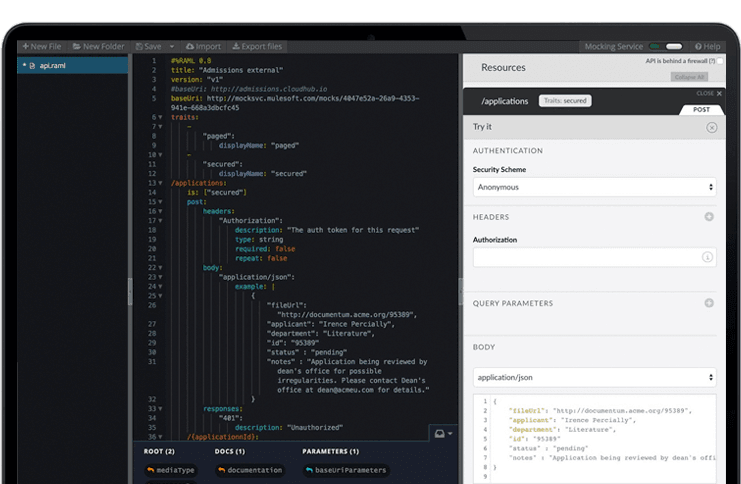
The Anypoint Platform developed by MuleSoft and acquired by Salesforce in early 2018 is designed to
connect apps, data, and devices anywhere, on-premises or in the cloud. This platform was built to
offer out-of-the-box connectors as well as tools that architects and developers can adopt quickly to
design, build and manage the entire lifecycle of their APIs, applications, and products.
Solutions Architect in Information Technology at United Techno (Computer Software, 51-200 employees)
Chose Jitterbit
Jitterbit plays well in the general-purpose integration that can be used to integrate multiple systems and used by different departments within an Enterprise. I see it as a more basic option for Boomi that is less expensive. So if you are looking for something like Boomi, and …
A de minimis incentive was given to thank the reviewer for their time. The incentive was not used to bias or drive a particular response, nor was the incentive contingent on a positive endorsement. More Info
This is a great tool for bringing data out of your locked, internal systems and getting it into the cloud. It meshes well with Salesforce and is fairly easy to use, helping the transition from other older, more complex tools into a more modern environment. It has lots of competition in this space and some are better than others, but if your data is straight forward and you know it well, Jitterbit will get the job done. If you are not as close or comfortable with your data and need to do some wildly complex migrations, there might be better packages out there for you.
A de minimis incentive was given to thank the reviewer for their time. The incentive was not used to bias or drive a particular response, nor was the incentive contingent on a positive endorsement. More Info
MuleSoft Anypoint Platform is best tool in the market for developing APIs with complex structures communicating with various different types of applications including web applications as well as legacy applications. Also applications including database connectivity for fetching and updating data in the DB tables. I cant think of any scenario which MuleSoft Anypoint Platform could not be used for developing the integrations.
A de minimis incentive was given to thank the reviewer for their time. The incentive was not used to bias or drive a particular response, nor was the incentive contingent on a positive endorsement. More Info
A de minimis incentive was given to thank the reviewer for their time. The incentive was not used to bias or drive a particular response, nor was the incentive contingent on a positive endorsement. More Info
A de minimis incentive was given to thank the reviewer for their time. The incentive was not used to bias or drive a particular response, nor was the incentive contingent on a positive endorsement. More Info
Migrating operations from QA to Production work well for initial deployment, however, when migrating an update to an existing job to production, sometimes certain project items are duplicated. This is not the end of the world... the duplicates can be removed, but would be nice if it was not required.
I have not found a way to trap under-the-covers SOAP errors (for example, when a query you are running against Salesforce takes too long). You get a warning error in the operation log that the job only pulled a "partial" file, but it does not fail.
A de minimis incentive was given to thank the reviewer for their time. The incentive was not used to bias or drive a particular response, nor was the incentive contingent on a positive endorsement. More Info
Has more features than what we really need so we're paying for more than we use. Sort of like paying for an Abrams tank when all we really need is a Toyota Corolla.
Not a value product, tends to be expensive.
Takes a while for developers to learn to use Mulesoft Anypoint.
A de minimis incentive was given to thank the reviewer for their time. The incentive was not used to bias or drive a particular response, nor was the incentive contingent on a positive endorsement. More Info
I have been evaluating other tools as a continuous improvement practice. I would like something that would be easier to use for a non-technical user. I work for a small organization and have no back-up for Jitterbit if something happens to me. We don't have the technically savvy employees to understand it.
We have migrated our existing over 100+ APIs from legacy to MuleSoft Anypoint Platform and the processing has seen over 40% improvement and saved huge amount in overall annual billing. From development perspective, MuleSoft Vibe has made developers life so easy and reduced development time. Extensive logging, and build-in connectors for other integration tools, logging and repo is providing kind of one place solutions. Any point Platform is providing various options like runtime, API manager, Access management, segregation of Business groups and so many other option which is helping us to monitor, configure and manage all our APIs in one place
Anypoint Platform support is very responsive. There is also a huge knowledge base and an active online forum where answers to most questions can be found. When needed support engages the engineering group so adequate solutions or workarounds are always provided.
A de minimis incentive was given to thank the reviewer for their time. The incentive was not used to bias or drive a particular response, nor was the incentive contingent on a positive endorsement. More Info
I have started with MuleSoft Fundamentals course provided by MuleSoft training at start. This was sufficient to do initial learning and get onboarded. The online documentation with different Runtime versions/deprecated functions and keywords are well documented. The automated solution provided by MuleSoft Anypoint Platform to upgrade 3.0 to 4.0 gave a good head start while learning MuleSoft Anypoint Platform and working altogether with Online training and documentations
Evaluated Dell Boomi and Celigo as alternatives prior to purchasing Jitterbit. We went with Jitterbit at that time because we could handle all changes ourselves without any assistance from Jitterbit, and we liked their size and nimbleness. Dell Boomi was too big for us, and Celigo at that time did not have a self-service model. Every change had to go through them (although that has since changed). We were not in a position to be able to wait for someone to make changes for us given the rate of change within the business.
A de minimis incentive was given to thank the reviewer for their time. The incentive was not used to bias or drive a particular response, nor was the incentive contingent on a positive endorsement. More Info
Once we have moved all of our system integration APIs to the MuleSoft Anypoint Platform, we will need to communicate with a wide variety of external systems. All of our business and service logic is stored in the aforementioned core systems. Anypoint Platform (and all of our APIs) makes it easy to connect to various other platforms. In order to link to these many other systems, connectors and/or components are utilized, and they are simple to configure and integrate.
A de minimis incentive was given to thank the reviewer for their time. The incentive was not used to bias or drive a particular response, nor was the incentive contingent on a positive endorsement. More Info
The time it takes to connect systems has reduced by orders of magnitude. Previously, we would custom-develop connectors between various systems and they would all be managed by different vendors. With Jitterbit speed-to-deploy and the efficiency gained by managing all connections in one dashboard has been the greatest piece of the ROI.
A de minimis incentive was given to thank the reviewer for their time. The incentive was not used to bias or drive a particular response, nor was the incentive contingent on a positive endorsement. More Info
A de minimis incentive was given to thank the reviewer for their time. The incentive was not used to bias or drive a particular response, nor was the incentive contingent on a positive endorsement. More Info