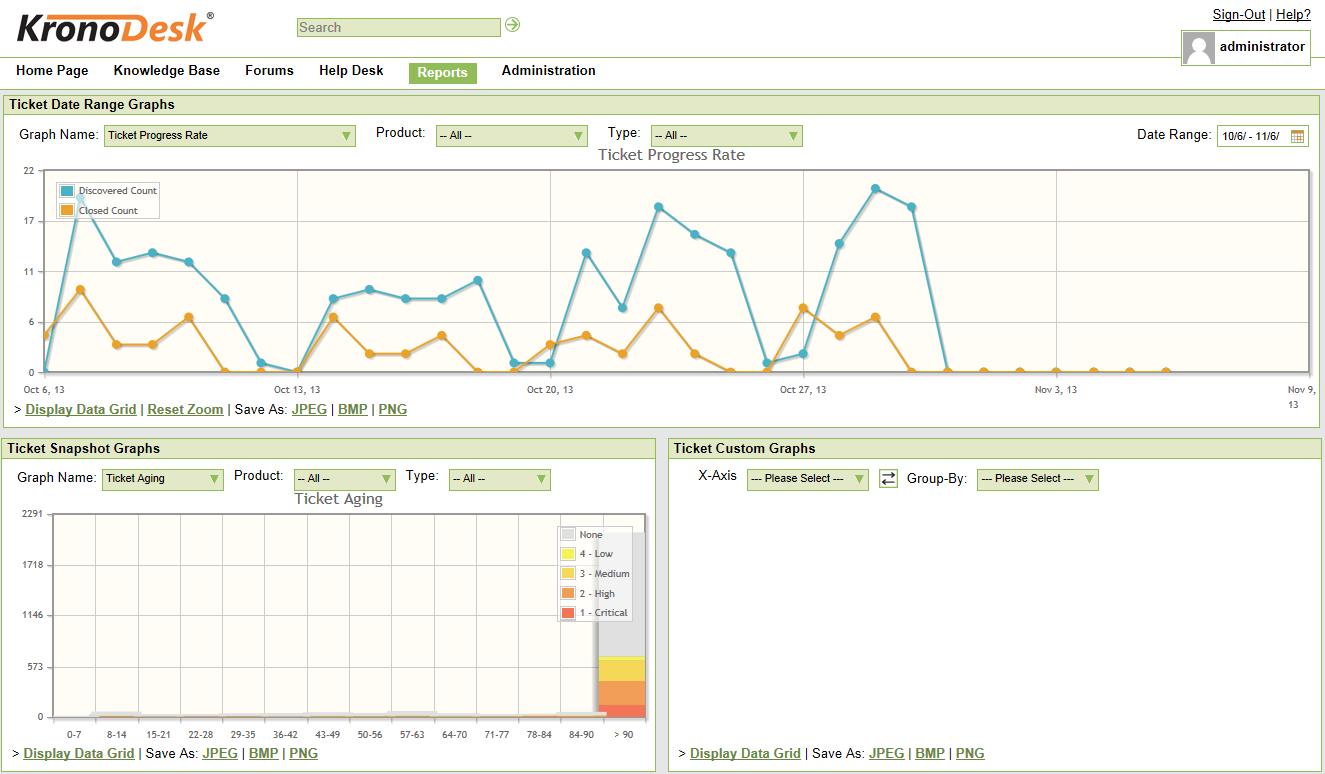
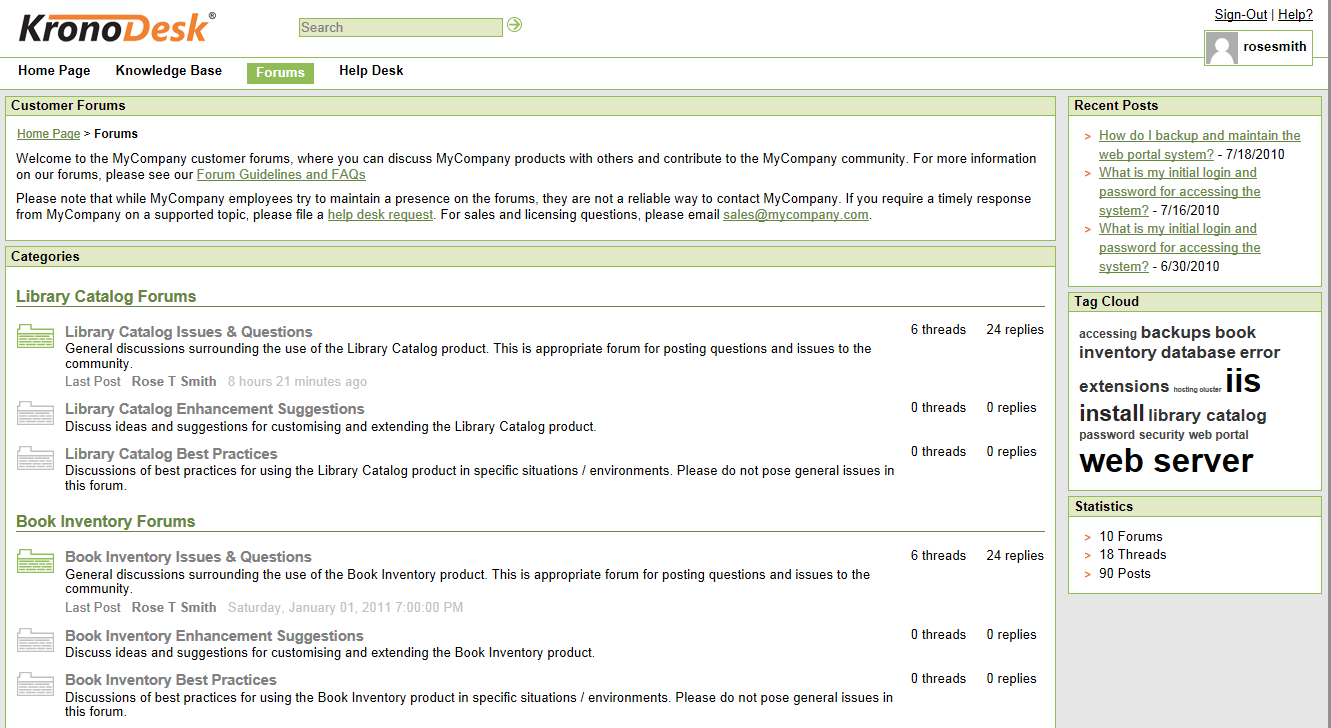
KronoDesk is an integrated customer support system that includes help desk ticketing, support forums and a self-service knowledge base.
$63.66
per month per concurrent user
Parature (Discontinued)
Score 5.0 out of 10
N/A
Parature was a self-service customer support platform providing a self-service knowledge base to connect with customers across multiple channels. The company was acquired by Microsoft in January 2014 and reached EOL in 2017.
N/A
Pricing
KronoDesk
Parature (Discontinued)
Editions & Modules
Cloud
$63.66 per
per month per concurrent user
Download
$633.66
per year per concurrent user
No answers on this topic
Offerings
Pricing Offerings
KronoDesk
Parature (Discontinued)
Free Trial
Yes
No
Free/Freemium Version
No
No
Premium Consulting/Integration Services
No
No
Entry-level Setup Fee
No setup fee
No setup fee
Additional Details
Discount available for annual billing on cloud plans. Discount available for volume of concurrent users. 3 concurrent user minimum.
Several freeware/shareware tools like Bugzilla are missing integration with other systems. HP, IBM and CA like systems are too cumbersome and complicated for "normal" users, for me too much "hassle" to monitor issues and related information and links to other issues.
Before choosing Parature we reviewed many of the currently available solutions before building our short list of Parature, SugarCRM, Zendesk, Salesforce, and NetSuite. In the end, the licensing models for Salesforce and Netsuite eliminated them from consideration. The SugarCRM …
Parature comes in at just the right blend between ticketing solutions like Ceridian and Remedy. Ceridian is a little too cut-down/simple while Remedy can be mired by its complexity. Parature shares the same features as quite a few other ticketing solutions, but hits strongly in …
I'm currently using Solarwinds Web Help Desk and I think the 2 are very comparable. I didn't select either product but I'd rate Parature at the same level as WHD or better.
Salesforce is so much more intuitive and the layout is so much better. I never had any training nor did I need it with SF and with Parature it was a constant battle to understand its issues. I don't like to feel I have to resort to a manual every time I use the product.
Between SolarWinds and Altiris, I like the advantage that Parature gives. The auto reply is a huge assistance when dealing with people outside of my organization.
I advise my customers to use it for all issue tracking, in business development as well as in business operations. An interface to operational systems is therefor very helpful and enlarges the value of the KronoDesk knowledge base, provided that this information is "open" to all users of all departments.
Parature earns a "7" on my rating scale because it fits the bill for a ticketing solution. While it is not the most powerful utility I have come across, it is fairly user friendly and gets the job done. There is quite a bit of room for customizing the interface, but it comes with a learning curve. A score of "7" reflects what I would tell anyone who is looking for feedback on this application; it's better than a majority of the market share, but still has room to grow!
The possibility to create a system/subsystem/component/interface tree of the system landscape, to be used to more detailed issue associations and subsequent detailed planning and monitoring of issues.
A quick issue entry with the most important information would be helpful.
A "live" report that can contains my current "hot" issues would be helpful.
We left Parature for Salesforce Service Cloud. While Parature was functional, as our business matured we needed better support, more stability, and a lot more features. In addition, it integrated with our sales, marketing, and finance department, allowing us to all use a single solution and be able to share information across departments.
It was bulky, cumbersome, and didn't allow us to handle the volume of cases we received on a daily basis. Many of our issues were highly technical in nature and we would often need to work on 2 or 3 at once. The poor design choices prevented this, which was unfortunate.
They recently had one very extended outage. It was a data center issue - but they were not diversified enough so in the end the system was down for almost 8 hours. There are also periods of time where for no reason the system simply doesn't respond. This small outages are usually short (just a few minutes), and have in fact been occurring less often, so it appears some corrective actions have been taken.
Several freeware/shareware tools like Bugzilla are missing integration with other systems. HP, IBM and CA like systems are too cumbersome and complicated for "normal" users, for me too much "hassle" to monitor issues and related information and links to other issues.
Before choosing Parature we reviewed many of the currently available solutions before building our short list of Parature, SugarCRM, Zendesk, Salesforce, and NetSuite. In the end, the licensing models for Salesforce and Netsuite eliminated them from consideration. The SugarCRM solution was our current solution, and didn't appear to be a key area of focus for Sugar (though we continue to use SugarCRM for everything except the Ticketing feature). Zendesk lacked the Download Module feature which is a critical element of our deployment. In the end, it was Parature that addressed all of the needs we identified and did so in a single, hosted solution. It was also one of the least expensive to deploy and maintain.
Positive: everything is housed in one place, we are paperless and we are efficient.
Negative: the bugs of this product make the above equally as frustrating. Also, some people don't use it correctly and going back and fixing their mistake is time-consuming. The reporting feature are also pretty flawed.