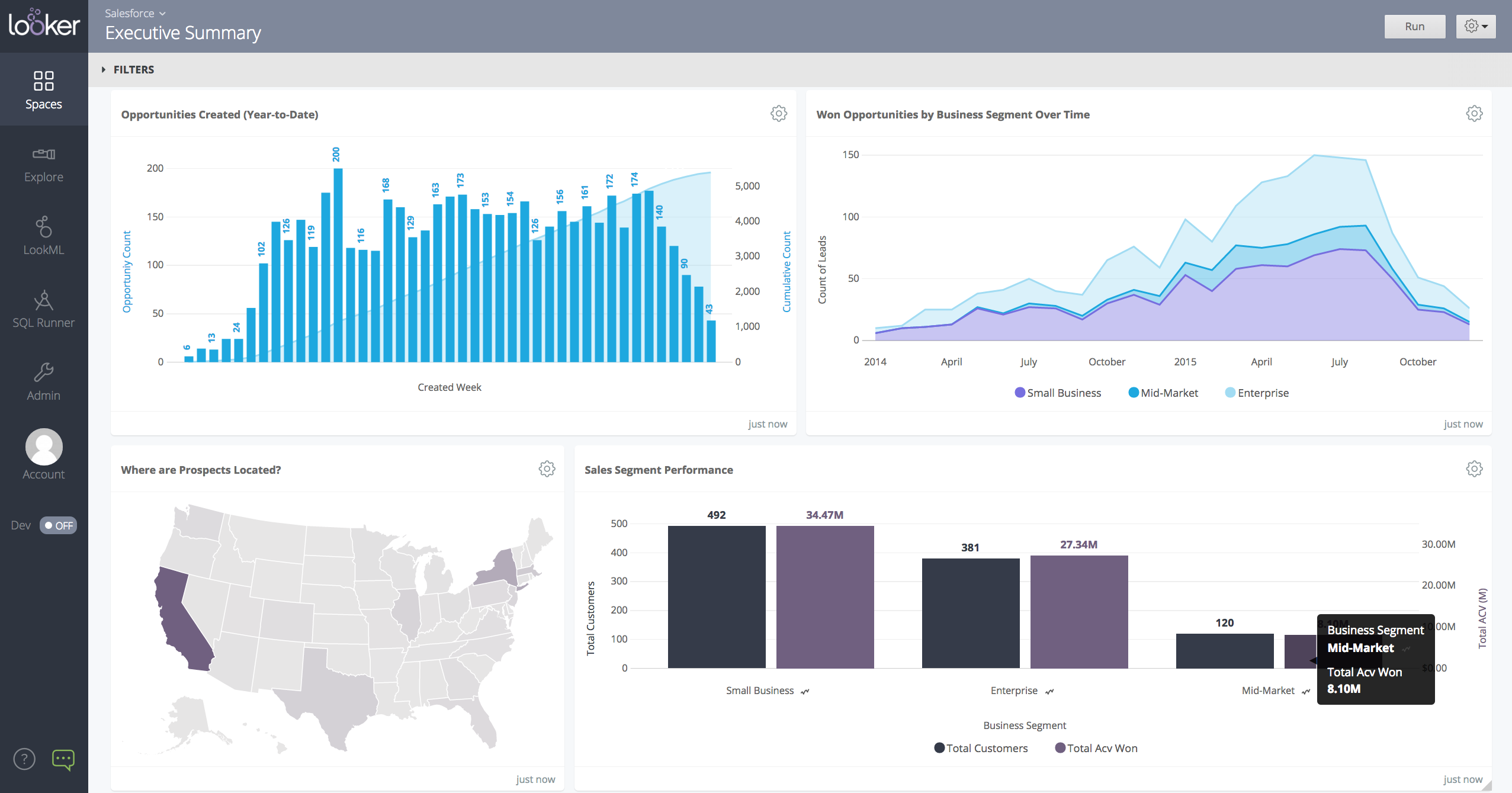
Looker is a BI application with an analytics-oriented application server that sits on top of relational data stores. It includes an end-user interface for exploring data, a reusable development paradigm for data discovery, and an API for supporting data in other systems.
N/A
Shiny
Score 8.0 out of 10
N/A
Shiny allows users to create data visualization apps, and is designed to be easy to write with. These apps let users interact with data and analyses with R or Python.
Looker was the most customizable option for our business and cost wise made the most sense. They do have a free tier option that some of the other weren't offering to us at the time. Looker has a great- mobile app solution while tableau is a desktop-based platform. Tableau also …
The biggest advantage that Looker Studio has is that it's really easy to use and to distribute to other use. You can have a really complex report set up in a couple of minutes with an extract data source that enables Looker to update really fast.
Looker is less complex to use and links directly to google suite which we use across the business and personally think is a better user experience than microsoft.
We have not used any other products; we've only ever needed to use Looker Studio and didn't need to demo anything else because it provided everything we needed.
Looker stacks up well against other data providers for usability and friendly interfaces, plus the ability to customise. We actually integrate Looker with other analytics tools in the same sphere (power bi, dreamdata and others) so that we can have one comprehensive dashboard …
In my opinion, Looker is no Power BI. It is good, but I think Power BI is amazing. That said, in my experience, Power BI is nowhere near as easy to setup and report on Google services as Looker is. We plan to continue using Power BI for c-suite and corporate reporting, …
Looker is a free and easier analytics and dashboard tool. It provides enough data and features to get things done and analyze marketing data. The other tools have more advanced features and are more suited for other things besides marketing.
Tableau provides additional visual functionality and is great for more in-depth visuals or further data exploration, but it is costly and an extremely robust solution for simple data reporting. Looker can't be beat when it comes to integrating with other G-Suite tools. All in …
Looker is a lot less overwhelming and lets you take the data that you have in Google analytics to make it understandable, focused and specific to the audience that is viewing the content. I haven’t used any other tools, but feel because of the ease of accessibility and cost, …
I prefer agency analytics as it has a lot more agnostic integration options and is much speedier but does come at a cost. I would recommend this over Looker studio for sure. It has great templates to use too and allows for more customisation and racing benchmarks which is a …
We'll still use Semrush's reporting for some clients - depending on the metrics which are important for them and whether they have an interest in live reporting or simply monthly PDF reports.
If you company is using Google suite products, Looker is a no-brainer. Tableau is probably the most flexibly but as a result it has the least governance capabilities. Power BI is kind of old-school in terms of how it feels to use it. I think in general, Looker brings a lot of …
Better in terms of data configuration with slight harder learning curve, available help material is not that much and we usually have to connect with Looker Help with chat for our data and analysis questions. While Looker offers a wide range of visualization options, there were …
Looker Studio, you can easily report on data from various sources without programming. Looker Studio is available at no charge for creators and report viewers. Enterprise customers who upgrade to Looker Studio Pro will receive support and expanded administrative features, …
It takes forever sometimes to have data ready in tableau dashboard, and also it takes effort to maintain each dashboards. We do not have so many efforts to maintain all. Also, we need to be able to see data faster and therefore take actions and work faster. With Looker we might …
Looker gives you options to integrate external APIs with great ease. Our data analytics team is able to easily use multiple data sources as input to the Looker dashboard, and everything is consolidated in one single Dashboard. You also have an option for Shared folders to be …
I chose Looker because can incorporate multiple sources, mostly which are Google owned. The data can sync automatically, and the graphs are visually appealing.
Looker Studio is not as robust as Tableau or Microsoft BI. So it does not provide quite as much insight or depth and it has more limitations overall then the other major reporting products. However, it is also free and connects perfectly with other Google products. Plus, all of …
Technically, Power BI is much more complete and powerful, but it's like an ocean liner. I didn't need all that equipment. In my case, I needed to move more quickly, like on a speedboat, to build a page with several data sources in a single source of truth that could be easily …
Looker is a free tool to use on the basic level, which can't really compare apples to apples since all of the other services are paid services. Looker already has a leg up because of that. The other platforms definitely have more features and capabilities off the bat because it …
Whilst dashboarding may be comparable with some of the other products we evaluated. Nothing compared to the analytical capabilities on offer with Shiny. An added advantage was that we had colleagues knowledgeable in R which meant bringing in Shiny and getting to grips with it …
Shiny is much cheaper to use than Tableau Desktop and Microsoft Power BI. It's not as fancy, and maybe not as effective, but you save lots of money by using Shiny over the previously listed alternatives. The graphs and charts you can make in Shiny are very good for …
Both Tableau and Power BI are easier to learn and allow you to develop dashboards in a faster and more intuitive way, but both have limitations in what you can do with them and if you want to do something more specific it is always more complicated. RStudio is much more …
Shiny can be a good tool in academic but its not upto standard of TMT industry but could possibly be useful in life science industry (which is where its more prevalent usually), its good as its mostly free (not including cost of servers and compute). I would rank its …
Shiny allows easy and fast development of a product into production whereas Jupyter Notebook can be broken really easily by a user. The idea of having a specific server that works with that model is very practical and it's a good advantage. In the contrary, the quantity of …
When data drives potential for new orders, Looker earns its place in our tech stack. If, on the other hand, we are hoping for pipeline generation, Looker is useful if you are willing to repeatedly go check customer utilizations .... it is not appropriate if you are hoping to automate data analysis for this purpose.
Shiny is very good for developing dashboards or web applications with specific functionalities. But it is not so easy to use to develop from scratch, it is always better to use another tool to have a general idea of what is expected of a dashboard and then develop the most specific functionalities in Shiny. It is much more flexible than other tools and that is why I consider it to be better for most cases, only that it is more complex to develop or has a longer learning curve.
We are very haooy with Looker, it provides us with all the funciomalities we need for both the day to day oerformance tracking and longer periods reporting. It is easy to use for account managers, configurable and customizable for soecialists and what is most imoortant, our clinets generally really love it
Looker is relatively easy to use, even as it is set up. The customers for the front-end only have issues with the initial setup for looker ml creations. Other "looks" are relatively easy to set up, depending on the ETL and the data which is coming into Looker on a regular basis.
Somehow resources heavy, both on server and client. I recommned at least 50Mbs data rate and high performance desktop comouter to be abke to run comolex tasks and configure larger amount of data. On the other hand, the client does not need to worry when viewing, the performance is usually ok
Never had to work with support for issues. Any questions we had, they would respond promptly and clearly. The one-time setup was easy, by reading documentation. If the feature is not supported, they will add a feature request. In this case, LDAP support was requested over OKTA. They are looking into it.
In my opinion, Looker is no Power BI. It is good, but I think Power BI is amazing. That said, in my experience, Power BI is nowhere near as easy to setup and report on Google services as Looker is. We plan to continue using Power BI for c-suite and corporate reporting, especially for internal databases, but will gladly use Looker for our marketing information for AdWords, Analytics, Search Console, and YouTube.
Whilst dashboarding may be comparable with some of the other products we evaluated. Nothing compared to the analytical capabilities on offer with Shiny. An added advantage was that we had colleagues knowledgeable in R which meant bringing in Shiny and getting to grips with it was a lot more seamless and welcomed by the end users.
Other than some people not liking the numbers, I don't see any negative impacts; we haven't experienced that.
The reports help us unravel the story of our users and how they are sifting through our pages.
Our clients enjoy seeing the numbers to understand better what stands out on their sites.
The reports have helped us see what campaigns are working and where we need to tweak things.
The reports have enabled us to have better conversations with stakeholders about how their web pages should be modified, edited, etc., to reflect the data.