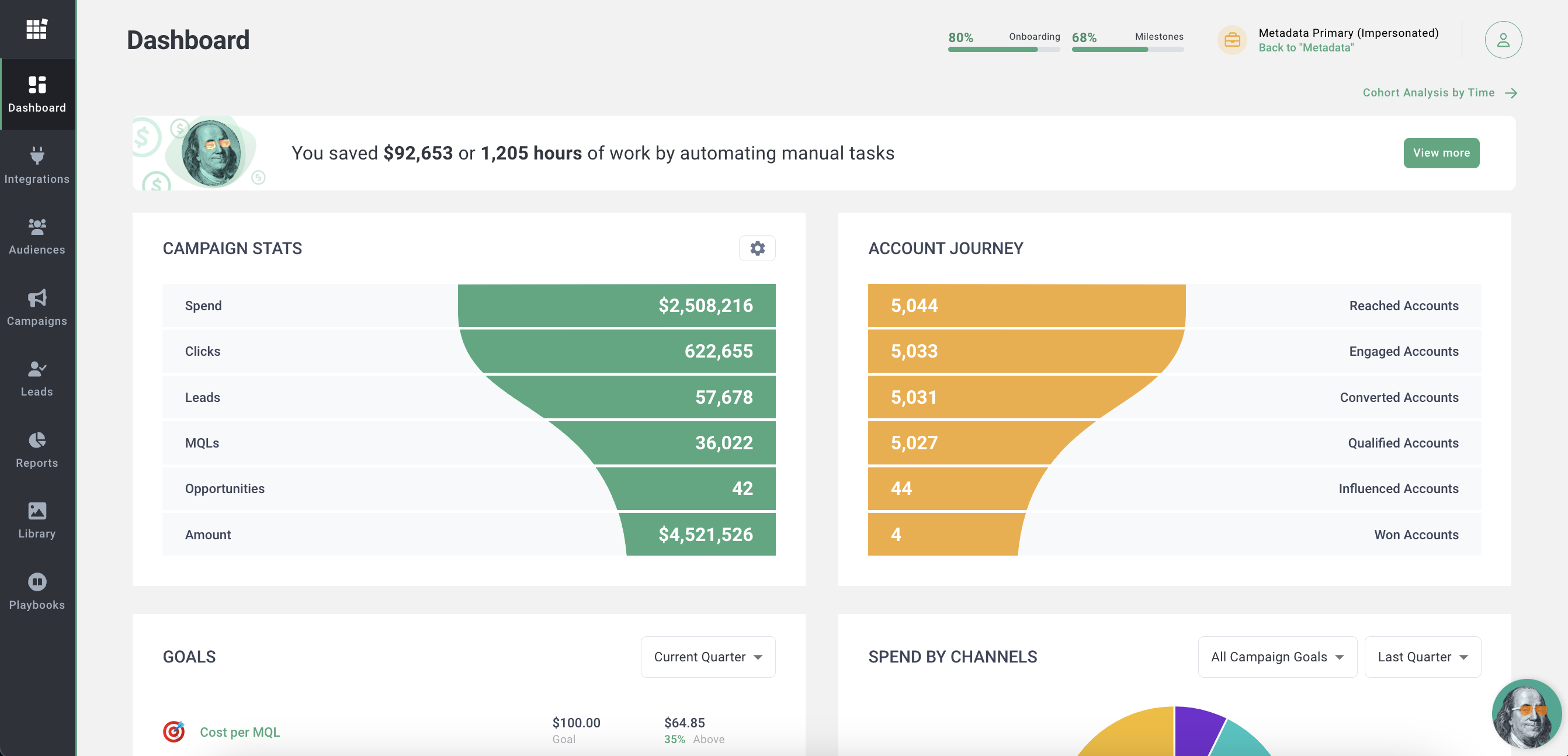
Based in San Francisco, Metadata.io is a Demand Generation and ABM platform designed to execute thousands of B2B campaigns in a matter of hours, automatically optimizing campaigns for pipeline impact at a high velocity.
$24,000
per year
Opal
Score9.1 out of 10
Enterprise companies (1,001+ employees)
Opal is a platform for brands, used to plan, create, and calendar their content - across teams and channels. Opal aims to enable tight alignment and high levels of efficiency. Marketing teams from companies such as Starbucks, Microsoft, and Target use Opal to collaborate, plan, and visualize, while ensuring an always-unified brand voice. Users can: Plan every facet of the brand experience, to ensure consistency throughout every moment and across every…
Metadata is well suited when you have a really large ad budget (>50k per month at least). This is because the power of metadata lies in the ability to quickly set up and run a large number of experiments (combinations of channel, audience, creative, and conversion assets). To evaluate these variations, all of them need a large number of impressions, clicks, and conversions to be statistically relevant. If your budget is smaller, you will either have a very small number of experiments (not fully utilizing the power of metadata), or your experiments will not have enough clicks to make informed decisions. We had expected a better explanation of this from metadata before signing up.
A de minimis incentive was given to thank the reviewer for their time. The incentive was not used to bias or drive a particular response, nor was the incentive contingent on a positive endorsement. More Info
I honestly cannot recommend this tool enough. Opal is such a valuable tool for brand content creators and there is nothing like it available. If you're serious about content marketing and have a need to find ways to collaborate, plan and provide more visibility among teams, then Opal really is the only way to go. One more thing that's not being mentioned: The tool is simply amazing but it's only as amazing is the team behind the tool. Their customer support and willingness to quickly be in touch when needed is a key feature within itself. Seriously, such a good team of people.
A de minimis incentive was given to thank the reviewer for their time. The incentive was not used to bias or drive a particular response, nor was the incentive contingent on a positive endorsement. More Info
A de minimis incentive was given to thank the reviewer for their time. The incentive was not used to bias or drive a particular response, nor was the incentive contingent on a positive endorsement. More Info
Content planning: you can look at one asset and see how it is being used across multiple channels by multiple teams.
Content collaboration: it is really easy to see what other people and teams are contributing to an asset, or how they are using it. We can also duplicate content that was created by another team to use as a starting point in our own content collaboration.
High level/big picture overview: Opal allows us to see content that is being created, planned and scheduled very easily; it goes beyond social content (which we can also see in Sprinklr) to show us content created across multiple channels.
A de minimis incentive was given to thank the reviewer for their time. The incentive was not used to bias or drive a particular response, nor was the incentive contingent on a positive endorsement. More Info
If you don't have a large budget and audience it's hard to meaningfully optimize. If I have 4 ad creatives, to 2 audience groups on FB and LinkedIn, that creates 16 experiments, each of which needs an ample enough budget, say $40/day, that's now $640 per day or $19K per month.
Limited ability to edit ads after they've been launched. You usually have to stop the ad, clone it, and launch a new campaign.
Can't add new ads to existing campaigns which limits the ability to optimize. If I start an MD campaign with 4 ads, and in a few weeks we see that one is working well and the other 2 are not performing, I can pause those (or it can autopause by rules), but I can't add 2 more new creatives to the mix against the high performer. I'd have to either stop the high performer, and recreate it in a new campaign (losing likes and comments), OR - leave the high performer in the first campaign, and create. a second campaign with the new ones, which will only optimize against each other.
Limited to a single conversion event on a landing page. I'm not able to choose either a Demo Request OR a Sign-Up conversion, I can only choose one.
Google search ads are doable but aren't necessarily more feature-rich or easy-to use than native, so there's no value added to doing it through Metadata in my opinion aside from unifying ad reporting.
A de minimis incentive was given to thank the reviewer for their time. The incentive was not used to bias or drive a particular response, nor was the incentive contingent on a positive endorsement. More Info
Requires someone to really manage the structure in order to keep the tool organized and use it effectively. When this is done right, though, it's worthwhile.
A de minimis incentive was given to thank the reviewer for their time. The incentive was not used to bias or drive a particular response, nor was the incentive contingent on a positive endorsement. More Info
A de minimis incentive was given to thank the reviewer for their time. The incentive was not used to bias or drive a particular response, nor was the incentive contingent on a positive endorsement. More Info
We chose [Metadata.io] because it was a smaller company and could get more personalized attention. The price was better and they seemed more eager to support us. The feature set was what we were looking for and not more - it was exactly as robust as we needed it to be. Didn't want to pay for features we weren't going to use.
A de minimis incentive was given to thank the reviewer for their time. The incentive was not used to bias or drive a particular response, nor was the incentive contingent on a positive endorsement. More Info
A de minimis incentive was given to thank the reviewer for their time. The incentive was not used to bias or drive a particular response, nor was the incentive contingent on a positive endorsement. More Info
Huge decrease in CPLs, CPMQL and Cost Per Opportunity
Big improvement in MQL to SQL rates
90%+ of our leads from paid social now have valid business emails, before it was like 30%
Saving us hundreds of hours over the course of the next year doing daily manual optimization and budget management tasks for us so we can focus on strategy and testing new things
A de minimis incentive was given to thank the reviewer for their time. The incentive was not used to bias or drive a particular response, nor was the incentive contingent on a positive endorsement. More Info
Opal allows for more discipline in marketing as teams are better aligned on messaging and big moments.
Opal cuts down on communication breakdowns and mistakes, which in the end leads to more happy customers.
I think Opal provides the team with more confidence as everyone is on the same page. With everything in one place rather than communications being lost in emails, etc., everyone is more efficient and can work knowing that there is one source of truth.
A de minimis incentive was given to thank the reviewer for their time. The incentive was not used to bias or drive a particular response, nor was the incentive contingent on a positive endorsement. More Info