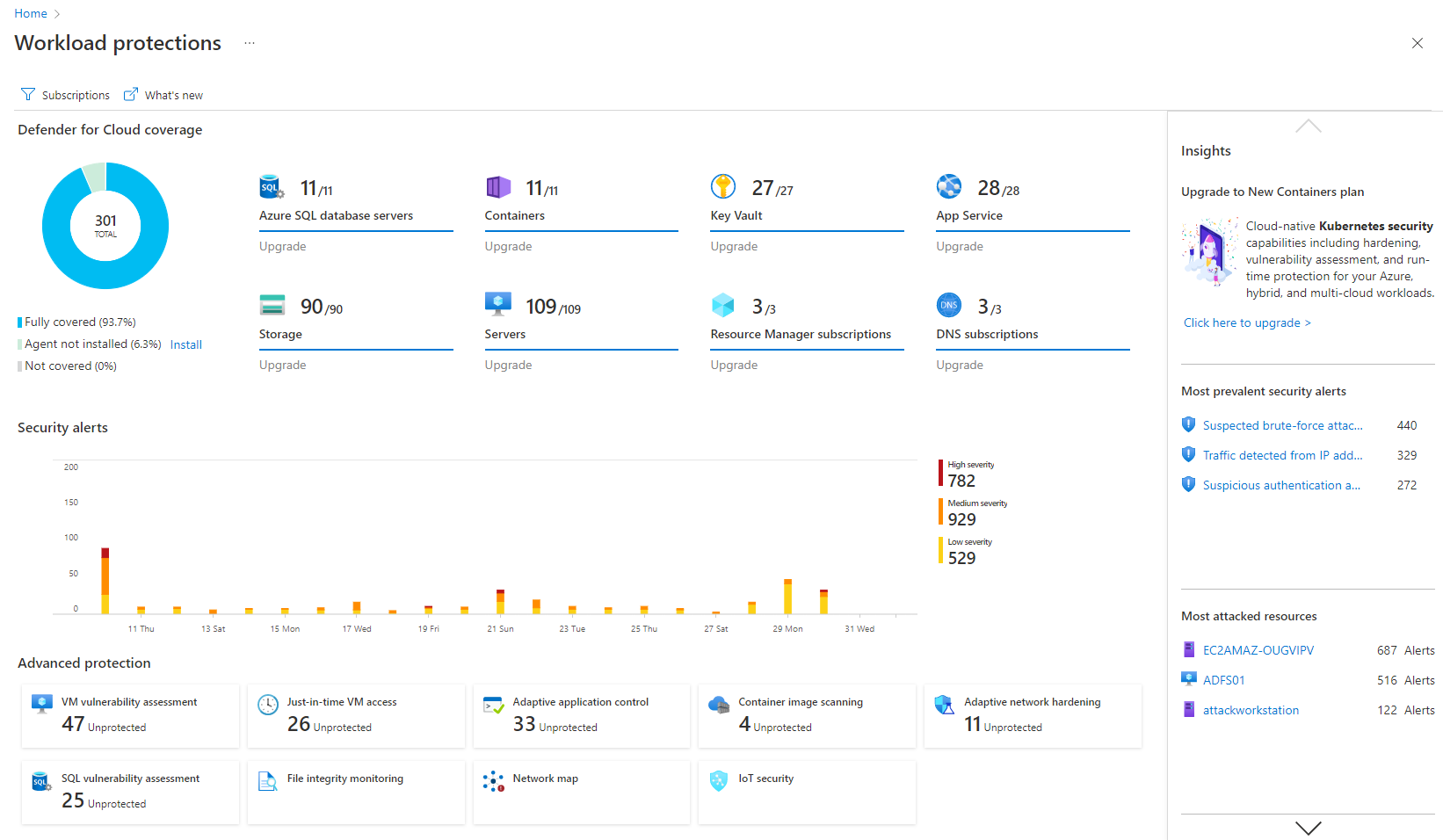
Microsoft Defender for Cloud is a Cloud Security Posture Management (CSPM) and Cloud Workload Protection Platform (CWPP) for Azure, on-premises, and multicloud (Amazon AWS and Google GCP) resources.
N/A
Red Hat OpenShift
Score 9.2 out of 10
N/A
OpenShift is Red Hat's Cloud Computing Platform as a Service (PaaS) offering. OpenShift is an application platform in the cloud where application developers and teams can build, test, deploy, and run their applications.
$0.08
per hour
Portainer
Score 9.0 out of 10
N/A
Portainer is a centralized container management platform for containerized apps and IoT device management. It helps accelerate container adoption and reduce time-to-value on Kubernetes, Docker, and Swarm with a management portal, allowing users to deliver and manage containerized applications from the data center to the edge. Portainer helps - Reduce the operational complexity associated with multi-cluster management Bridge the skills gap and facilitate feature…
Portainer is a user-friendly container management platform focused on Docker, providing a simplified graphical interface. Kubernetes (K8s) is a robust container orchestration platform that automates deployment and scaling, suitable for complex container environments. Docker is …
Portainer seems to be the best when you start with small environments and can grow with them. Portainer is also good for beginners with not too much knowledge about containers. Finally the start-up with 5 nodes for free was a great benefit.
Microsoft is well-suited with its definitive cloud, and I also like its Microsoft Intune ID. The conditional policies are great with that, and they're really good and well situated, so you can't beat them at that conditional policy level. Less appropriate, as I said, some of these low-hanging fruit features, like being good in phishing campaigns, and then I feel like maybe doing better at their seam products. So we'll see how that goes.
Red Hat OpenShift, despite its complexity and overhead, remains the most complete and enterprise-ready Kubernetes platform available. It excels in research projects like ours, where we need robust CI/CD, GPU scheduling, and tight integration with tools like Jupyter, OpenDataHub, and Quiskit. Its security, scalability, and operator ecosystem make it ideal for experimental and production-grade AI workloads. However, for simpler general hosting tasks—such as serving static websites or lightweight backend services—we find traditional VMs, Docker, or LXD more practical and resource-efficient. Red Hat OpenShift shines in complex, container-native workflows, but can be overkill for basic infrastructure needs.
Many developers, especially lesser experienced developers, don't have a really good background in setting up containers from the command line. Portainer is invaluable to them. Giving a UI to them gives them much more confidence and allows them to learn properties and capabilities of containers under far less stress. On the flip side of this, giving then a UI on a production system can lead to chaos...never give junior developers access to production servers.
We had a few microservices that dealt with notifications and alerts. We used OpenShift to deploy these microservices, which handle and deliver notifications using publish-subscribe models.
We had to expose an API to consumers via MTLS, which was implemented using Server secret integration in OpenShift. We were then able to deploy the APIs on OpenShift with API security.
We integrated Splunk with OpenShift to view the logs of our applications and gain real-time insights into usage, as well as provide high availability.
Separating server maintenance with application development, providing a clear user interface for developers who don't want to worry about the underlying server.
RBAC for container deployment linked to a SAML IDP, not something particularly easy in a native Docker instance but point and shoot in Portainer, allowing the use of Azure / Okta etc to provide user access.
Image management with multiple repositories is super clear and reduces incidents
Granular permissions and role-based access management could improve security. This would enable organizations to control who has access to and can set specific features.
While it offers integration with various Microsoft services, expanding support for third-party cloud platforms and applications would enhance its versatility. Many organizations use multiple cloud providers, and broader compatibility would be advantageous.
The cost structure could be more transparent, especially for larger organizations with extensive cloud resources. Clearer cost breakdowns and predictions would help organizations budget more effectively.
I wouldn't necessarily say there is look everyday technology transform. I can see a trend wherein Red Hat OpenShift is adopting all the new technology trends and helping their customers align with their priorities and the emerging technology trends. I wouldn't call out various scope for development every day. There is scope for development. It is all how the organizations adopt it and how they deliver it to their customers. I don't want to call out there is scope for development. It's happening. It is a never ending process.
At the moment, I don't have anything to call out. We are experiencing Red Hat OpenShift and we can see every day they're coming up with new features as and when they come up with new features, we want to experience it more and more. We are looking for opportunities wherein this can be leveraged to help our users and partners.
When setting up static IPs for a new container, having the used ones for a specific network at hand would be cool or something like a mini IPAM of some sort...
Using the developertools to see "oh, it's a 40x or 500" when something doesn't seem to load because the ui just states "Didn't work" is kinda annoying. expandable toasts or something would be nice.
It is a great product that integrates nicely when running an Azure platform and even multi-cloud environment. Not looking for point-solutions but a suite that answers most requirements. It is very comfortable being able to use KQL, workbooks and automation that is native to the azure platform
OpenShift is really easy of use through its management console. OpenShift gives a very large flexibility through many inbuilt functionalities, all gathered in the same place (it's a very convenient tool to learn DevOps technics hands on) OpenShift is an ideal integrated development / deployment platform for containers
My visibility is limited because I'm only doing very small pieces of what the overall org does. And also, we have limitations on what we're allowed to use. It's not like we get a new product as users or leadership level users, and everything is on, and we can just do whatever we want. We're very restricted in what we can use any tooling within the org because of the different levels of regulatory constraints we have, because of just the nature of who we are inherently. So that's why. I don't think it's necessarily the product. I think it's more or less of what we're able to do with the product.
The virtualization part takes some getting used to it you are coming from a more traditional hypervisor. Customization options are not intuitive to these users. The process should be more clear. Perhaps a guide to Openshift Virtualization for users of RHV, VMware, etc. would ease this transition into the new platform
Accessibility for Non-Experts: even with some people having a bit longer on-boarding it is still very simple Quick setup is insanely useful, we can get it running in 10 seconds after installing docker Portainer has once again super clean UI and is very user friendly. Deployment/monitoring and management are super easy. I can tell just from a glance if something is out of date (watching at you Watchtower not doing your job for some reason)
Redhat openshift is generally reliable and available platform, it ensures high availability for most the situations. in fact the product where we put openshift in a box, we ensure that the availability is also happening at node and network level and also at storage level, so some of the factors that are outside of Openshift realm are also working in HA manner.
Overall, this platform is beneficial. The only downsides we have encountered have been with pods that occasionally hang. This results in resources being dedicated to dead or zombie pods. Over time, these wasted resources occasionally cause us issues, and we have had difficulty monitoring these pods. However, this issue does not overshadow the benefits we get from Openshift.
Every time we need to get support all the Red Hat team move forward looking to solve the problem. Sometimes this was not easy and requires the scalation to product team, and we always get a response. Most of the minor issues were solved with the information from access.redhat.com
One of their staff members jumped on a video call immediately with me and led me through the problem and solution during a quick session of screen sharing. In this day and age that is above and beyond, especially when it comes to software. It took approximately 5-10 minutes to diagnose and fix, including pleasantries!
I was not involved in the in person training, so i can not answer this question, but the team in my org worked directly with Openshift and able to get the in person training done easily, i did not hear problem or complain in this space, so i hope things happen seamlessly without any issue.
We went thru the training material on RH webesite, i think its very descriptive and the handson lab sesssions are very useful. It would be good to create more short duration videos covering one single aspect of openshift, this wll keep the interest and also it breaks down the complexity to reasonable chunks.
Microsoft Defender for Cloud is definitely the choice with the latest market trend and attacks that are currently happening. Microsoft has been able to safe guard a lot after the recent serious attacks happening globally in the digital world. There is a trust in this software and with the latest updates and machine learning capabilities, Microsoft Defender for Cloud should be the choice.
The Tanzu Platform seemed overly complicated, and the frequent changes to the portfolio as well as the messaging made us uneasy. We also decided it would not be wise to tie our application platform to a specific infrastructure provider, as Tanzu cannot be deployed on anything other than vSphere. SUSE Rancher seemed good overall, but ultimately felt closer to a DIY approach versus the comprehensive package that Red Hat OpenShift provides.
Portainer takes the cup in terms of usability and features. It is also more useful for smaller deployments, whereas Kubernetes in our opinion and experience, could probably be more suited to certain other use cases. Portainer is also a fresh feel among all the preexisting container management solutions and brings positivity and a new breeze in the industry.
It's easy to understand what are being billed and what's included in each type of subscription. Same with the support (Std or Premium) you know exactly what to expect when you need to use it. The "core" unit approach on the subscription made really simple to scale and carry the workloads from one site to another.
This is a great platform to deployment container applications designed for multiple use cases. Its reasonably scalable platform, that can host multiple instances of applications, which can seamlessly handle the node and pod failure, if they are configured properly. There should be some scalability best practices guide would be very useful
It simplifies security management and saves time. I'm not sure, but I'm very confident it saved me a couple of paychecks by centralizing the data I need to secure the cloud environment.
I also utilize the inventory overview to monitor my team's activities and verify they are following internal regulations, as well as cost overruns.
The recommendations can be utilized as a valuable instructional tool. I have the team explain why they are receiving them, why they are not following them, and what they are doing differently.
All of the above. Red Hat OpenShift going into a developer-type setting can be stood up very quickly. There's a very short period to have developers onboard to it and they're able to become productive much faster than a grow your own type solution.
Increased productivity: Portainer's user-friendly interface and streamlined container management can help increase the productivity of IT teams.
Cost savings: By simplifying container management, Portainer can help reduce the time and resources required to manage container environments, potentially leading to cost savings.