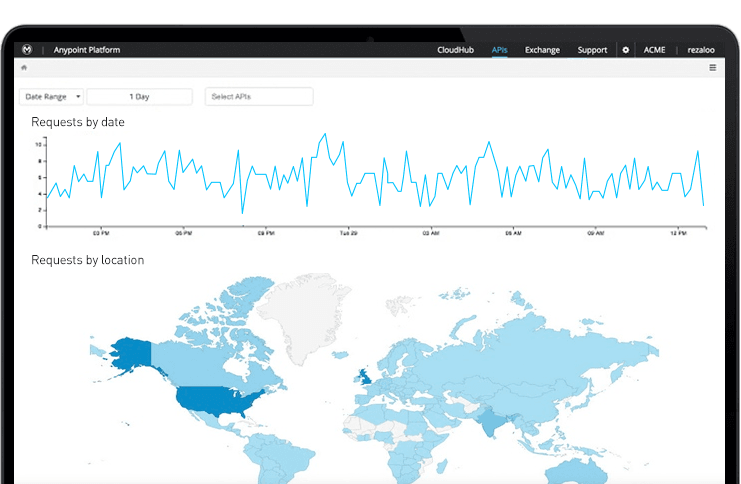
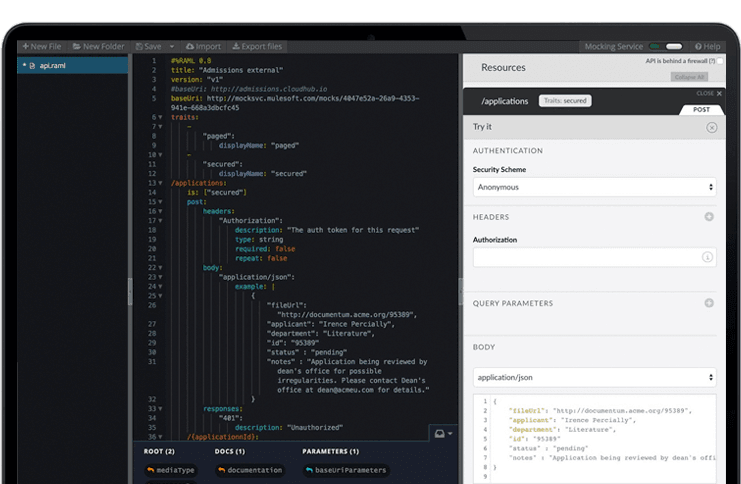
The Anypoint Platform developed by MuleSoft and acquired by Salesforce in early 2018 is designed to
connect apps, data, and devices anywhere, on-premises or in the cloud. This platform was built to
offer out-of-the-box connectors as well as tools that architects and developers can adopt quickly to
design, build and manage the entire lifecycle of their APIs, applications, and products.
N/A
UiPath Automation Platform
Score8.5 out of 10
N/A
UiPath's agentic platform combines the company's Robotic Process Automation (RPA) solution for automating repetitive tasks with agentic automation. By unifying agentic AI, automation, BPM, and process intelligence, the platform gives organizations control to design, run, and optimize new agentic processes.
MuleSoft Anypoint Platform is best tool in the market for developing APIs with complex structures communicating with various different types of applications including web applications as well as legacy applications. Also applications including database connectivity for fetching and updating data in the DB tables. I cant think of any scenario which MuleSoft Anypoint Platform could not be used for developing the integrations.
A de minimis incentive was given to thank the reviewer for their time. The incentive was not used to bias or drive a particular response, nor was the incentive contingent on a positive endorsement. More Info
UiPath Automation Platform is well-suited for automating repetitive and time-consuming tasks such as invoice processing, data entry, and report generation. By using UiPath Automation Platform, employees can focus on more strategic tasks, which leads to increased efficiency. Additionally, UiPath Automation Platform is highly effective at automating rule-based processes, such as financial processes like bank statement reconciliation, account payable, and account receivable processes that follow a set of predetermined rules.
A de minimis incentive was given to thank the reviewer for their time. The incentive was not used to bias or drive a particular response, nor was the incentive contingent on a positive endorsement. More Info
Any type of application can be automated (Desktop Application, Web Application and also applications reachable only via remote technologies such as Citrix, Remote Desktop and so on).
The writing of a process code takes place entirely through the use of objects. In the event that there were no objects capable of solving a particular problem, it is possible to use some languages of the .net platform such as: VB.net, C#.
It is easy to scale the solution by adding more robots to run a process in case the solution requires more performance in the future.
It can also be used by functional analysts to design the flow to be automated.
An academy is available online where basic and advanced courses can be taken. It is also possible to take a completely free basic certification.
A de minimis incentive was given to thank the reviewer for their time. The incentive was not used to bias or drive a particular response, nor was the incentive contingent on a positive endorsement. More Info
Has more features than what we really need so we're paying for more than we use. Sort of like paying for an Abrams tank when all we really need is a Toyota Corolla.
Not a value product, tends to be expensive.
Takes a while for developers to learn to use Mulesoft Anypoint.
A de minimis incentive was given to thank the reviewer for their time. The incentive was not used to bias or drive a particular response, nor was the incentive contingent on a positive endorsement. More Info
As I mentioned, Excel automation is not very effective, there are a number of packages to add, but there is nothing as smooth as a good macro.
Working with selectors is certainly challenging and UiPath does a good job with that, but there is room for improvement since the interface could be smarter in selecting the right attributes and warn the user if something is not properly setup.
A de minimis incentive was given to thank the reviewer for their time. The incentive was not used to bias or drive a particular response, nor was the incentive contingent on a positive endorsement. More Info
This platform has so much potential and have been garnering a lot of attention by proving benefits in terms of saving operational and manpower costs. I am sure with minute efforts we were able to achieve our ROI and the same is the case with many of our customers whom we have been working around Digital Automation initiatives.
A de minimis incentive was given to thank the reviewer for their time. The incentive was not used to bias or drive a particular response, nor was the incentive contingent on a positive endorsement. TR verified that a representative sample of customers was invited. More Info
We have migrated our existing over 100+ APIs from legacy to MuleSoft Anypoint Platform and the processing has seen over 40% improvement and saved huge amount in overall annual billing. From development perspective, MuleSoft Vibe has made developers life so easy and reduced development time. Extensive logging, and build-in connectors for other integration tools, logging and repo is providing kind of one place solutions. Any point Platform is providing various options like runtime, API manager, Access management, segregation of Business groups and so many other option which is helping us to monitor, configure and manage all our APIs in one place
There are two main reasons with this rating 1. UiPath Automation Platform requires the old school type of Change Weather management, Which actually eats a lot of time to manage and roll out the recent changes. There is not something kind of CI/CD when you are developing the things With UiPath Automation Platform. 2. Very high development and maintenance cost, which actually decrease its usability.
A de minimis incentive was given to thank the reviewer for their time. The incentive was not used to bias or drive a particular response, nor was the incentive contingent on a positive endorsement. More Info
A de minimis incentive was given to thank the reviewer for their time. The incentive was not used to bias or drive a particular response, nor was the incentive contingent on a positive endorsement. More Info
A de minimis incentive was given to thank the reviewer for their time. The incentive was not used to bias or drive a particular response, nor was the incentive contingent on a positive endorsement. More Info
Anypoint Platform support is very responsive. There is also a huge knowledge base and an active online forum where answers to most questions can be found. When needed support engages the engineering group so adequate solutions or workarounds are always provided.
A de minimis incentive was given to thank the reviewer for their time. The incentive was not used to bias or drive a particular response, nor was the incentive contingent on a positive endorsement. More Info
UiPath RPA has an exceptional studio interface. It has been a year and so since I am using UiPath RPA. Whether it is some my personal task to scrape information & links from the Journal or find a specific character string from multiple PDF collection using OCR, UiPath RPA has made its roots to our technological ecosystem
A de minimis incentive was given to thank the reviewer for their time. The incentive was not used to bias or drive a particular response, nor was the incentive contingent on a positive endorsement. More Info
I have started with MuleSoft Fundamentals course provided by MuleSoft training at start. This was sufficient to do initial learning and get onboarded. The online documentation with different Runtime versions/deprecated functions and keywords are well documented. The automated solution provided by MuleSoft Anypoint Platform to upgrade 3.0 to 4.0 gave a good head start while learning MuleSoft Anypoint Platform and working altogether with Online training and documentations
Video material supported by text. The training has evolved a lot in the past 3 years to become more attractive. Specific training tracks exist for the different roles in RPA development, where everyone is expected to learn basic development.
A de minimis incentive was given to thank the reviewer for their time. The incentive was not used to bias or drive a particular response, nor was the incentive contingent on a positive endorsement. More Info
A de minimis incentive was given to thank the reviewer for their time. The incentive was not used to bias or drive a particular response, nor was the incentive contingent on a positive endorsement. More Info
Once we have moved all of our system integration APIs to the MuleSoft Anypoint Platform, we will need to communicate with a wide variety of external systems. All of our business and service logic is stored in the aforementioned core systems. Anypoint Platform (and all of our APIs) makes it easy to connect to various other platforms. In order to link to these many other systems, connectors and/or components are utilized, and they are simple to configure and integrate.
A de minimis incentive was given to thank the reviewer for their time. The incentive was not used to bias or drive a particular response, nor was the incentive contingent on a positive endorsement. More Info
As compared to other products, we require programming knowledge and concepts to work but UiPath is for everyone. It provides us extensive event logging at various stages and effective exception handling for applications and business. It increases our agility and enhances the overall productivity further by using the source control SVC. The solution that we implemented is also very scalable in terms of incorporating new requirements.
The open source tools require lots of IT effort in order to set up and maintain over time. UiPath is like a complete package and customer service is also active in terms of solving issues arising while automating procession on a day to day basis.
A de minimis incentive was given to thank the reviewer for their time. The incentive was not used to bias or drive a particular response, nor was the incentive contingent on a positive endorsement. More Info
A de minimis incentive was given to thank the reviewer for their time. The incentive was not used to bias or drive a particular response, nor was the incentive contingent on a positive endorsement. More Info
A de minimis incentive was given to thank the reviewer for their time. The incentive was not used to bias or drive a particular response, nor was the incentive contingent on a positive endorsement. More Info