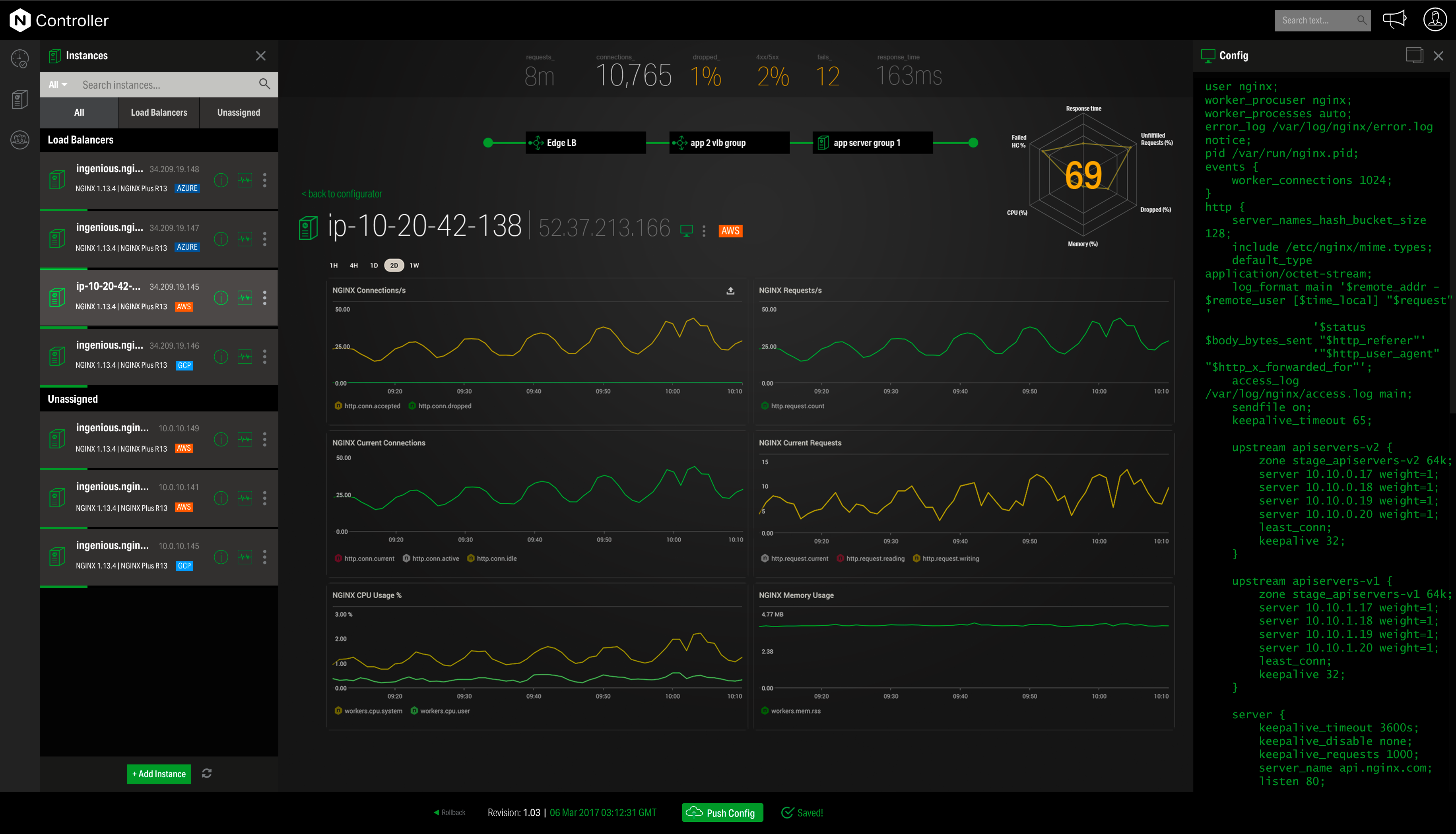
NGINX, a business unit of F5 Networks, powers over 65% of the world's busiest websites and web applications. NGINX started out as an open source web server and reverse proxy, built to be faster and more efficient than Apache. Over the years, NGINX has built a suite of infrastructure software products o tackle some of the biggest challenges in managing high-transaction applications. NGINX offers a suite of products to form the core of what organizations need to create…
N/A
Qlik Talend Cloud
Score8.5 out of 10
N/A
The Qlik Talend Cloud suite of solutions offer data integration, data quality, application integration, and data governance that work with key data sources, targets, architectures, or methodologies to ensure business users always have trusted and accurate data.
N/A
Talend Open Studio (discontinued)
Score9.7 out of 10
N/A
Talend Open Studio was an open source integration software, used to build basic data pipelines or execute simple ETL and data integration tasks. Qlik and Talend discontinued the service in early 2024, and it is no longer available.
Nginx is well-suited for any web server scenarios, such as web applications, backend or reverse proxy for both application and HTTP requests, and distribution. It is less appropriate for Windows-based applications that run directly on a Windows Server host. In any case, it is very easy to manage, through separate conf files for each application or site you want to host with it.
A de minimis incentive was given to thank the reviewer for their time. The incentive was not used to bias or drive a particular response, nor was the incentive contingent on a positive endorsement. TR verified that a representative sample of customers was invited. More Info
This tool fits all kinds of organizations and helps to integrate data between many applications. We can use this tool as data integration is a key feature for all organizations. It is also available in the cloud, which makes the integration more seamless. The firm can opt for the required tools when there are no data integration needs.
A de minimis incentive was given to thank the reviewer for their time. The incentive was not used to bias or drive a particular response, nor was the incentive contingent on a positive endorsement. More Info
For quick daily integrations Talend is a very good tool and it makes development time so short and easy. Citizen developers who are not great programmers can pick up and start using Talend Open Studio within weeks. It's well suited for all kinds of data migration between various systems. It is less appropriate for smaller synchronous services where you need to trace the complete transaction and how data moved between them. It's also less appropriate for small data movements where other tools can be easier to use and manage.
A de minimis incentive was given to thank the reviewer for their time. The incentive was not used to bias or drive a particular response, nor was the incentive contingent on a positive endorsement. More Info
A de minimis incentive was given to thank the reviewer for their time. The incentive was not used to bias or drive a particular response, nor was the incentive contingent on a positive endorsement. More Info
Talend Data Integration allows us to quickly build data integrations without a tremendous amount of custom coding (some Java and JavaScript knowledge is still required).
I like the UI and it's very intuitive. Jobs are visual, allowing the team members to see the flow of the data, without having to read through the Java code that is generated.
A de minimis incentive was given to thank the reviewer for their time. The incentive was not used to bias or drive a particular response, nor was the incentive contingent on a positive endorsement. More Info
Customer support can be strangely condescending, perhaps it's a language issue?
I find it a little weird how the release versions used for Nginx+ aren't the same as for open source version. It can be very confusing to determine the cross-compatibility of modules, etc., because of this.
It seems like some (most?) modules on their own site are ancient and no longer supported, so their documentation in this area needs work.
It's difficult to navigate between nginx.com commercial site and customer support. They need to be integrated together.
I'd love to see more work done on nginx+ monitoring without requiring logging every request. I understand that many statistics can only be derived from logs, but plenty should work without that. Logging is not an option in many environments.
A de minimis incentive was given to thank the reviewer for their time. The incentive was not used to bias or drive a particular response, nor was the incentive contingent on a positive endorsement. More Info
The community is not that up to date and forum is not that great in response. Probably we should make people aware of the tool more on how to use and its implementations.
Talend crashes when transforming a lot of data (millions of rows).
Proper training documentation is a must for talend which is currently lagging. This will help users to learn more about Talend and use it effectively.
A de minimis incentive was given to thank the reviewer for their time. The incentive was not used to bias or drive a particular response, nor was the incentive contingent on a positive endorsement. More Info
A de minimis incentive was given to thank the reviewer for their time. The incentive was not used to bias or drive a particular response, nor was the incentive contingent on a positive endorsement. More Info
There is no licence requirement for Talend Open Studio. So, this is not relevant question. However, if you are asking whether we will use Talend in future. Yes. We will continue to use it. It's very powerful free tool which caters to all our extra, transform, load capabilities. We just love Talend for it's great functionality and ease of use.
A de minimis incentive was given to thank the reviewer for their time. The incentive was not used to bias or drive a particular response, nor was the incentive contingent on a positive endorsement. More Info
This tool is really easy to use and configure. Consumes very less system resources. It is highly modular and configurable. You can easily use it with other tools like certbot for SSLs. You can configure basic security with configuration and headers
A de minimis incentive was given to thank the reviewer for their time. The incentive was not used to bias or drive a particular response, nor was the incentive contingent on a positive endorsement. TR verified that a representative sample of customers was invited. More Info
We use Talend Data Integration day in and day out. It is the best and easiest tool to jump on to and use. We can build a basic integration super-fast. We could build basic integrations as fast as within the hour. It is also easy to build transformations and use Java to perform some operations.
A de minimis incentive was given to thank the reviewer for their time. The incentive was not used to bias or drive a particular response, nor was the incentive contingent on a positive endorsement. More Info
Talend Open Studio is based on Eclipse and is full of redundant procedures to do one thing, like when installing libraries. Sometimes I cannot manually download the libraries that it can't find.
Many times, Talend freezes. When you give a cancel command, it takes several minutes to stop. It also takes a great toll on our PC with 16 GB of ram and I7 CPU, even in idle status. If you are downloading Maven Jar/Libraries, you cannot do anything and have to wait until the task is finished.
Community support is great, and they've also had a presence at conferences. Overall, there is no shortage of documentation and community support. We're currently using it to serve up some WordPress sites, and configuring NGINX for this purpose is well documented.
A de minimis incentive was given to thank the reviewer for their time. The incentive was not used to bias or drive a particular response, nor was the incentive contingent on a positive endorsement. More Info
Good support, specially when it relates to PROD environment. The support team has access to the product development team. Things are internally escalated to development team if there is a bug encountered. This helps the customer to get quick fix or patch designed for problem exceptions. I have also seen support showing their willingness to help develop custom connector for a newly available cloud based big data solution
A de minimis incentive was given to thank the reviewer for their time. The incentive was not used to bias or drive a particular response, nor was the incentive contingent on a positive endorsement. More Info
Talend Open Studio is free and we are not using the enterprise version which comes with licence and support. So, mostly depend on the open source community for any issues that we face. The document is good and we didn't have to use any support so far. We did evaluate the enterprise version and so far sticking to the free version.
A de minimis incentive was given to thank the reviewer for their time. The incentive was not used to bias or drive a particular response, nor was the incentive contingent on a positive endorsement. More Info
I have found that [NGINX] seems to perform better throughout the years with less issues although I've used Apache more. I would definitely recommend [NGINX] for any high volume site and I've seen this to usually be the case from most provided web hosts who will pick [NGINX] over alternatives
A de minimis incentive was given to thank the reviewer for their time. The incentive was not used to bias or drive a particular response, nor was the incentive contingent on a positive endorsement. More Info
In comparison with the other ETLs I used, Talend is more flexible than Data Services (where you cannot create complex commands). It is similar to Datastage speaking about commands and interfaces. It is more user-friendly than ODI, which has a metadata point of view on its own, while Talend is more classic. It has both on-prem and cloud approaches, while Matillion is only cloud-based.
A de minimis incentive was given to thank the reviewer for their time. The incentive was not used to bias or drive a particular response, nor was the incentive contingent on a positive endorsement. More Info
Informatica has a limited number of components that you can use. This places a heavy limitation on the capabilities of Informatica. On the other hand, Talend allows you to create your own custom components using Java. For businesses that need to perform a wide variety of data operations, it can be quite useful to have the option of creating your own custom components to satisfy business needs.
A de minimis incentive was given to thank the reviewer for their time. The incentive was not used to bias or drive a particular response, nor was the incentive contingent on a positive endorsement. More Info
By using Nginx, we can host multiple web services on a single server, keeping our infrastructure costs lower.
Nginx maintains our HTTPS connections, allowing us to keep our promise to our customers that their data is safe in transit.
Due to Nginx's extremely low failure rate, our web addresses always return something meaningful, even when individual services go down. In sense, this means we are "always online" and allows us to maintain brand and support our customers even in the face of catastrophe.
A de minimis incentive was given to thank the reviewer for their time. The incentive was not used to bias or drive a particular response, nor was the incentive contingent on a positive endorsement. More Info
It’s only been a positive RoI with Talend given we’ve interfaced large datasets between critical on-Prem and cloud-native apps to efficiently run our business operations.
A de minimis incentive was given to thank the reviewer for their time. The incentive was not used to bias or drive a particular response, nor was the incentive contingent on a positive endorsement. More Info
I delivered projects the client did not believe were possible, and I provided intermediate value by providing visibility to hidden data problems in their systems they could not detect before.
I was able to work 3 projects at a time, pausing gracefully in one while switching to the other, with minimal effort.
A de minimis incentive was given to thank the reviewer for their time. The incentive was not used to bias or drive a particular response, nor was the incentive contingent on a positive endorsement. More Info