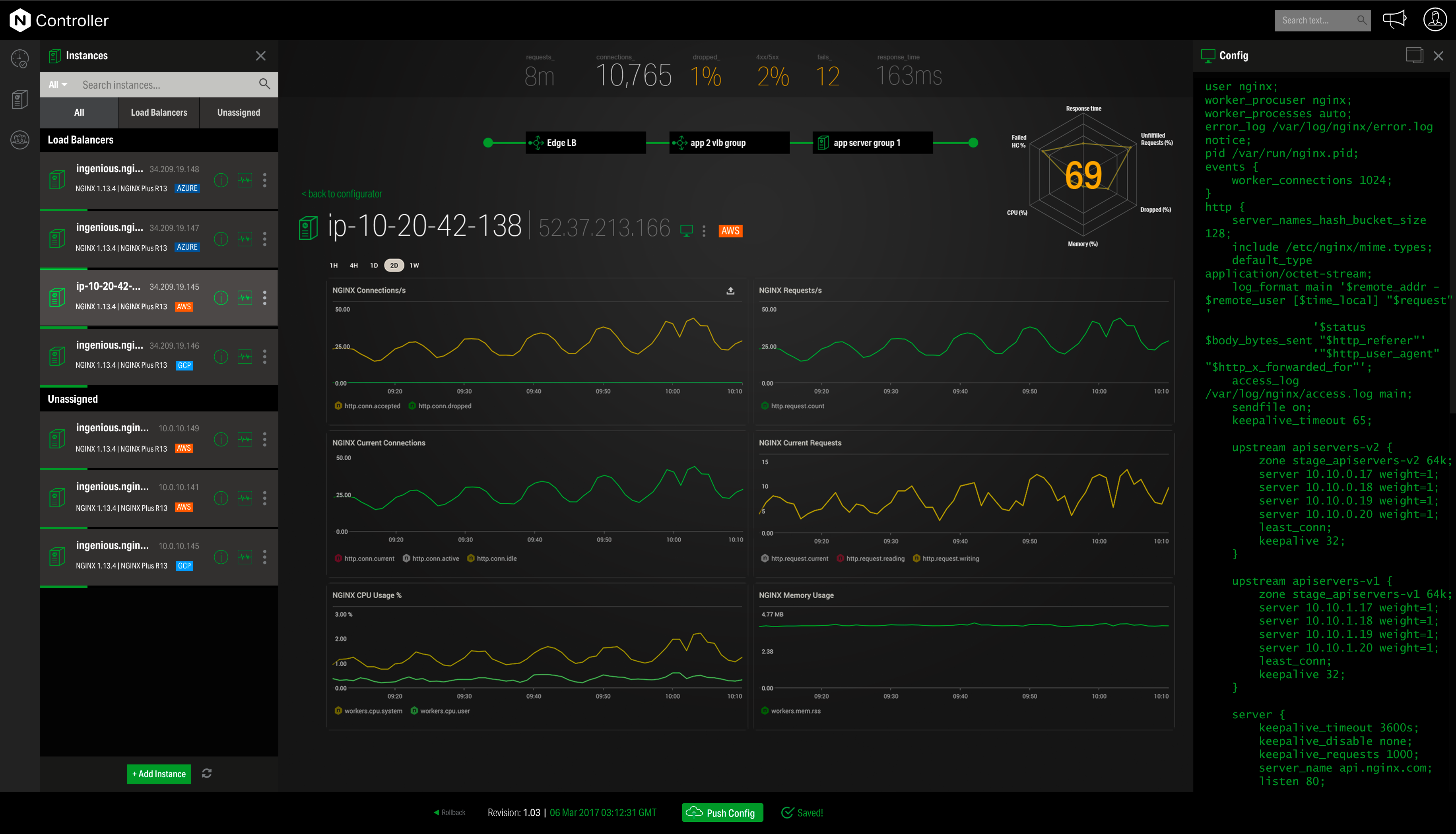
NGINX, a business unit of F5 Networks, powers over 65% of the world's busiest websites and web applications. NGINX started out as an open source web server and reverse proxy, built to be faster and more efficient than Apache. Over the years, NGINX has built a suite of infrastructure software products o tackle some of the biggest challenges in managing high-transaction applications. NGINX offers a suite of products to form the core of what organizations need to create…
N/A
SolarWinds IP Address Manager (IPAM)
Score7.6 out of 10
N/A
Austin-based SolarWinds offers Internet Protocal address management (IPAM) networking service.
N/A
Pricing
NGINX
SolarWinds IP Address Manager (IPAM)
Editions & Modules
No answers on this topic
No answers on this topic
Offerings
Pricing Offerings
NGINX
SolarWinds IP Address Manager (IPAM)
Free Trial
Yes
Yes
Free/Freemium Version
Yes
No
Premium Consulting/Integration Services
Yes
No
Entry-level Setup Fee
Optional
Optional
Additional Details
—
SolarWinds professional support is included to help customers on active maintenance 7 days a week, 365 days a year.
Nginx is well-suited for any web server scenarios, such as web applications, backend or reverse proxy for both application and HTTP requests, and distribution. It is less appropriate for Windows-based applications that run directly on a Windows Server host. In any case, it is very easy to manage, through separate conf files for each application or site you want to host with it.
A de minimis incentive was given to thank the reviewer for their time. The incentive was not used to bias or drive a particular response, nor was the incentive contingent on a positive endorsement. TR verified that a representative sample of customers was invited. More Info
SolarWinds IP Address Manager is very useful the bigger and more complex the environment. Smaller organizations will have to consider the cost as it provides little benefit over monitoring maybe 2-3 servers. But I have over 24 DHCP servers with on average 15 subnets each so tracking and monitoring all that was very time-consuming. As a result, it was generally ignored until there was an issue. With SolarWinds IP Address Manager, I was able to set alerts to monitor scope utilization and duplicate IP addresses.
A de minimis incentive was given to thank the reviewer for their time. The incentive was not used to bias or drive a particular response, nor was the incentive contingent on a positive endorsement. TR verified that a representative sample of customers was invited. More Info
A de minimis incentive was given to thank the reviewer for their time. The incentive was not used to bias or drive a particular response, nor was the incentive contingent on a positive endorsement. More Info
With IPAM automated address scanning, we can be confident that we are looking at an up-to-date, accurate snapshot of our network.
The built-in alerts are a great safety net. We know that even if we aren't paying close attention to our IP address space, IPAM is. If a range is nearly full, IPAM lets us know before it becomes a real problem.
IPAM's event logging gives us insight into any and all changes made by our network engineers.
A de minimis incentive was given to thank the reviewer for their time. The incentive was not used to bias or drive a particular response, nor was the incentive contingent on a positive endorsement. More Info
Customer support can be strangely condescending, perhaps it's a language issue?
I find it a little weird how the release versions used for Nginx+ aren't the same as for open source version. It can be very confusing to determine the cross-compatibility of modules, etc., because of this.
It seems like some (most?) modules on their own site are ancient and no longer supported, so their documentation in this area needs work.
It's difficult to navigate between nginx.com commercial site and customer support. They need to be integrated together.
I'd love to see more work done on nginx+ monitoring without requiring logging every request. I understand that many statistics can only be derived from logs, but plenty should work without that. Logging is not an option in many environments.
The user experience is not as intuitive as other products. We have to be more restrictive around level 1 help desk access compared to NCM or NPM in SolarWinds.
Making and enforcing changes, not just monitoring, has been hit or miss in some instances.
A de minimis incentive was given to thank the reviewer for their time. The incentive was not used to bias or drive a particular response, nor was the incentive contingent on a positive endorsement. More Info
A de minimis incentive was given to thank the reviewer for their time. The incentive was not used to bias or drive a particular response, nor was the incentive contingent on a positive endorsement. More Info
We are heavily invested in SolarWinds. We currently own Network Performance Monitor, Netflow Traffic Analyzer, User Device Tracker, Server Application Monitor and Network Configuration Manager. We have NOC mode setup for deskside support for monitoring any down devices that may effect our network across the globe. This application gives us the information we need when we need it.
A de minimis incentive was given to thank the reviewer for their time. The incentive was not used to bias or drive a particular response, nor was the incentive contingent on a positive endorsement. More Info
This tool is really easy to use and configure. Consumes very less system resources. It is highly modular and configurable. You can easily use it with other tools like certbot for SSLs. You can configure basic security with configuration and headers
A de minimis incentive was given to thank the reviewer for their time. The incentive was not used to bias or drive a particular response, nor was the incentive contingent on a positive endorsement. TR verified that a representative sample of customers was invited. More Info
SolarWinds IPAM is like what SolarWinds itself says, i.e. easy to use and simple. SolarWinds has really made their orion and non-orion platform products so simple that any newbie can give a try and make the best use out of it. I learned SolarWinds IPAM by myself in a POC environment, and not just IPAM but other modules and now I own 6 certifications. You see how easy to use this product is.
A de minimis incentive was given to thank the reviewer for their time. The incentive was not used to bias or drive a particular response, nor was the incentive contingent on a positive endorsement. More Info
A de minimis incentive was given to thank the reviewer for their time. The incentive was not used to bias or drive a particular response, nor was the incentive contingent on a positive endorsement. More Info
We do not integrate IPAM into other systems other than the standard Orion integration. The performance is reasonable, however, we are running all the SolarWinds applications on a very large server.
A de minimis incentive was given to thank the reviewer for their time. The incentive was not used to bias or drive a particular response, nor was the incentive contingent on a positive endorsement. TR verified that a representative sample of customers was invited. More Info
Community support is great, and they've also had a presence at conferences. Overall, there is no shortage of documentation and community support. We're currently using it to serve up some WordPress sites, and configuring NGINX for this purpose is well documented.
A de minimis incentive was given to thank the reviewer for their time. The incentive was not used to bias or drive a particular response, nor was the incentive contingent on a positive endorsement. More Info
I have not contacted customer support and therefore have no experience in this area. I know we have some issues with our VAR support at this time for Orion, but I don't know if the IPAM falls into the same support structure. Perhaps others in the organization may know more regarding the support area.
A de minimis incentive was given to thank the reviewer for their time. The incentive was not used to bias or drive a particular response, nor was the incentive contingent on a positive endorsement. More Info
I have found that [NGINX] seems to perform better throughout the years with less issues although I've used Apache more. I would definitely recommend [NGINX] for any high volume site and I've seen this to usually be the case from most provided web hosts who will pick [NGINX] over alternatives
A de minimis incentive was given to thank the reviewer for their time. The incentive was not used to bias or drive a particular response, nor was the incentive contingent on a positive endorsement. More Info
SolarWinds IP Address Manager was cheaper than both alternatives and far easier to manage. Device42 interface is years behind what Solarwinds offers. It is very outdated; BT Diamond required remote management and we constantly had to message support, it reached a point where it was better not to have the product at all.
A de minimis incentive was given to thank the reviewer for their time. The incentive was not used to bias or drive a particular response, nor was the incentive contingent on a positive endorsement. TR verified that a representative sample of customers was invited. More Info
We have not experienced any scalability issues with this product. However, SolarWinds needs to allow users to scale horizontally without any license restrictions. For example, we would like to separate Netflow and Orion onto different platforms but are unable to due to license restrictions.
A de minimis incentive was given to thank the reviewer for their time. The incentive was not used to bias or drive a particular response, nor was the incentive contingent on a positive endorsement. TR verified that a representative sample of customers was invited. More Info
By using Nginx, we can host multiple web services on a single server, keeping our infrastructure costs lower.
Nginx maintains our HTTPS connections, allowing us to keep our promise to our customers that their data is safe in transit.
Due to Nginx's extremely low failure rate, our web addresses always return something meaningful, even when individual services go down. In sense, this means we are "always online" and allows us to maintain brand and support our customers even in the face of catastrophe.
A de minimis incentive was given to thank the reviewer for their time. The incentive was not used to bias or drive a particular response, nor was the incentive contingent on a positive endorsement. More Info
IPAM has saved countless hours of running scripts and gathering data to compile reports to plan re-subnetting globally.
IPAM has reduced helpdesk incidents by immediately spotting bad DNSR and IP conflicts.
IPAM has helped eliminate blocks on projects whereas there is not currently enough address space requiring major changes to accommodate more IP'ed servers, gear, etc.
A de minimis incentive was given to thank the reviewer for their time. The incentive was not used to bias or drive a particular response, nor was the incentive contingent on a positive endorsement. More Info