Optimizely Configured Commerce is a SaaS, headless, and composable e-commerce platform that helps manufacturers and distributors scale e-commerce growth using as much or as little out-of-the-box functionality as they prefer; saving organizations time to deploy meaningful buying experiences.
N/A
Spryker Cloud Commerce OS
Score6.4 out of 10
N/A
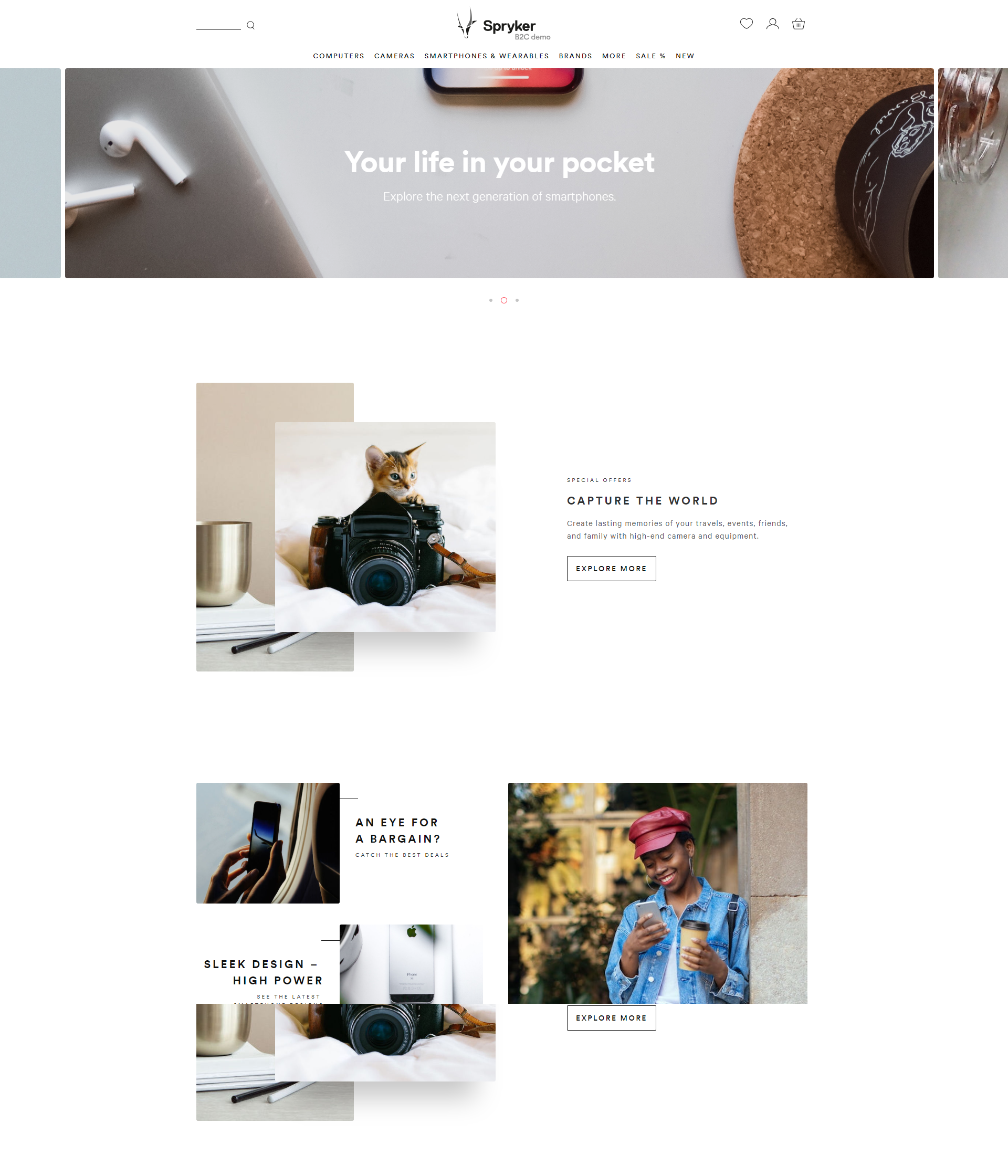
Spryker Cloud Commerce OS is a modular Commerce System that enables B2B, B2C, and Marketplace business models through any customer interface, touchpoint, and device. Boasting extensibility, best-in-class performance, and fast time-to-market, the vendor states Spryker is trusted by brands such as TOYOTA, HILTI, and TomTailor. The Spryker Cloud Commerce OS NOW version has been specifically developed for manufacturers and brands who want to reach customers directly online.
Pricing is based on the duration and terms of your contract with the vendor. This entitles you to a specified quantity of use for the contract duration. If you choose not to renew or replace your contract before it ends, access to these entitlements will expire.
The eCommerce catalog side has a lot of benefits to it and has been much easier to work with and customize than the CMS side. It is this integration and using both for a branded marketing website that has the user journey from browsing and leading into the eCommerce side that has been the bigger challenge, outside of the overall stability of the releases with the bugs we have encountered. I think the solution is well suited if you are mainly a catalog site. We, however, sell machinery and solutions that are not sold via the eCommerce site and we need to showcase them on the website. However, we have a core industrial catalog of consumable products that support the machine and solutions purchases which are very well suited for the eCommerce catalog. It is the CMS/Catalog integration that has caused a need for more customizations to the platform and as a result increased costs to maintain, lowering our overall ROI from the solution. We are also a bit hamstrung by having to rely on our development partner to make changes that our digital agency is better suited to do for us in the CMS. It is requiring extra cost and resources as a result. If more functionality could be surfaced, it would be much better.
A de minimis incentive was given to thank the reviewer for their time. The incentive was not used to bias or drive a particular response, nor was the incentive contingent on a positive endorsement. More Info
Spryker is very well suited (B2C and/or B2B) for big companies with complex and individual business models or also if your company needs a certain level of customization. Very good fit, if you need a scalable system. It is rather not the perfect fit for small companies or companies with very basic E-Commerce needs.
Integration Jobs/Connections - Providing a good out-of-the-box solution to hook into ERPs and common endpoints.
Design and Development Partner Network to work with - If you have customizations in mind, the Optimizely partner network will give you the chance to find a suitable partner to meet your needs.
Good layout/flow/settings breakdown - There are a lot of "redundant" settings, but the more management access, the better.
A de minimis incentive was given to thank the reviewer for their time. The incentive was not used to bias or drive a particular response, nor was the incentive contingent on a positive endorsement. More Info
A de minimis incentive was given to thank the reviewer for their time. The incentive was not used to bias or drive a particular response, nor was the incentive contingent on a positive endorsement. More Info
A de minimis incentive was given to thank the reviewer for their time. The incentive was not used to bias or drive a particular response, nor was the incentive contingent on a positive endorsement. TR verified that a representative sample of customers was invited. More Info
Content - content administration is not a strong part of Spryker, although it improved over the years. I still see room for improvement in the world of bigger CMS systems being able to also do "commerce".
Backoffice-usability - for non-technical users the first few days, weeks and month[s] can be full of surprises. An extended documentation, or more intuitive handling on the backoffice could serve every party on Spryker.
Off-the-shelf internationalization - Spryker right now comes with an initial data set in English and German, which is for a German based company already a pretty stable starting point. Extension on the base data for Europe-wide used countries would be very helpful - French, Italian, Polish, Russian, etc.
A de minimis incentive was given to thank the reviewer for their time. The incentive was not used to bias or drive a particular response, nor was the incentive contingent on a positive endorsement. More Info
Quite flexible and easy to use for daily marketing user tasks, like updating page listings, promotions, and copy. More in-depth tasks like managing product attributes, rearranging product taxonomy placement, and CMS editing are not user-friendly and require a careful and detailed process to follow.
A de minimis incentive was given to thank the reviewer for their time. The incentive was not used to bias or drive a particular response, nor was the incentive contingent on a positive endorsement. More Info
Spryker's usability depends a lot on custom development. Therefore, I would like not to consider usability as something that comes with Spryker Cloud Commerce OS. Spryker Cloud Commerce OS; however, brings all the tools needed to design a solution with great usability.
It's a mixed bag. The team has been very nice, but there has been an underlying feeling of condescension because we have complained or "caused trouble" over the inadequacy of the CMS component. Also, support for modifications or UI changes has been terribly slow. Understandably, COVID has made life hard for everyone, but there is an expectation that we complete our work immediately, but their team will "put it in queue" when we have a request or find a bug. Further, we certainly feel that we were sold a list of capabilities that we have not seen come to fruition. Finally, the change of ownership 3 times (Insite -> Epi -> Opti) over our implementation period has been both confusing and disruptive.
A de minimis incentive was given to thank the reviewer for their time. The incentive was not used to bias or drive a particular response, nor was the incentive contingent on a positive endorsement. TR verified that a representative sample of customers was invited. More Info
Support suffered from Spryker Cloud Commerce OS's rapid growth. Contacts, department heads, and support systems changed frequently. Support processes as well as documentation are rather poor. One notices that they are putting more effort into the customers recently, but in the course of growth, there is still a lack of focus here. As a customer, I would like to see growth at a slower pace and a phase of stabilization.
A de minimis incentive was given to thank the reviewer for their time. The incentive was not used to bias or drive a particular response, nor was the incentive contingent on a positive endorsement. More Info
I was not very involved with this process. It has been 3 years since we made a decision and I can't even remember the name of the other companies we were considering. I was in a different role then so I was less involved with the eCommerce department. I do remember really liking the people we were working with. That played a huge role in our selection since we would be working with them for years on the site.
A de minimis incentive was given to thank the reviewer for their time. The incentive was not used to bias or drive a particular response, nor was the incentive contingent on a positive endorsement. TR verified that a representative sample of customers was invited. More Info
If you compare Spryker with commerce solutions on the market, you will notice that the focus is not on the front end. Spryker assumes that the store is only one of many possible channels through which customers order today and in the future. To understand the differences, one must therefore take a look at Spryker's architecture. This is divided into the Spryker [Cloud] Commerce OS (the backend with all process-related components), the front-end modules for B2C and B2B, as well as the integration modules (middleware) and interfaces (Glue API).
Automation of updates and integration with ERP has saved time and provides reliable data for the website in sync with ERP
Integration with external PIM has saved time and provides reliable sync with content data for the website. Changes and improvements have been slow and difficult.
A de minimis incentive was given to thank the reviewer for their time. The incentive was not used to bias or drive a particular response, nor was the incentive contingent on a positive endorsement. TR verified that a representative sample of customers was invited. More Info
Extending the reach and visibility of the brand through content and commerce.
Increased customer satisfaction through better accessibility (self-service) and easy access to important product information (CAD data, technical documentation, etc.).
Rapid deployment thanks to packaged business capabilities and clear development leads to fast ROI and low TCO.
A de minimis incentive was given to thank the reviewer for their time. The incentive was not used to bias or drive a particular response, nor was the incentive contingent on a positive endorsement. More Info