Plone is a free and open source content management system built on top of the Zope application server. Plone can be used for any kind of website, including blogs, internet sites, webshops, and internal websites.
N/A
Spryker Cloud Commerce OS
Score6.4 out of 10
N/A
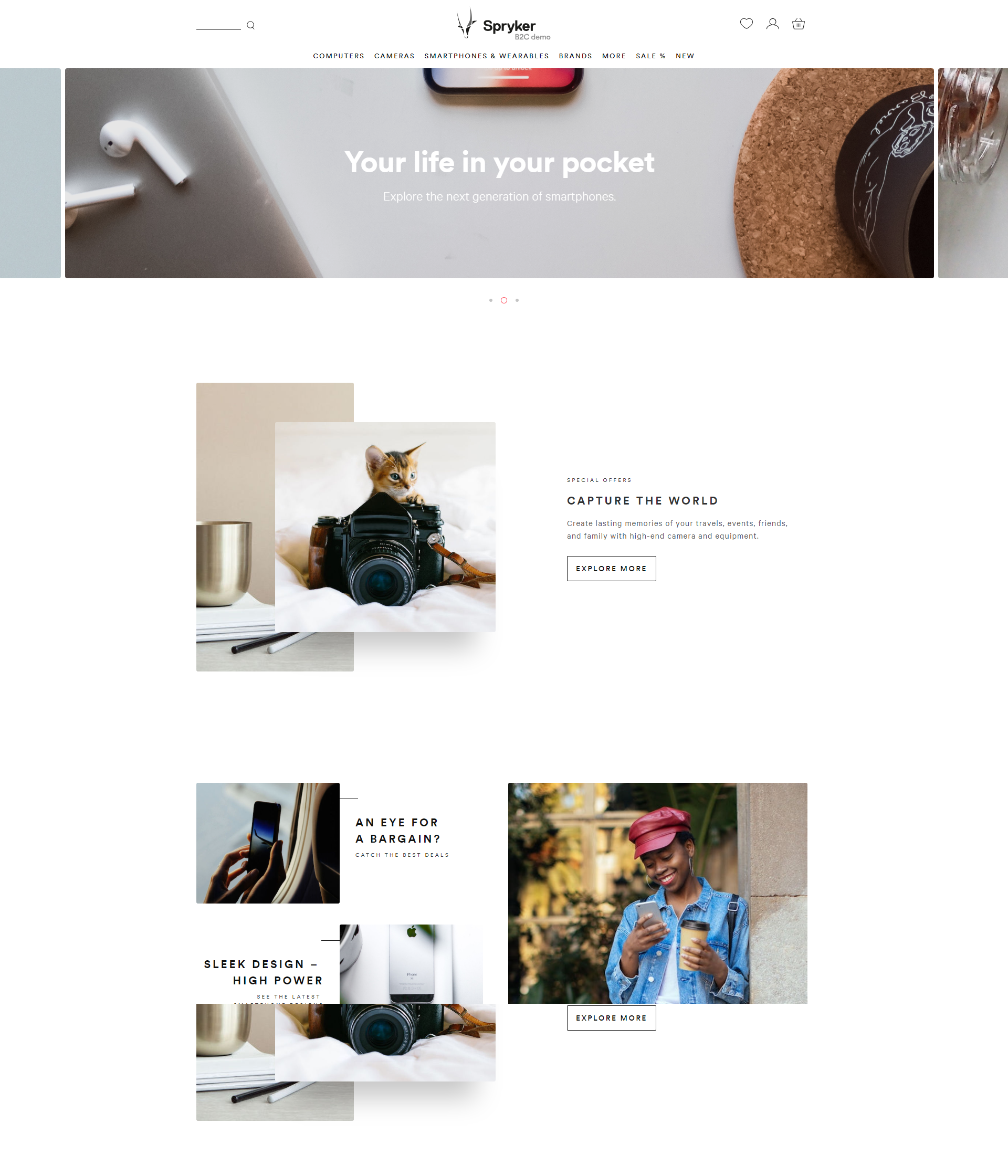
Spryker Cloud Commerce OS is a modular Commerce System that enables B2B, B2C, and Marketplace business models through any customer interface, touchpoint, and device. Boasting extensibility, best-in-class performance, and fast time-to-market, the vendor states Spryker is trusted by brands such as TOYOTA, HILTI, and TomTailor. The Spryker Cloud Commerce OS NOW version has been specifically developed for manufacturers and brands who want to reach customers directly online.
Pricing is based on the duration and terms of your contract with the vendor. This entitles you to a specified quantity of use for the contract duration. If you choose not to renew or replace your contract before it ends, access to these entitlements will expire.
The larger your organization, the more appropriate Plone will be. This is not to say that Plone is a worse choice for small websites, only that the minimum investment for a Plone site is certainly higher than for other platforms. If you already use Plone for your site and are looking for a redesign or an overhaul, I would only advise switching to a different platform such as WordPress or Drupal if your organization is downsizing. For any other situation, Plone is the natural choice for your growth.
Spryker is very well suited (B2C and/or B2B) for big companies with complex and individual business models or also if your company needs a certain level of customization. Very good fit, if you need a scalable system. It is rather not the perfect fit for small companies or companies with very basic E-Commerce needs.
Plone is a folder-based system, organising content in a similar way desktop-users are doing for the last two decades. No need to teach non-tech customers some relational-database like paradigm for content management.
Plone is secure. It is the most secure CMS you can get your hands on.
Plone is flexible, and makes fast development easy.
A de minimis incentive was given to thank the reviewer for their time. The incentive was not used to bias or drive a particular response, nor was the incentive contingent on a positive endorsement. More Info
Not everything is configurable or editable by Plone, and when you need to adjust or add custom pieces in, you need to deal with Zope. Zope has an ugly, confusing and difficult UI and structure as a backend.
Using 3rd party products is difficult to do - there are a few different ways to get them installed, all of which take a bit of luck to get right.
Building custom products for Plone is not fun. You've got to deal with an archaic framework to tie in that is not well documented (there is documentation about many things, but not great documentation and there are a lot of holes in the documentation).
Content - content administration is not a strong part of Spryker, although it improved over the years. I still see room for improvement in the world of bigger CMS systems being able to also do "commerce".
Backoffice-usability - for non-technical users the first few days, weeks and month[s] can be full of surprises. An extended documentation, or more intuitive handling on the backoffice could serve every party on Spryker.
Off-the-shelf internationalization - Spryker right now comes with an initial data set in English and German, which is for a German based company already a pretty stable starting point. Extension on the base data for Europe-wide used countries would be very helpful - French, Italian, Polish, Russian, etc.
A de minimis incentive was given to thank the reviewer for their time. The incentive was not used to bias or drive a particular response, nor was the incentive contingent on a positive endorsement. More Info
Compared to the amount of Plone sites, users and customizations we have in our organization, the amount of support requests and training needed is really small.
The new user interface in Plone 6 is even better, it is super fast, has lots of different blocks for enhancing the page, has flexible layout system and is easy to extend with more features.
Spryker's usability depends a lot on custom development. Therefore, I would like not to consider usability as something that comes with Spryker Cloud Commerce OS. Spryker Cloud Commerce OS; however, brings all the tools needed to design a solution with great usability.
Our Plone sites are very robust. We have critical systems on Plone and we have been running sites on Plone for over 20 years with very little unexpected downtime.
Plone is very intensive in its operations, and if not configured well it can be slow. However it is designed and built with speed in mind and with proper use of coding, templates and caching can perform extremely well under high loads. It is capable of scaling to very high load availability environments with no specific coding requirements.
Support suffered from Spryker Cloud Commerce OS's rapid growth. Contacts, department heads, and support systems changed frequently. Support processes as well as documentation are rather poor. One notices that they are putting more effort into the customers recently, but in the course of growth, there is still a lack of focus here. As a customer, I would like to see growth at a slower pace and a phase of stabilization.
A de minimis incentive was given to thank the reviewer for their time. The incentive was not used to bias or drive a particular response, nor was the incentive contingent on a positive endorsement. More Info
Drupal: Plone is cheaper, so with Drupal is more complex to reach the required ROI. However, Drupal has a lower learning curve WordPress: For our necessities it has a more expensive learning curve than plone. Joomla, is easier to use. However, it have some issues on security and web content where Plone is much better
A de minimis incentive was given to thank the reviewer for their time. The incentive was not used to bias or drive a particular response, nor was the incentive contingent on a positive endorsement. More Info
If you compare Spryker with commerce solutions on the market, you will notice that the focus is not on the front end. Spryker assumes that the store is only one of many possible channels through which customers order today and in the future. To understand the differences, one must therefore take a look at Spryker's architecture. This is divided into the Spryker [Cloud] Commerce OS (the backend with all process-related components), the front-end modules for B2C and B2B, as well as the integration modules (middleware) and interfaces (Glue API).
The impact Plone has had at the University of Oshkosh is as follows: this software allows student workers to learn about IT departments and CMS's in a user-friendly way. It gives many students great jobs that look great on their resumes.
Since there are great training manuals for Plone, there is increased employee efficient in the workplace. Training doesn't take long, and if there's ever a question, the Plone manual is a great tool to refer to.
If an employee using Plone quits, its easy to find someone to replace them with quick training and great resources.
Extending the reach and visibility of the brand through content and commerce.
Increased customer satisfaction through better accessibility (self-service) and easy access to important product information (CAD data, technical documentation, etc.).
Rapid deployment thanks to packaged business capabilities and clear development leads to fast ROI and low TCO.
A de minimis incentive was given to thank the reviewer for their time. The incentive was not used to bias or drive a particular response, nor was the incentive contingent on a positive endorsement. More Info