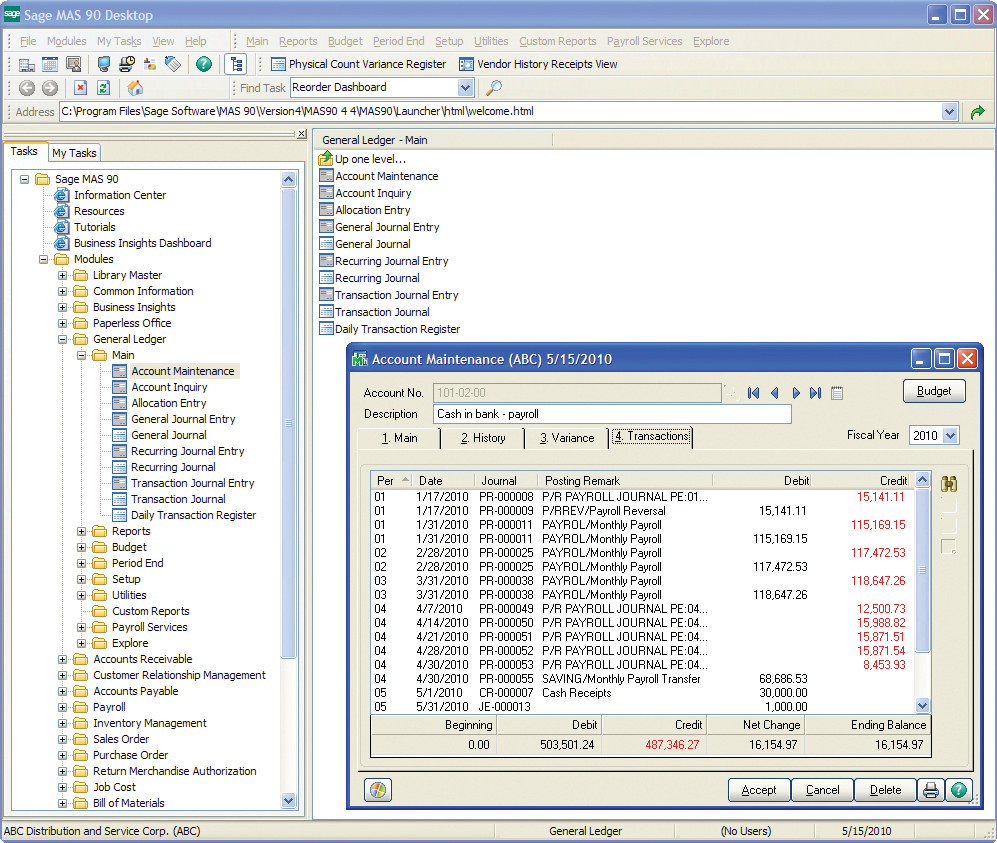
Sage 100 (or Sage 100cloud is a business management software offering a broad range of modules designed to meet the many needs of virtually any business. It encompasses financial operations and accounting, payroll, business intelligence, CRM, eBusiness, manufacturing and distribution.
N/A
Sage 50
Score7.7 out of 10
Small Businesses (1-50 employees)
Sage 50cloud Accounting (formerly Sage 50 Accounting) is accounting software designed for small businesses. Sage 50cloud Accounting (formerly Sage 50, and formerly Peachtree) lets businesses invoice customers, pay bills, manage inventory, control costs, and pay employees. The solution includes high-level dashboards and in-depth reports.
$61.92
per month per user
Pricing
Sage 100cloud
Sage 50
Editions & Modules
Sage 100 ERP Standard
Custom Pricing
Per Seat per Month
Sage 100 ERP Advanced
Custom Pricing
Per Seat per Month
Sage 100 ERP Premium
Custom Pricing
Per Seat per Month
Sage 100 ERP Online
$0
Per User per Month
Sage 50 Pro Accounting
$61.92
per month
Sage 50 Premium Accounting
$103.92
per month per user
Sage 50 Quantum Accounting 3 User
$177.17
per month per user
Offerings
Pricing Offerings
Sage 100cloud
Sage 50
Free Trial
No
Yes
Free/Freemium Version
No
No
Premium Consulting/Integration Services
No
Yes
Entry-level Setup Fee
No setup fee
No setup fee
Additional Details
—
Annual billing plans also available for all products.
More Pricing Information
Community Pulse
Sage 100cloud
Sage 50
Considered Both Products
Sage
Verified User
Chose Sage 100cloud
I didn't choose Sage 100 ERP -- it was already in use when I started at the organization over five years ago. It has the same types of pros and cons as other big hulking software suites meant to power the infrastructure of corporations. It's slow, tough to customize, and …
A de minimis incentive was given to thank the reviewer for their time. The incentive was not used to bias or drive a particular response, nor was the incentive contingent on a positive endorsement. More Info
Sage 100 ERP Consultant in Professional Services at CPA Technology, LLC (Computer Software, 1-10 employees)
Chose Sage 100cloud
All three products are very good, but at some point reach their limits and Sage 100 ERP becomes a very good, easy to use, cost effective solutions. It is also more secure than QuickBooks or Sage 50.
A de minimis incentive was given to thank the reviewer for their time. The incentive was not used to bias or drive a particular response, nor was the incentive contingent on a positive endorsement. More Info
Sage
Verified User
Chose Sage 50
I have used mainframe type programs with more bells and whistles than Sage 50. For what we do, that expensive software is a waste of money. Sage 50 is a solid program. I have used QuickBooks and they have online software that is an advantage. But it's not as good in ways an …
A de minimis incentive was given to thank the reviewer for their time. The incentive was not used to bias or drive a particular response, nor was the incentive contingent on a positive endorsement. More Info
Chief Financial Officer in Finance and Accounting at MD&E, Inc. dba: MD&E CLARITY (Accounting, 1-10 employees)
Chose Sage 50
Sage One and QuickBooks Online can only support a micro-business. Microsoft Dynamics is too hard to use. Sage 50 is just right. Sage 100 is the big brother for the larger business needing more depth in the modules.
Sage 100 has been well suited for running the monthly accounts receivable and accounts payable aging reports. This helps us track our accounts that need to be collected and payments that need to be made. Our field operations team has been slow and unwanting to adopt the Sage Field Ops just because they're resistant to change and technology. It's less appropriate for really detailed accounting reports spanning for long periods of time with all accounts because it takes a very long time to run and process.
A de minimis incentive was given to thank the reviewer for their time. The incentive was not used to bias or drive a particular response, nor was the incentive contingent on a positive endorsement. More Info
Sage 50 Accounts is well-suited for small to medium-sized enterprises, where there is a moderate number of expenses and invoices that need processing, typically by a company with a smaller finance team. Sage 50 is probably less suitable for a large organisation that needs to handle a higher volume of transactions and manage significant stock levels.
A de minimis incentive was given to thank the reviewer for their time. The incentive was not used to bias or drive a particular response, nor was the incentive contingent on a positive endorsement. More Info
A de minimis incentive was given to thank the reviewer for their time. The incentive was not used to bias or drive a particular response, nor was the incentive contingent on a positive endorsement. More Info
We can build "templates" for recurrent charges/invoices. This saves some time and also ensures that we always use the right accounting rubric.
A lot of additional information can be filled out such as client information (name, address, ...) which makes the software a little more complete.
If you don't need an updated version every year (my case) then the software is not too expensive. The pro version that I'm using was just a little over $300.
I really like the banking statement consolidation which allows you to ensure you got the right information registered.
A de minimis incentive was given to thank the reviewer for their time. The incentive was not used to bias or drive a particular response, nor was the incentive contingent on a positive endorsement. More Info
Sage 100 at times will simply not connect to our server, we get remote support & all is well but, that issue tends to happen 2-3X a year.
Other than the above, I really can't complain. Coming from a more custom U.V. type database that used a whole bunch of codes to navigate, I think Sage 100 is 10x easier to use.
A de minimis incentive was given to thank the reviewer for their time. The incentive was not used to bias or drive a particular response, nor was the incentive contingent on a positive endorsement. More Info
Sage 50 could use some improvement in the Invoicing Module to allow for more flexibility in the design of the Invoice fields. The report customization tools could use some upgrading for easier use.
Fixed assets management module needs to be included with unlimited number of fixed assets.
I would put this out to bid, if I were at the same organization. There have been a lot of improvements and changes in enterprise software and my preference would be to find a good web-based or cloud-based tool. Lower overall cost of ownership and improved efficiency would be my target criteria for a rebid of this.
A de minimis incentive was given to thank the reviewer for their time. The incentive was not used to bias or drive a particular response, nor was the incentive contingent on a positive endorsement. More Info
I use this rating simply because I have a thriving Sage 50 consulting practice and will continue to keep my expertise in the product. I have consulted on both Sage 50 and QuickBooks for over 25 years so I have to maintain expertise in the solution as well as accounting and verticals.
A de minimis incentive was given to thank the reviewer for their time. The incentive was not used to bias or drive a particular response, nor was the incentive contingent on a positive endorsement. More Info
Overall Sage 100 has been pretty user friendly. If we have a question on anything, we are able to contact our implementation rep who helps us right away. Some of the Sage Field Operations may not be as intuitive for our field personnel to use. I wish the reports ran faster so that we could run and put together many reports quickly at once.
A de minimis incentive was given to thank the reviewer for their time. The incentive was not used to bias or drive a particular response, nor was the incentive contingent on a positive endorsement. More Info
I think Sage 50 is a trusted product and is reliable from a product delivery and support perspective. They have deep domain expertise in the non-profit space and should be a consideration for new non-profit startups or existing non-profits looking to migrate from other platforms. Overall, I believe that Sage 50 does many things well with few limitations.
A de minimis incentive was given to thank the reviewer for their time. The incentive was not used to bias or drive a particular response, nor was the incentive contingent on a positive endorsement. More Info
A de minimis incentive was given to thank the reviewer for their time. The incentive was not used to bias or drive a particular response, nor was the incentive contingent on a positive endorsement. More Info
They were very knowledgeable of the product, understood my timeline was limited for a software issue and allowed me to get back to my day to day work. The dial into your computer is great so you can monitor what they are doing and learn some tricks yourself
We had an advantage in implementing the tool in that our director of Ops had been part of the team implementing the ERP for other users so we knew what to expect and were able to avoid a lot of the challenges people sometimes face with implementations. However, the process still took far longer than desired.
A de minimis incentive was given to thank the reviewer for their time. The incentive was not used to bias or drive a particular response, nor was the incentive contingent on a positive endorsement. More Info
We implemented Sage 50 Premium Accounting in house, not using any third party or professional service. It was a relatively trouble free process, but can be tricky. Just read all instructions carefully, especially if you need to load the program on a network with more than one user
A de minimis incentive was given to thank the reviewer for their time. The incentive was not used to bias or drive a particular response, nor was the incentive contingent on a positive endorsement. More Info
I didn't choose Sage 100 ERP -- it was already in use when I started at the organization over five years ago. It has the same types of pros and cons as other big hulking software suites meant to power the infrastructure of corporations. It's slow, tough to customize, and doesn't connect well with other software. It does bring all the information into one place, which is great
A de minimis incentive was given to thank the reviewer for their time. The incentive was not used to bias or drive a particular response, nor was the incentive contingent on a positive endorsement. More Info
As we did the conversion almost 10 years ago it is hard to answer this question. At the time it was the ease of being able to produce both cash and accrual financial statements and reporting that led us to pick Sage
A de minimis incentive was given to thank the reviewer for their time. The incentive was not used to bias or drive a particular response, nor was the incentive contingent on a positive endorsement. More Info
I define scalable from two perspectives; 1) the scalability to handle more bookkeepers/accountants using the product, and 2) the scalability to handle increasing customer/vendor/employee and transactional data. Sage 50 does a good job on both fronts. From the single users operating a micro-business accounting for customer invoices and bill payments only, to the multi-staff, multi-location, multi-departmental complex transactional operation. Although Sage 50 is quite expensive for that smallest user, it is quite inexpensive for the larger business entity. So, for the new enterprise expecting rapid growth, Sage 50 is the application of choice.
Sage 100 overall had a very positive overall ROI for the business. All users were making decisions based on the same information and valuable time was no longer spent trying to analyze data from a number of sources.
Moving the warehouses to using Sage 100 reduced the operating expense of the distribution side of the business by 5% on an annual basis (~$100K).
A de minimis incentive was given to thank the reviewer for their time. The incentive was not used to bias or drive a particular response, nor was the incentive contingent on a positive endorsement. More Info
Sage definitely needs to do a better job with customer service. I have had to use them only a handful of times and it was not a great experience but not the worse I've seen. They didn't make us a priority and I felt that they didn't have a sense of urgency. They did address my lack of satisfaction and I can see that they are at least aware of the issues and they are trying to correct them.
Sage is exactly what we need in my current organization and I wouldn't change it for another system. I have used quite a few in my lifetime and I would say that it fits our needs.