Shopify is a commerce platform designed for both online stores and retail locations. Shopify offers a professional online storefront, a payment solution to accept credit cards, and the Shopify POS application to power retail sales.
$39
per month
ShopKeep
Score7 out of 10
Small Businesses (1-50 employees)
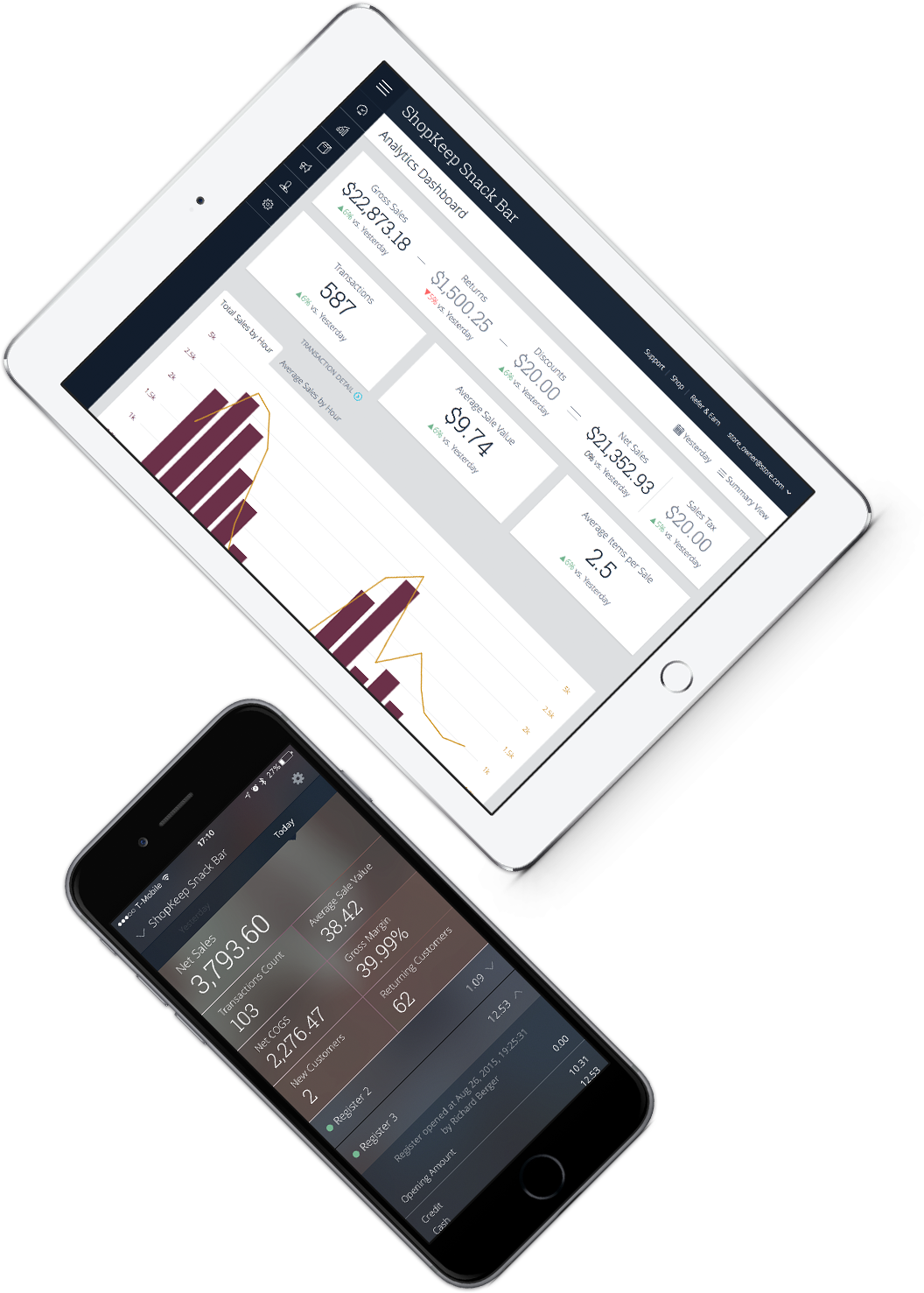
ShopKeep is an iPad point of sale system; The vendor says it is intuitive, secure, affordable software that helps merchants run smarter businesses. The product optimizes staffing and inventory, while offering sales reports and customer information on a cloud-based platform. The product includes low-cost, integrated payment processing, as well as point of sale hardware. According to the vendor, ShopKeep has 23,000 customers, and a customer…
Shopify allowed us to handle matrix items and combined listings. Both of which we could not do on our previous platform. There was some customization involved but overall, it did what we needed it to. The one downside was that if we want to change anything we would have to reload the entire set of matrix items manually.
A de minimis incentive was given to thank the reviewer for their time. The incentive was not used to bias or drive a particular response, nor was the incentive contingent on a positive endorsement. More Info
ShopKeep can maintain up to 10,000 individual stock items. This is perfect for a cafe, coffee shop, wine bar, small retail store, etc. If you're inventory exceeds the 10,000 items then it may not be a fit for you. Also, ShopKeep works with Apple tablets only (iPad 2 or later). If you prefer Android or PC based tablets then this won't work for you.
A de minimis incentive was given to thank the reviewer for their time. The incentive was not used to bias or drive a particular response, nor was the incentive contingent on a positive endorsement. More Info
It's base security and integration with trusted security partners (such as NoFraud) is a game-changer when it comes to reliability and a "hands off approach" for our IT department. The up-time is also very good.
It offers a wide range of verified plugins that are (for the most part) easy to install and use for any specific scenario you're looking for.
It's Analytics area in the admin is actually nice and offers a wide variety of reports that you can run.
A de minimis incentive was given to thank the reviewer for their time. The incentive was not used to bias or drive a particular response, nor was the incentive contingent on a positive endorsement. More Info
ShopKeep provides solid pre-sales support. They did a pre-sales screen-share demo that helped us ensure that their system would handle the needs of the business, and they assisted us in making decisions around which hardware would be appropriate.
ShopKeep's hardware seems well thought out and well integrated. One exception is issues with the connection between their recommended iCMP credit card scanner and the register. Other than that, the hardware works well together.
The register has excellent configurability and customization capabilities, and handles a large variety of products easily. High-volume products can have their own buttons on the register. Products can be added to a purchase by using these buttons, by scanning a bar code with an integrated bar code scanner, or by doing a live text search.
The register is also easily configurable to handle product options - either multiple options like pizza toppings, or exclusive options like regular or decaf coffee.
The ShopKeep system can handle hybrid retail/quick serve/restaurant scenarios with grace. This was a factor that eliminated many other systems that are optimized for one or the other, or where the products for handling retail are completely separate from the products for handling quick serve/restaurant operations. Since this customer has a location where there is a quick serve counter, a restaurant, and a retail gift shop all in the same location, ShopKeep's ability to handle all of these kinds of transactions from the same platform is a powerful advantage. ShopKeep also recently added functionality to transfer open tickets between registers, so that if a customer starts out with a cup of coffee at the quick serve counter, their ticket can be picked up and added to at the gift shop if they wander in there to purchase items.
ShopKeep has a Back Office system that can be accessed through any Web browser, or through their mobile app. The Back Office system is used to import and export data, manage inventory, configure the iPad registers, set up product options, manage employees, and report transactions, sales, product costs & margins, and other data.
Discounts, returns and credits are relatively easy to handle from the register, and the system can be configured to require a manager to approve these kinds of transactions, or not.
Bulk imports and exports are handled well by ShopKeep's Back Office. When setting up initial inventory, products can be added through Excel, then imported as comma-separated values (CSV) files by uploading them through the Web browser. Once inventory is established, adding or modifying items can be done directly through the Web interface.
ShopKeep has a mobile app that can be used by owners or managers to remotely access real-time snapshots of sales and other important data whenever they wish.
I would love it if Shopify built an in house app which helped us post UGCs and social proof from platforms such as Instagram, Youtube etc. more seamlessly on our website. Right now, we are able to do it through third party apps but the look and feel is just okay.
A de minimis incentive was given to thank the reviewer for their time. The incentive was not used to bias or drive a particular response, nor was the incentive contingent on a positive endorsement. More Info
A de minimis incentive was given to thank the reviewer for their time. The incentive was not used to bias or drive a particular response, nor was the incentive contingent on a positive endorsement. More Info
Nothing we have used in the past or have seen thus far even comes close to offering what we get with Shopify Plus, especially for the price. You cannot even come close to getting what we are getting at the price we pay. We are beyond thrilled and Shopify Plus meets and exceeds all of our needs and expectations. We love it!
A de minimis incentive was given to thank the reviewer for their time. The incentive was not used to bias or drive a particular response, nor was the incentive contingent on a positive endorsement. More Info
Because we expect the current issue with the credit card reader disconnecting from the register to be solved with an upcoming software update, and we like many of the features of Shopkeep.
It is fairly easy to use Shopify regardless of what task you are attempting to perform. Most things are customizable to a degree without requiring coding ability. I have very limited coding experience and have still been able to navigate my way around changing features of the website that require edits to the code with the use of AI and trial-and-error. This previously wasn't possible with the WooCommerce platform.
A de minimis incentive was given to thank the reviewer for their time. The incentive was not used to bias or drive a particular response, nor was the incentive contingent on a positive endorsement. More Info
The register functionality is excellent, both from a learning standpoint and an operations standpoint. Cashiers learn how to use the register quickly, and the registers can be configured with hot buttons for fast-moving products. Setting up product variations and additions is straightforward. The web-accessible Back Office has good features, but lacks enough granularity to provide a store manager with the ability to modify inventory settings without giving them access to all of the financial reports as well.
A de minimis incentive was given to thank the reviewer for their time. The incentive was not used to bias or drive a particular response, nor was the incentive contingent on a positive endorsement. More Info
A de minimis incentive was given to thank the reviewer for their time. The incentive was not used to bias or drive a particular response, nor was the incentive contingent on a positive endorsement. More Info
In terms of support I give Shopify a 9 out of 10 because they're always very friendly and thorough, and they personally can't solve my problem for me they always point me in the proper direction with the proper information I need to move forward
A de minimis incentive was given to thank the reviewer for their time. The incentive was not used to bias or drive a particular response, nor was the incentive contingent on a positive endorsement. More Info
Occasional long waits [5 minutes or more] or call-backs needed for telephone support. Email support replies usually take several hours. Support personnel are generally friendly and knowledgable.
Shopify offered us several trainings to setup a Shopify store, how to build a brand, SEO, product photography etc. All this content have been super helpful in our journey.
A de minimis incentive was given to thank the reviewer for their time. The incentive was not used to bias or drive a particular response, nor was the incentive contingent on a positive endorsement. More Info
A de minimis incentive was given to thank the reviewer for their time. The incentive was not used to bias or drive a particular response, nor was the incentive contingent on a positive endorsement. More Info
If moving from a "dumb" cash register system, spend all the time needed to get starting inventory and product costing and pricing correct. Shopkeep has good tools for reporting inventory, margins, and other critical business info, but the information is only useful if the starting figures are accurate.
Big Commerce and SAP Hybris are two other platforms we've investigated and Shopify is by far easiest to use and customize. While it doesn't do everything out of the box, the apps do fill in many gaps. The cost however, is probably the biggest selling point against these other two options.
A de minimis incentive was given to thank the reviewer for their time. The incentive was not used to bias or drive a particular response, nor was the incentive contingent on a positive endorsement. More Info
ShopKeep is an inexpensive choice iPad POS system that comes with all of the tools needed to do business without any long-term contracts or expensive fees. It also offers free 24/7 phone and email support along with online live chat during business hours. Coffee Shop Manager offered some of these items, but they also tied you into a long-term contract and you were charged fee after fee for support, etc. Also, the CSM system was big and took up a lot of space compared to ShopKeep's integration with an Apple iPad tablet.
A de minimis incentive was given to thank the reviewer for their time. The incentive was not used to bias or drive a particular response, nor was the incentive contingent on a positive endorsement. More Info
A de minimis incentive was given to thank the reviewer for their time. The incentive was not used to bias or drive a particular response, nor was the incentive contingent on a positive endorsement. More Info
It got the store up quickly so the client could start selling. She was previously selling products on Etsy and Facebook and wanted to consolidate everything onto one website, so the main thing Shopify solved was to reduce the store owner's time in managing all her products on multiple sites. Also, we had previously built a website on Wix with all the custom functionality and branding she needed - a truly great, high-end website - but it performed so slowly that it was unusable. So the speed at which Shopify can be set up and then works on the page is appreciable.
The website was manageable by the client - she could figure the system out herself after a while so she saved money on costs for hiring developers. She did have to hire developers to customize some of the plug-ins but costs are all relative; it wasn't a high investment compared to building a full e-commerce website. With the complexity and size of her product base and the functionality and branding she wanted to have in a website, and the potential of her business, she would have needed to invest well over $10,000 to get to where she really needs to be. In the end she kept the budget under $5000.00.
Costs kept climbing with plug-ins having to be added with everything. My client became more involved in building the website and began to try multiple plugins, and she did not have the skill base to evaluate the plugins functionalities so she chose plugins that did not do everything she needed, and then ended up paying the plugin developers to customize the plugins. So on one hand, it's pretty amazing to be able to bring up an e-commerce website as quickly as a week or so, but on the other hand if you need anything customized or deeper functionality in regards to product searching and filtering on the web page, and management on the backend, it quickly goes beyond the skills of the average person to manage, and above their expected budget as well. In the end my client really did not get anything close to the functionality for the website we had originally envisioned.
Shopify was the easiest way we could find to bring the client's products to a global market. We evaluated several other platforms and the functionality simple did not seem to be adequate, so Shopify seemed like the only solution that could do enough of what we needed and still stay within this client's budget. Really the problem in this project was not platform per se but that the budget wasn't large enough. Shopify managed to provide a solution for an ecommerce store with thousands of products on a tiny budget, so in the sense of pure functionality it provided the best value of all the platforms we evaluated. The solution still isn't big enough for this client's business though so, without having insights into this client's post-build sales results, my guess is that because her new website did not make her products easier to sort through, and she likely didn't have much more budget left to invest in SEO and other marketing of the website, her sales probably didn't increase substantially as a result of having built the website. So I think this project all in all did not likely have a high ROI.
A de minimis incentive was given to thank the reviewer for their time. The incentive was not used to bias or drive a particular response, nor was the incentive contingent on a positive endorsement. More Info
ShopKeep didn't integrate with my accounting software. I had to double enter all financial data.
Without inventory controls, all of my financial information was inaccurate. It is impossible to grow a business without accurate financial information.
A de minimis incentive was given to thank the reviewer for their time. The incentive was not used to bias or drive a particular response, nor was the incentive contingent on a positive endorsement. More Info