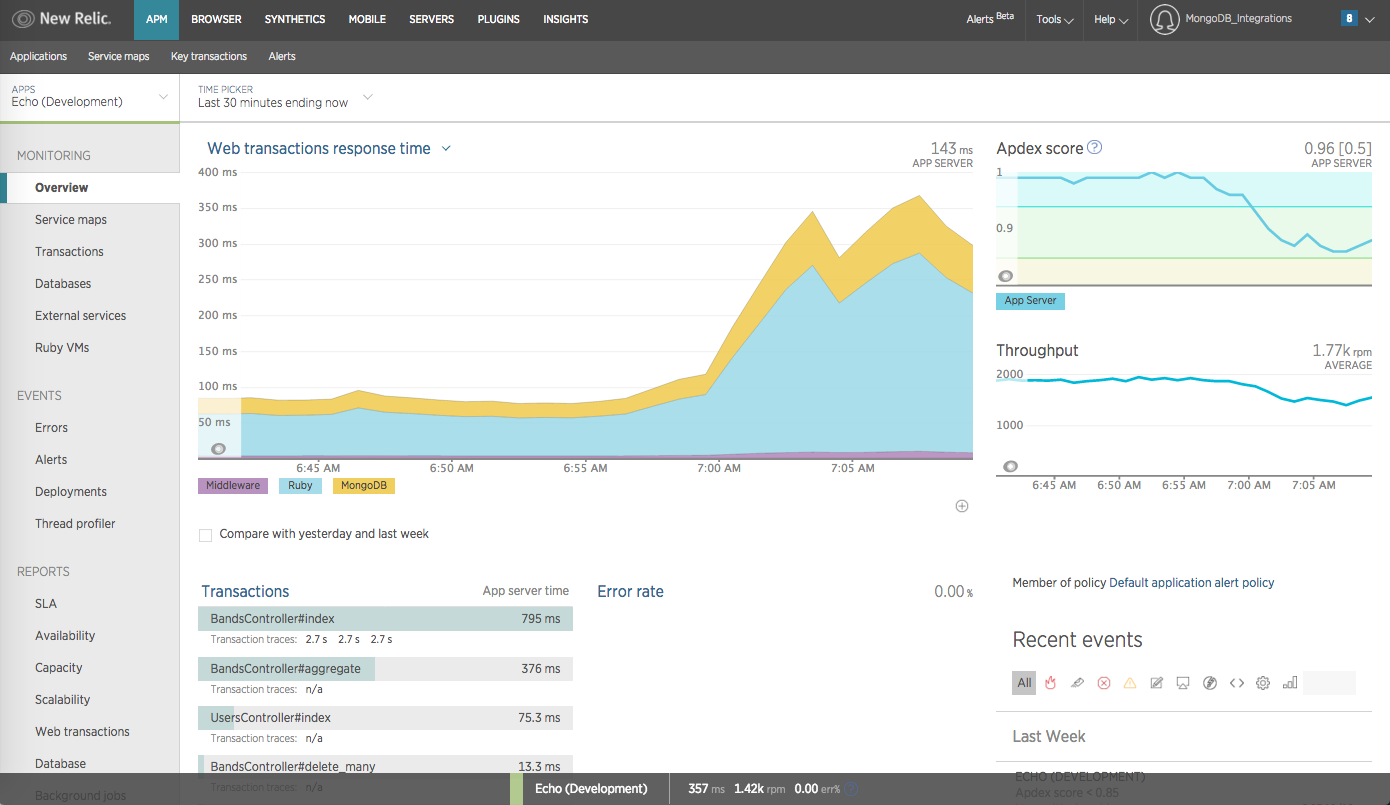
MongoDB is an open source document-oriented database system. It is part of the NoSQL family of database systems. Instead of storing data in tables as is done in a "classical" relational database, MongoDB stores structured data as JSON-like documents with dynamic schemas (MongoDB calls the format BSON), making the integration of data in certain types of applications easier and faster.
$0.10
million reads
SingleStore
Score8.2 out of 10
N/A
SingleStore aims to enable organizations to scale from one to one million customers, handling SQL, JSON, full text and vector workloads in one unified platform.
$0.69
per hour
Pricing
MongoDB
SingleStore
Editions & Modules
Shared
$0
per month
Serverless
$0.10million reads
million reads
Dedicated
$57
per month
OnDemand
$0.69
per hour
Offerings
Pricing Offerings
MongoDB
SingleStore
Free Trial
Yes
Yes
Free/Freemium Version
Yes
Yes
Premium Consulting/Integration Services
No
Yes
Entry-level Setup Fee
No setup fee
Optional
Additional Details
Fully managed, global cloud database on AWS, Azure, and GCP
—
More Pricing Information
Community Pulse
MongoDB
SingleStore
Considered Both Products
MongoDB
No answer on this topic
SingleStore
Verified User
Chose SingleStore
SingleStore outperforms Snowflake in real-time analytics and transactional workloads but lags in large-scale batch processing. Compared to MongoDB Atlas, SingleStore excels in complex SQL queries and joins, while MongoDB handles unstructured, document-based data better. Its …
A de minimis incentive was given to thank the reviewer for their time. The incentive was not used to bias or drive a particular response, nor was the incentive contingent on a positive endorsement. More Info
Co-Founder & CTO in Engineering at PitcheroGPS (Sports, 11-50 employees)
Chose SingleStore
We knew early on that MySQL (Amazon Aurora) would not be suitable for this workload as it cannot query our time series data as fast as SingleStore. We also use MongoDB Atlas for another application but we could not achieve the raw speed we saw from SingleStore. Our technical …
A de minimis incentive was given to thank the reviewer for their time. The incentive was not used to bias or drive a particular response, nor was the incentive contingent on a positive endorsement. More Info
CTO (Chief Technical Officer) in Engineering at Rimdian (Marketing & Advertising, 1-10 employees)
Chose SingleStore
SingleStore outperformed both MongoDB and PostgreSQL for OLAP workloads. Its ability to shard data and handle parallel processing of SQL "JOIN" queries across shards is a game changer.
A de minimis incentive was given to thank the reviewer for their time. The incentive was not used to bias or drive a particular response, nor was the incentive contingent on a positive endorsement. More Info
A de minimis incentive was given to thank the reviewer for their time. The incentive was not used to bias or drive a particular response, nor was the incentive contingent on a positive endorsement. More Info
Verified User
Chose SingleStore
SingleStore provides a solution for working with larger amount of data (vs. MySQL) with better performance (vs. BigQuery) without having to preprocess the data (vs. MongoDB), so basically it does better for specific use cases.
A de minimis incentive was given to thank the reviewer for their time. The incentive was not used to bias or drive a particular response, nor was the incentive contingent on a positive endorsement. TR verified that a representative sample of customers was invited. More Info
Verified User
Chose SingleStore
SingleStore (memsql) out performs based on our analysis with sample data sets within org. We could see limitations with other products which SingleStore can overcall like scaling with data while performing with similar SLA. It also has the advantage of row store and column …
A de minimis incentive was given to thank the reviewer for their time. The incentive was not used to bias or drive a particular response, nor was the incentive contingent on a positive endorsement. More Info
Verified User
Chose SingleStore
Greenplum is good in handling very large amount of data. Concurrency in Greenplum was a major problem. Features available in SingleStore like Pipelines and in memory features are not available in Greenplum.
Gemfire was not scaling well like SingleStore. Support of both …
A de minimis incentive was given to thank the reviewer for their time. The incentive was not used to bias or drive a particular response, nor was the incentive contingent on a positive endorsement. More Info
A de minimis incentive was given to thank the reviewer for their time. The incentive was not used to bias or drive a particular response, nor was the incentive contingent on a positive endorsement. More Info
Verified User
Chose SingleStore
We selected SingleStore due to its multi cloud nature, SQL compatibility and customer references who operate similar applications as us
A de minimis incentive was given to thank the reviewer for their time. The incentive was not used to bias or drive a particular response, nor was the incentive contingent on a positive endorsement. More Info
Database Administrator in Information Technology at Schoolcraft (Education Management, 51-200 employees)
Chose SingleStore
It seems that SingleStore is good at being able to handle complex queries against large datasets out of the box. In the past, we've had to do quite a bit of manual configuration and database performance tuning, but SingleStore (so far) has seemed to require minimal …
A de minimis incentive was given to thank the reviewer for their time. The incentive was not used to bias or drive a particular response, nor was the incentive contingent on a positive endorsement. More Info
A de minimis incentive was given to thank the reviewer for their time. The incentive was not used to bias or drive a particular response, nor was the incentive contingent on a positive endorsement. More Info
Chief Technology Officer in Information Technology at albo (Financial Services, 201-500 employees)
Chose SingleStore
I guess the main difference is how the memory is used for stacking and storing data until it reaches the final destination, the performance is awesome compared with others and when you have a real time business with a certain complexity. The development team would be more …
A de minimis incentive was given to thank the reviewer for their time. The incentive was not used to bias or drive a particular response, nor was the incentive contingent on a positive endorsement. More Info
If asked by a colleague I would highly recommend MongoDB. MongoDB provides incredible flexibility and is quick and easy to set up. It also provides extensive documentation which is very useful for someone new to the tool. Though I've used it for years and still referenced the docs often. From my experience and the use cases I've worked on, I'd suggest using it anywhere that needs a fast, efficient storage space for non-relational data. If a relational database is needed then another tool would be more apt.
A de minimis incentive was given to thank the reviewer for their time. The incentive was not used to bias or drive a particular response, nor was the incentive contingent on a positive endorsement. More Info
Good for Applications needing instant insights on large, streaming datasets. Applications processing continuous data streams with low latency. When a multi-cloud, high-availability database is required When NOT to Use Small-scale applications with limited budgets Projects that do not require real-time analytics or distributed scaling Teams without experience in distributed databases and HTAP architectures.
A de minimis incentive was given to thank the reviewer for their time. The incentive was not used to bias or drive a particular response, nor was the incentive contingent on a positive endorsement. More Info
Being a JSON language optimizes the response time of a query, you can directly build a query logic from the same service
You can install a local, database-based environment rather than the non-relational real-time bases such a firebase does not allow, the local environment is paramount since you can work without relying on the internet.
Forming collections in Mango is relatively simple, you do not need to know of query to work with it, since it has a simple graphic environment that allows you to manage databases for those who are not experts in console management.
A de minimis incentive was given to thank the reviewer for their time. The incentive was not used to bias or drive a particular response, nor was the incentive contingent on a positive endorsement. More Info
A de minimis incentive was given to thank the reviewer for their time. The incentive was not used to bias or drive a particular response, nor was the incentive contingent on a positive endorsement. More Info
An aggregate pipeline can be a bit overwhelming as a newcomer.
There's still no real concept of joins with references/foreign keys, although the aggregate framework has a feature that is close.
Database management/dev ops can still be time-consuming if rolling your own deployments. (Thankfully there are plenty of providers like Compose or even MongoDB's own Atlas that helps take care of the nitty-gritty.
A de minimis incentive was given to thank the reviewer for their time. The incentive was not used to bias or drive a particular response, nor was the incentive contingent on a positive endorsement. More Info
It does not release a patch to have back porting; it just releases a new version and stops support; it's difficult to keep up to that pace.
Support engineers lack expertise, but they seem to be improving organically.
Lacks enterprise CDC capability: Change data capture (CDC) is a process that tracks and records changes made to data in a database and then delivers those changes to other systems in real time.
For enterprise-level backup & restore capability, we had to implement our model via Velero snapshot backup.
A de minimis incentive was given to thank the reviewer for their time. The incentive was not used to bias or drive a particular response, nor was the incentive contingent on a positive endorsement. More Info
I am looking forward to increasing our SaaS subscriptions such that I get to experience global replica sets, working in reads from secondaries, and what not. Can't wait to be able to exploit some of the power that the "Big Boys" use MongoDB for.
A de minimis incentive was given to thank the reviewer for their time. The incentive was not used to bias or drive a particular response, nor was the incentive contingent on a positive endorsement. More Info
A de minimis incentive was given to thank the reviewer for their time. The incentive was not used to bias or drive a particular response, nor was the incentive contingent on a positive endorsement. TR verified that a representative sample of customers was invited. More Info
NoSQL database systems such as MongoDB lack graphical interfaces by default and therefore to improve usability it is necessary to install third-party applications to see more visually the schemas and stored documents. In addition, these tools also allow us to visualize the commands to be executed for each operation.
A de minimis incentive was given to thank the reviewer for their time. The incentive was not used to bias or drive a particular response, nor was the incentive contingent on a positive endorsement. More Info
[Until it is] supported on AWS ECS containers, I will reserve a higher rating for SingleStore. Right now it works well on EC2 and serves our current purpose, [but] would look forward to seeing SingleStore respond to our urge of feature in a shorter time period with high quality and security.
A de minimis incentive was given to thank the reviewer for their time. The incentive was not used to bias or drive a particular response, nor was the incentive contingent on a positive endorsement. More Info
Solutions are based around a business needs and even when implementing such solution, real time insights are also followed through showing the updates the business are implementing while informing the end users as what is new with technology.
A de minimis incentive was given to thank the reviewer for their time. The incentive was not used to bias or drive a particular response, nor was the incentive contingent on a positive endorsement. More Info
SingleStore excels in real-time analytics and low-latency transactions, making it ideal for operational analytics and mixed workloads. Snowflake shines in batch analytics and data warehousing with strong scalability for large datasets. SingleStore offers faster data ingestion and query execution for real-time use cases, while Snowflake is better for complex analytical queries on historical data.
A de minimis incentive was given to thank the reviewer for their time. The incentive was not used to bias or drive a particular response, nor was the incentive contingent on a positive endorsement. More Info
Finding support from local companies can be difficult. There were times when the local company could not find a solution and we reached a solution by getting support globally. If a good local company is found, it will overcome all your problems with its global support.
A de minimis incentive was given to thank the reviewer for their time. The incentive was not used to bias or drive a particular response, nor was the incentive contingent on a positive endorsement. More Info
The support deep dives into our most complexed queries and bizarre issues that sometimes only we get comparing to other clients. Our special workload (thousands of Kafka pipelines + high concurrency of queries). The response match to the priority of the request, P1 gets immediate return call. Missing features are treated, they become a client request and being added to the roadmap after internal consideration on all client needs and priority. Bugs are patched quite fast, depends on the impact and feasible temporary workarounds. There is no issue that we haven't got a proper answer, resolution or reasoning
A de minimis incentive was given to thank the reviewer for their time. The incentive was not used to bias or drive a particular response, nor was the incentive contingent on a positive endorsement. More Info
A de minimis incentive was given to thank the reviewer for their time. The incentive was not used to bias or drive a particular response, nor was the incentive contingent on a positive endorsement. More Info
While the setup and configuration of MongoDB is pretty straight forward, having a vendor that performs automatic backups and scales the cluster automatically is very convenient. If you do not have a system administrator or DBA familiar with MongoDB on hand, it's a very good idea to use a 3rd party vendor that specializes in MongoDB hosting. The value is very well worth it over hosting it yourself since the cost is often reasonable among providers.
A de minimis incentive was given to thank the reviewer for their time. The incentive was not used to bias or drive a particular response, nor was the incentive contingent on a positive endorsement. More Info
We allowed 2-3 months for a thorough evaluation. We saw pretty quickly that we were likely to pick SingleStore, so we ported some of our stored procedures to SingleStore in order to take a deeper look. Two SingleStore people worked closely with us to ensure that we did not have any blocking problems. It all went remarkably smoothly.
A de minimis incentive was given to thank the reviewer for their time. The incentive was not used to bias or drive a particular response, nor was the incentive contingent on a positive endorsement. More Info
We have [measured] the speed in reading/write operations in high load and finally select the winner = MongoDBWe have [not] too much data but in case there will be 10 [times] more we need Cassandra. Cassandra's storage engine provides constant-time writes no matter how big your data set grows. For analytics, MongoDB provides a custom map/reduce implementation; Cassandra provides native Hadoop support.
Greenplum is good in handling very large amount of data. Concurrency in Greenplum was a major problem. Features available in SingleStore like Pipelines and in memory features are not available in Greenplum. Gemfire was not scaling well like SingleStore. Support of both Greenplum and Gemfire was not good. Product team did not help us much like the ones in SingleStore who helped us getting started on our first cluster very fast.
A de minimis incentive was given to thank the reviewer for their time. The incentive was not used to bias or drive a particular response, nor was the incentive contingent on a positive endorsement. More Info
A de minimis incentive was given to thank the reviewer for their time. The incentive was not used to bias or drive a particular response, nor was the incentive contingent on a positive endorsement. More Info
Open Source w/ reasonable support costs have a direct, positive impact on the ROI (we moved away from large, monolithic, locked in licensing models)
You do have to balance the necessary level of HA & DR with the number of servers required to scale up and scale out. Servers cost money - so DR & HR doesn't come for free (even though it's built into the architecture of MongoDB
As the overall performance and functionality were expanded, we are able to deliver our data much faster than before, which increases the demand for data.
Metadata is available in the platform by default, like metadata on the pipelines. Also, the information schema has lots of metadata, making it easy to load our assets to the data catalog.