

What is Adobe Experience Manager?
Adobe Experience Manager (AEM) is a Content Management System (CMS) designed for environments where content is consumed by both human visitors and AI agents. Unlike Headless-Only CMS solutions that prioritize content storage and API delivery, AEM is architected for content visibility across multiple surfaces, including web, mobile, LLMs, and emerging agentic channels.
What Adobe Experience Manager Is
Experience Manager combines Structured Content Management, Digital Asset Management (DAM), automated workflows, enterprise governance, and Edge Delivery within an integrated platform. The vendor states that many enterprises utilize AEM as a Headless System of Record to power mobile applications and multi-site experiences while leveraging the platform's native presentation and optimization layers.
Agentic CMS: The Foundation for AI Discovery
AEM is designed as a content management system that supports AI discovery. The platform prioritizes structured and governed content for ingestion and citation by AI systems. The solution includes agent capabilities—such as the Brand Experience Agent, Brand Governance Agent, and Content Advisor Agent—intended to automate the content lifecycle, enforce compliance, and optimize traffic for human and machine-based interactions.
Key Capabilities
- Experience Manager Sites: A decoupled architecture for creating and delivering personalized web and application experiences via Content Fragments, GraphQL, and REST APIs.
- Experience Manager Assets: A Digital Asset Management system to govern assets, featuring AI models trained on proprietary brand data and creative requirements.
- Experience Manager Forms: Digital enrollment workflows integrated with backend Systems of Record.
- AEM Sites Optimizer: Tools for the continuous monitoring of performance, SEO, and discoverability (requires AEM Sites).
- LLM Optimizer: Provides visibility into agentic traffic using CDN signals and offers recommendations to improve content discovery by AI systems.
- Edge Delivery Services: Content delivery and personalization performed at the Network Edge, designed for assembly and service in milliseconds.
- Experience Manager Guides and Learning Manager: Component Content Management for technical documentation and an integrated Learning Management System (LMS).
Differentiators
- Integrated Content and Decisioning: AEM integrates with Adobe Journey Optimizer and Real-Time CDP to make content delivery decisions based on Unified Customer Profiles and behavioral signals.
- Embedded Generative AI: Adobe Firefly and generative content features are included within the authoring environment as native capabilities.
- Enterprise Governance: Support for Multi-site, Multi-brand, and Multi-language operations with Role-Based Access Control (RBAC), workflow approvals, and Audit Trails.
Categories & Use Cases









Videos
Screenshots


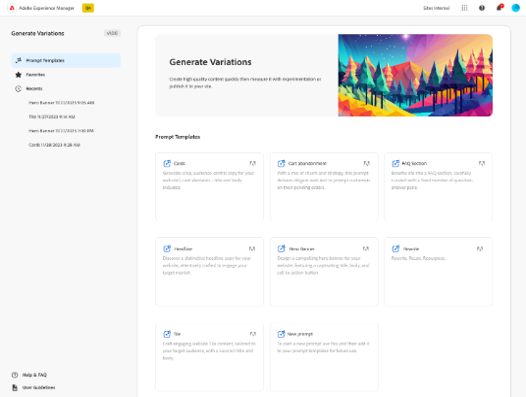
1 / 9
Screenshot of AEM Forms - Creates an adaptive form
Technical Details
| Deployment Types | SaaS |
|---|---|
| Mobile Application | No |
| Supported Languages | Chinese, English, French, German, Italian, Japanese, Korean, Portuguese, Slovenian |
| Security | Security Report on Whistic Security Network |
FAQs
What is Adobe Experience Manager?
Adobe Experience Manager is a combined web content management system and digital asset management system. The combined applications of Adobe Experience Manager Sites and Adobe Experience Manager Assets is offered by the vendor as an end-to-end solution for managing and delivering marketing content.
What are Adobe Experience Manager's top competitors?
Acquia Digital Experience Platform are common alternatives for Adobe Experience Manager.
What is Adobe Experience Manager's best feature?
Reviewers rate Role-based user permissions highest, with a score of 8.4.