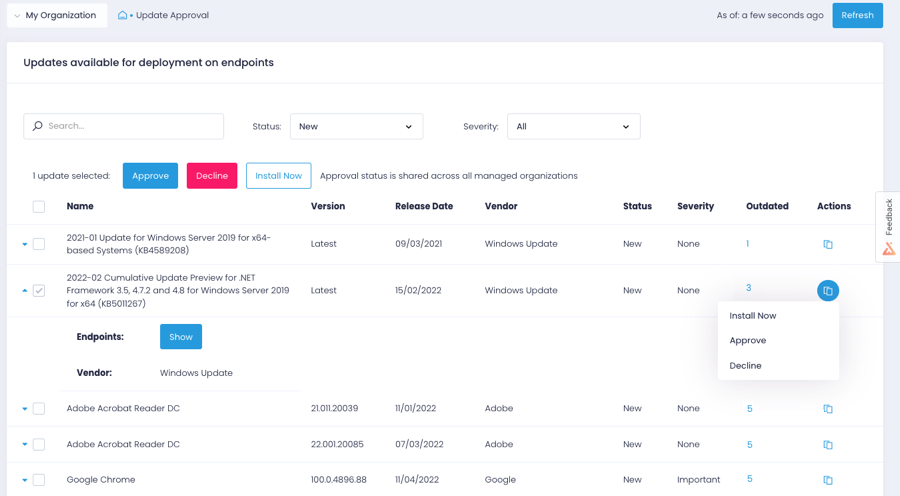
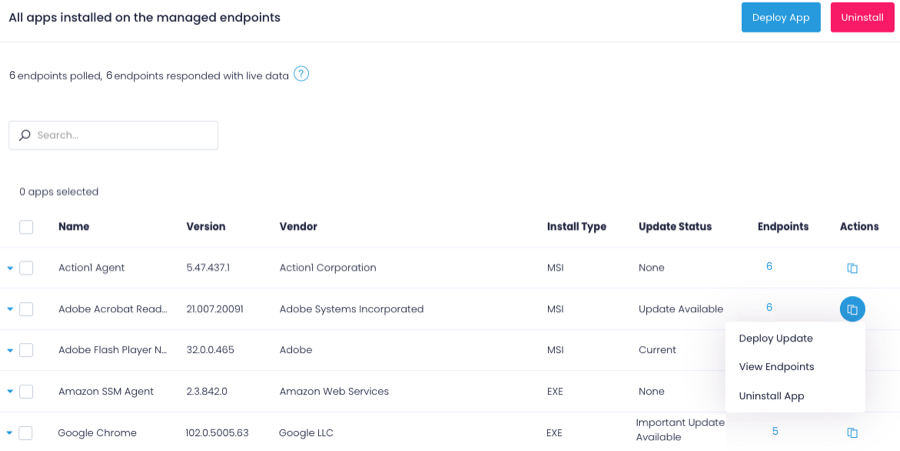
Action1 is an autonomous endpoint management platform that is cloud-native, scalable, and configurable in 5 minutes. It is free for the first 200 endpoints, with no functional limits. By pioneering autonomous OS and third-party patching - AEM’s foundational use case - through peer-to-peer patch distribution and real-time vulnerability assessment without needing a VPN, it eliminates costly, time-consuming routine labor, preempts ransomware and security risks, and protects the digital…
N/A
Tanium
Score 8.7 out of 10
N/A
Tanium delivers Autonomous Endpoint Management (AEM) with the goal of allowing security-conscious organizations to break down silos between IT and Security operations that results in reduced complexity, cost, and risk.
If your organization is like mine (nonprofit and tight budget) this product is for you. The first 200 endpoints are free and being we are a small organization, this product is perfect for us. I was able to use Action1 to upgrade all my endpoints from Windows 10 to 11 pretty much effortlessly. If you are not a nonprofit and have more endpoints over 200, this is still a great product to use as I don't find it very expensive to incorporate into your infrastructure.
Tanium is well suited for organizations where enterprise infrastructure has great significance and needs to be properly managed as well as protected. Most organizations depend upon their infrastructure to sustain so Tanium can be a boon for them to sustain in this competitive market. However, Tanium is less appropriate for the traditional offices that don't have or have a less online presence.
Easy remote access to devices. That simple. We have some very unskilled users in the field where asking them to access their PC via conventional remote tools like TeamViewer, Anydesk, etc. was always a pain. Now, all they have to do is ensure their PC is online, and we can connect to them.
Remote software deploy. Before Action1, we did have some GPOs and scripts, but again - being able to deploy to PCs outside of our office/LAN, is just beautiful. On top of the standard repository, being able to create new packages is very useful for our scenario.
Inventory Reporting. Recently we had to identify PCs running old versions of Windows. Can't highlight enough how easy it is.
The deployment screens for update deferrals can be hard to understand at first and easy to skip since it carries some default info when you create a new automation rather than a more conspicuous prompt to update.
One issue is its ring topology, as the data is stored in central hubs and pushed through its peer nodes. If the central hub fails, then the associated node will also result in failure.
Another problem is that all Tanium management is on premises requiring the customer to maintain it. If we want ask any help from Tanium support we always get a response like "you are maintaining it yourselves and it's your responsibility.
The Tanium User Interface could be improved a bit as, although the tool is rich in performance, a more impressive UI might really attract new customers.
Action1 has taken many of the tasks that are time consuming and made them simple automated tasks that can be run on a schedule. I can schedule tasks to run off-hours and know that they will be done and I no longer have worry about it. As someone who does IT support for a living, it just makes my job so much simpler with less stress.
After looking at different solutions, Action1 [Cloud Remote Monitoring and Management Solution] was the perfect fit for us that delivered all of the features we wanted without being as costly as some of the others alternatives we've looked at. There was no minimum endpoint count and they even offer up to 50 endpoints for free, which is really great for a small organization like us to help us lower our starting costs and still allows us to grow at our pace without having to commit to a defined amount of endpoints to start.
Tanium is always my first choice, so much excellent feedback online from genuine users, easy to use in any system environment, and value for money, so many good things about Tanium stacks up against all the other competitors in the market. Tanium is one of the most reliable and trusted risk and compliance management software.
Saved hours per week on patching and able to ensure a 100% patching success rate.
Able to create custom alerting on potential problems as well as able to create some automation to automatically address problems.
Improved support to our remote locations and users.
Custom deployments allow us to have a mechanism to deploy custom applications we build as well as other third party applications we need to distribute.