Aha! Roadmaps is used to set strategy, prioritize features, and share visual plans. It includes Aha! Ideas Essentials for crowdsourcing feedback. For an integrated product development approach, Aha! Roadmaps and Aha! Develop can be used together. The software is available with a 30-day trial.
$59
per month per user
monday.com
Score 8.3 out of 10
Mid-Size Companies (51-1,000 employees)
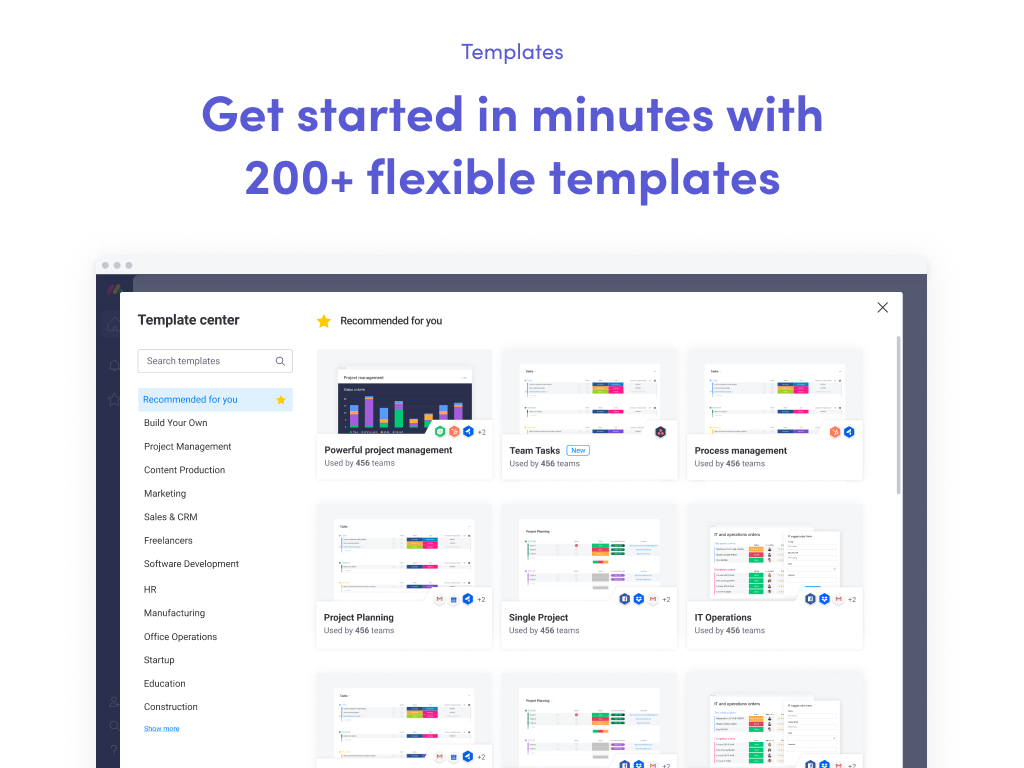
monday.com Work OS is an open platform designed so that anyone can create the tools they need to run all aspects of their work. It includes ready-made templates or the ability to customize any work solution ranging from sales pipelines to marketing campaigns, CRMs, and project tracking.
Compared to some other types of software we've tested or use in other areas of the company Aha! has a better user interface, has more customization ability and grows with the company and the work we're doing.
In terms of outright features, a lot of roadmapping tools have the same feature set. We chose Aha! based on look-and-feel, the easy learning curve, and the reviews it has. Between collaboration, milestone tracking, comment threads, and content importing and exporting, we had …
It is great for organizations that want to ensure that the work they focus on is the work that will have the most impact on value and drive them toward their strategic objectives. I consider it to be a real Product Management tool. If all you are looking for is a tool to hold your product backlog or collect customer feedback, then Aha! is probably going to be overkill for your needs
The platform has a good deal of versatility and extensibility, but I do not feel it is well suited for anything too complex. More complexity seems to bog down performance and increase maintenance to keep everything humming. As much as possible, avoid creating too many bespoke workarounds that will end up creating tech debt. The platform seems to work best for more straightforward scenarios and smaller to mid-size companies. Pricing can be reasonable for specific teams, but can feel a little too pricey for company-wide usage. It has served us well for the early stages of our company, but we find ourselves offloading the more complex use cases to other apps specifically developed for those, and reducing to just those teams that are more deeply embedded in the functionality.
Aha! is an all around product management suite. It is great for breaking product plans into initiatives, features, and user stories. This helps the organization understand the product plan and what is driving individual work items. Unlike Jira and project management tools, it helps you prioritize by major themes, features, and releases. Once you start to use it, you can't go back to a project management tool because the views for organizing and prioritizing features just isn't there.
Aha! also excels at idea management. You can create a portal for users to submit ideas and manage them through a workflow. Users can submit ideas through a variety of channels, including email, ZenDesk, and SalesForce. You can even attach account values to an idea submitted through SalesForce, though the UI in SalesForce is a little kludgy. This is a great feature for those that have the capacity to manage feedback this way, but be aware that it takes time to manage.
Aha! works pretty well with Jira so that project managers can have their backlog that is understandable to the business and engineering can break down those work items however they want.
Aha! also has a lot of useful integrations: Slack, ZenDesk, Zapier, etc. It also integrates with every major software project management tool on the market: Jira, Pivotal, Rally, Redmine, and TFS.
I like summary of subitems, especially with subitasks as subitems and add item tracking for each subtask it can show total tracked in parent item. Similar with other columns, like numbers, status, date.
Dashboard features, Many kinds of dashboard view available, we can utilize on the basis of requirements.
monday.com workform is very powerful, easily share form link when submitted it will create line item in board with provided data.
monday.com automation is very helpful in order to automate steps with specific rules and easy setup.
monday.com also provides integrations in order to automate processes if need to integrate multiple app together. or need to transfer data between multiple apps.
I would like to see our company logo show up larger on the form feature.
I prefer the version of the form they have now instead of the new version for 2025. The current form shows the questions in bold font, and the new version does not. This may mean it could take our volunteers longer to get to the pertinent information on the form.
It would be nice if monday.com staff had monthly webinars showing how to use some features. such as, using formulas effectively.
Teams involved in content creation, such as marketing or editorial teams, could use monday.com to manage the entire content lifecycle. Boards might track content ideas, assignments, drafts, reviews, approvals, and publication schedules, helping teams collaborate and keep content production on track.
I think Aha! works really in general, it offers a very comprehensive and well-structured platform that supports strategic product management at scale. Although there is a learning curve for new users and a few areas to be improved. Overall, it is highly usable for experienced product teams who need a robust roadmap tool.
I give monday.com a 10/10 because I almost never encounter any lag or connectivity issues despite all of the many templates, boards, and automations we have. As a matter of fact, I feel like the last issue I encountered was over a year ago... and I'm in monday.com every single work day. Not only is monday trustworthy, it is easy to find what I'm looking for... making the overall usability extremely hard to beat.
Everything performs fairly well. Every now and then there are user errors where an employee will not click "ok" on a note they've created and simply exit out (I do wish that something was in place to prevent this, such as a pop "are you finished?")
We've always had excellent support whenever we need help from the company or need questions answered regarding the setup and installation of the product. Tickets are answered in a timely fashion and there's minimal back and forth to get issues resolved, which are rare.
monday.com only really care about accounts that have 20 seats or more. While this is great for monday.com, it pushes smaller organisations to evaluate alternatives. We rate monday.com highly in our organisation because key staff have already got good experience with the application and we know we will get to 20+ seats one day. But, till then the billing model and lack of permanent enterprise features is a dread.
To have someone walk you thru the features and capabilities of Monday.com is priceless. Someone also coming along later in the contract to see if you are maximizing the program to suit your company needs is beyond helpful. The staff that have provided this training are fun, creative and very patient.
We signed up for the accounts. Created the accounts. Ran the trial version and tested it live while we were running multiple projects and found that it was fitting our needs perfectly. When the trial ended and we were asked to purchase the full version, we did. We have found other ways to use it and it's a breeze.
In terms of outright features, a lot of roadmapping tools have the same feature set. We chose Aha! based on look-and-feel, the easy learning curve, and the reviews it has. Between collaboration, milestone tracking, comment threads, and content importing and exporting, we had every feature in Aha! that we were looking for.
monday.com is cleaner, offers more customization and is easier to design out with a team project focus in mind. With the ability to automate steps as well, it is super easy to move tasks along, have stages auto-update and to go through my personal to-do list of tasks to get things done.
For it to work across multiple departments and sites, I would like to see improvements made with integrations and automation. For this question, I am acknowledging not only the addition of internal triggers/automation, but also an expansion on external ones.
It has helped us improve our product lifecycle communication. We have less wasted time spent figuring out where the project is and what it's waiting on. This has helped departments further down the project better use their time so they're already aligned with what's happening rather than waiting for a handoff.
Aha! has helped include our customers more in our product planning and especially in our bug fixes and new feature roadmaps.
Aha! has improved our strategy meetings or roundup discussions by storing everything in one place. They're shorter and more focused.
Much easier to review my prior month and report to clients on work completed; easy to extract the information and work done to Excel to add budget tracking etc - I see this is possible in monday.com and I will investigate how/if this is possible on our current plan.
Very fast and easy set-up of Boards.
Still lots to learn and grasp - many more opportunities to become more efficient using monday.com. I'm only just getting started.
The initial automations are quick and easy to set up, and if set up correctly.
My month-end client status and progress reports are now more accurate, and I can keep track of all the information in one place (inside monday.com).