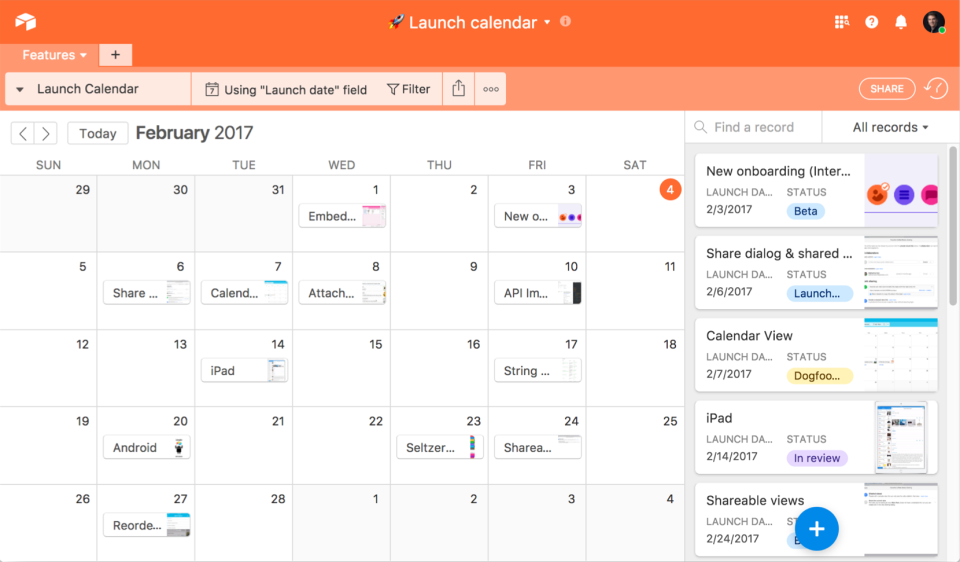
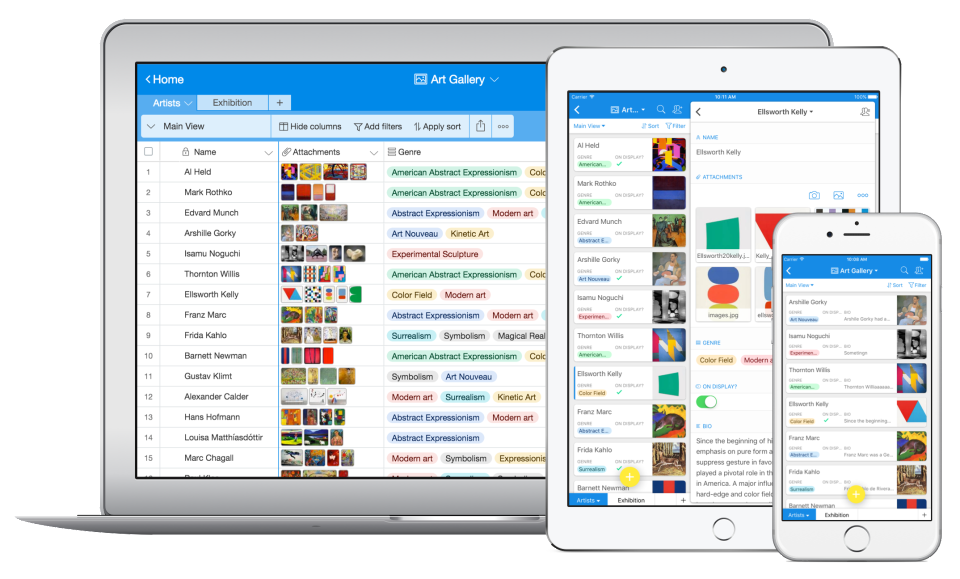
Airtable is a web-based application builder that combines spreadsheet usability with relational database architecture. The platform enables users to construct custom operational applications, configure automated workflows, and design tailored interfaces without traditional software development.
$24
per month per user
Asana
Score 8.5 out of 10
N/A
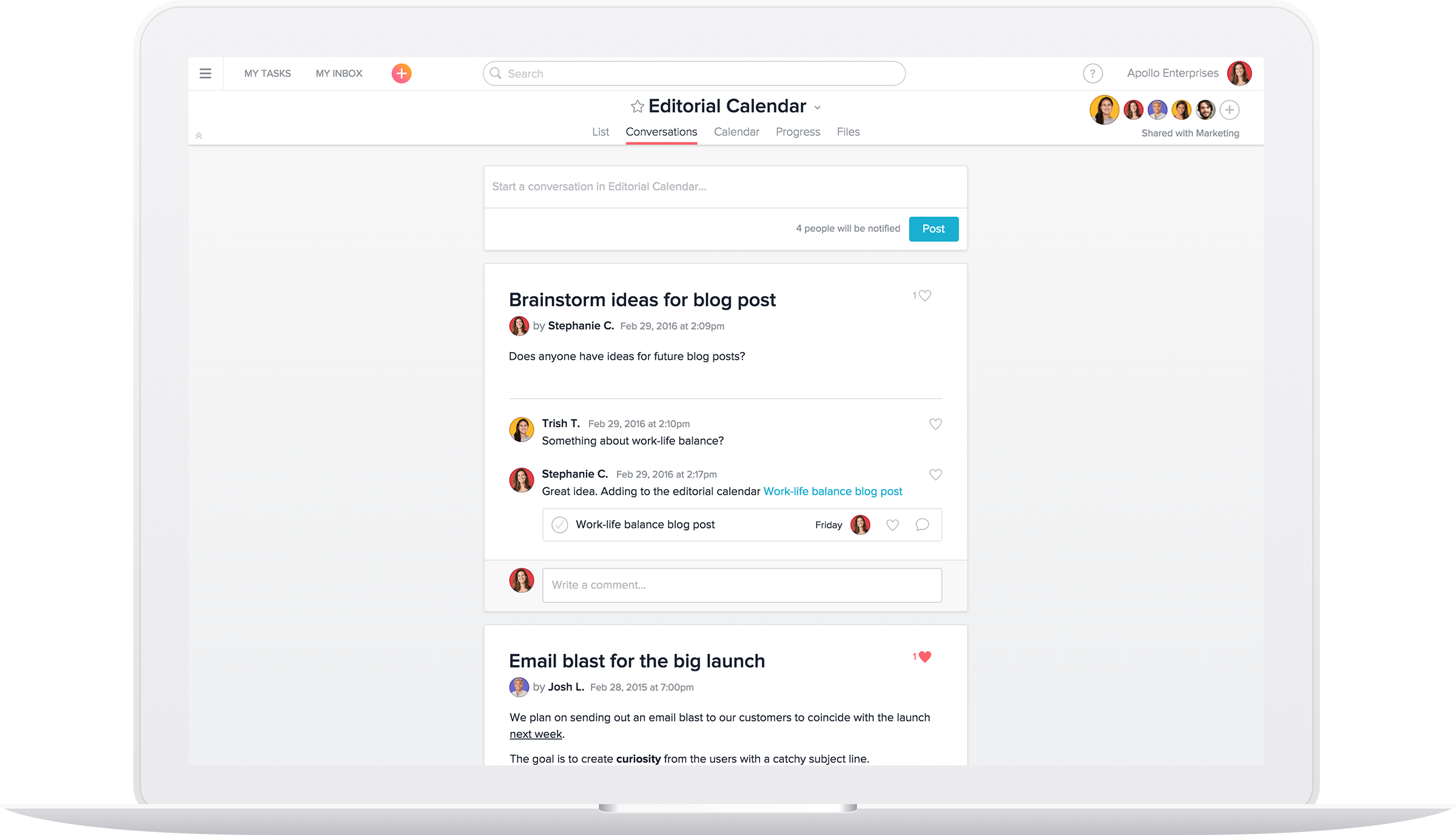
Asana is a web and mobile project management app. With tasks, projects, conversations, and dashboards, Asana lets an entire team know who's doing what by when, enabling workload balancing. Users can also add integrations for GANTT charts, time tracking and more.
$13.49
per month per user
Coda
Score 8.9 out of 10
N/A
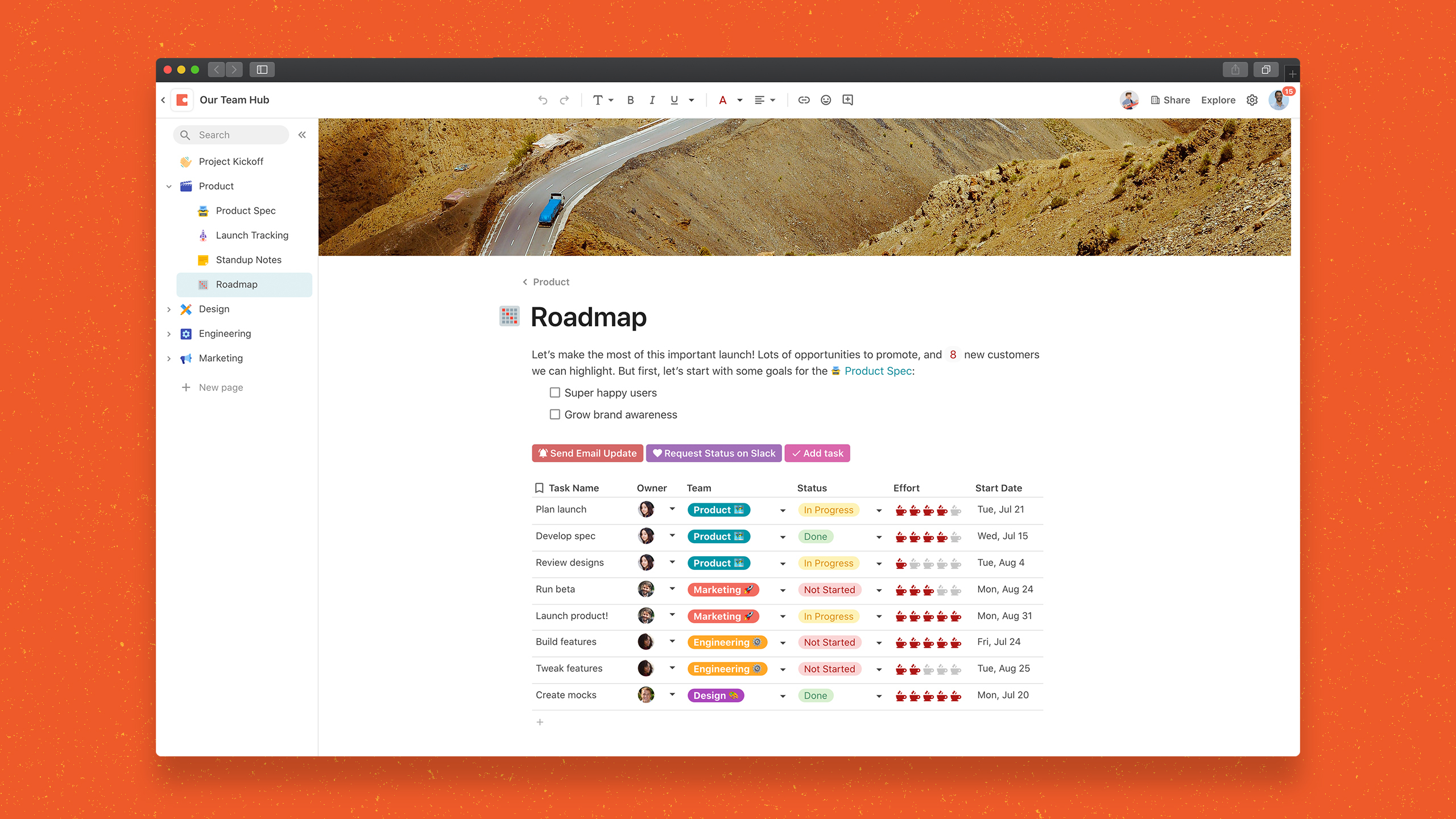
Coda is a unified workspace platform that transforms documents into interactive applications by combining documentation, spreadsheet functionality, relational databases, and AI-powered automation—enabling teams to consolidate multiple tools and automate complex workflows without writing code. The platform operates as a block-based document system where every page can contain interactive tables, buttons that trigger automations, live formulas, and conditional logic, all rendering from a shared…
Airtable is the best for structuring, automating and interacting with data, but only for internal use. For public-facing needs, other apps are required for their support of custom domains and styling.
Airtable is far more sophisticated than Sheets or Excel in terms of its functions. The interface is also much easier on the eyes. People are less familiar with it and there is a bit of a learning curve, but overall, Airtable empowers us to do more and to better understand our …
Airtable is the most user-friendly and adaptive. It's UX/UI is the most aesthetically pleasing (which matters a lot if its what you're staring at every day), and the customizability of having different views and perspectives of the same record is extremely helpful.
It is not comparable because we use it as a bridge those tools and our platform. So, in our use case, Airtable works more as a connector between the different tools we use and as a complement to eliminate repeated tasks trough automation. We are also exploring the possibility …
AirTable does a great job at Project Management. You can easily create tasks and set up reminders, including automated reminder emails, when deadlines draw near. You can group the tasks and can also group tasks in a variety of ways (not started, pending, completed or …
Airtable was a really good fit for this specific use case as it provided a huge number of collaboration features in an intuitive and pleasant-to-use interface. The free tier worked initially with our work, and the upgrade pathway was fair and made sense for us.
There's a saying that spreadsheets were never meant to be databases, and Airtable provides the missing piece for nontechnical users who need to hear that saying. It's more performant and provides more custom view options, for example, than Excel or Google Sheets.
Airtable is as powerful, if not more than these competitors. It has a simple interface like Asana or Trello but has robust data functions and tracking of Jira or ShotGrid (now called Flow). While I haven't found it as profoundly integrated as Jira, Airtable feels much more …
While a very capable tool, Smartsheet ultimately didn't provide the ease of use we required for our scenario. Monday was a great tool that felt very similar to Airtable, except its mobile app actually lead to some mismatched information and difficult use in time-sensitive …
I have tried Trello, Monday.com, Meister Task, and even Google Sheets. They are all great and solid applications. Some even have really nice user interfaces. However, none of them have met my primary need of being able to view my current projects and associated deadlines at a …
Airtable exceeds all competitors I’ve seen. The feature set is full and only growing. The UI is intuitive for non-tech employees. Any competitors that match Airtable are really operating in a different space. Airtable is the industry leader in this category. Period.
Asana is a great piece of software but it ultimately had too many features and offerings. Our main focus was having a 'smartsheet' that easily allowed for collaboration at a very affordable price. Airtable was the best fit for what we were looking for at the time. If we ever …
We have tried to use smart-sheet before but it is nowhere as good as Airtable. The user interface with Airtable is much better and it also has much more functionality.
The only similar thing that I have used is Google Sheets, and Airtable is much better than this as it provides way more abilities and creation of automation.
Asana is a highly effective instrument for managing teams and projects. The paid edition provides a multitude of features that can be tailored and used in accordance with the organisation's specific requirements.
Email integration facilitates notifications that remind team …
Overall for the money Asana brings a lot of value for organizations who want to do more with less and need a task and project management solution as a small company is growing and scaling to get to the next level. In the space when we evaluated didn't find a lot of other …
Against Jira it offers a more modern experience with less complex user interfaces. The admin and setup experience is also way faster with less (or no) legacy complexity.
Against other modern players like Linear and Basecamp it offers way more integrations so we can pull in data …
Asana is a top-tier project management software that helps us organize and track projects from start to finish. It allows us to apply tasks/to-dos to multiple projects without duplication, divide complex projects into smaller tasks, and track project progress. It also helps us …
Asana provides a mix of features between notion and Jira. Unlike Notion, it helps ease up the collaboration on vast projects and between multiple teams. Jira proved to be a little expensive with similar set of features if not more and which is why we thought of going with Asana.
I believe that Asana is more professional than Trello. I used Trello a long time ago, but it looked more suitable for a student project rather than for a professional team or business environment. I believe it has great features to help companies in different stages and of …
Since I have tried the two applications and saw their advantages and disadvantages, I see that Asana is much better in terms of dealing with files, ease of use, and the many features and characteristics that it has. Also, I noticed that it does not consume much space on my …
Side by side with the other two Asana by far beats Monday.com and is comparable and slightly better than ClickUp. Monday is completely browser-based and is hard to navigate and figure out how to set up. Asana and ClickUp are the exact opposite. Both are easy to set up and …
I like how extensive the capabilities are for Asana. With other softwares it seems there are many things lacking. I feel like Asana is also a very user friendly platform and aesthetically pleasing which is important in a modern office. We have many young people entering our …
Asana compared to Jira is certainly better in terms of user experience, since most of the people can start using it basically without having any kind of training or previous explanation, which makes it really useful not only for people already used to project management but …
Asana is amazing for a remote team, that we are currently as its accessible seamlessly to all our team member no matter where they are in the world. Its very easy to onboard new members to this platform as its very intuitive and easy for new people to get a hang of it. It has …
Basecamp was a great tool, but it was paid and things like recurring tasks and opening new projects was a pain. Asana, as a free tool, has been better for our organization as it serves the basic functions very well and is not complicated otherwise. I really like the …
We previously used airtable, and I'm not sure why we switched, but it seems like Coda has more flexibility and is a little more user friendly for generic users and not power users.
Coda is a more complete package that is very robust and will meet the needs of almost any organization who wants to track project and meet desired timelines. By implementing project trackers the team can easily collaborate together and get the work done. Coda is much easier to …
Coda is not as great as ClickUp or Notion in many ways, but it surely has a better user interface and pricing in my view and allows good collaboration. However, integrations work much better with other competitors as compared with Coda, and would prefer others if pricing was …
Trello seems to be more focused on IT oriented projects where as Coda has wide scale applications across all departments. Coda was selected because of the perception it was more dynamic and I believe it has proven to be more dynamic. Coda is a very easy to use and understand …
I don't know why leadership choose Coda over Google, but I do see the value in the organization as well as diversity of what you can do with pages designs and integrations
We used Airtable for a while and looked at Notion briefly. Airtable is good, yet a bit technical and doesn't come with rich text and formatting capabilities--so less suitable for publishing/sharing with the rest of the organization. We haven't used Notion for real; I did look …
Coda is very aesthetically appealing and fun to create docs. The benefit of Coda is that it makes a lot automated, but what is sacrificed is the flexibility that other tools can offer.
For general use cases, Google Docs or Airtable are often a better starting place. But if things get complex or you're constantly pairing the two together, consider graduating to Coda to save yourself long-term headaches.
Notion is great for personal use, but the powerful …
The tables within Coda are similar to lists in SharePoint or Google Tables, but the document portion of Coda is what sets it apart. Having the ability to summarize that table data in a document is unique to Coda.
Coda is the only tool with the ability to fully customize your views and the behavior within a given data table. They've put a LOT of thought into this and are miles above and beyond Smartsheet, Airtable, and Notion (I've evaluated all three extensively).
We were looking for many different things to improve our internal processes before we came across Coda. A large part of my work involves marketing, project management, service management and data analytics. For a company like ours, we find Coda the most cost-effective and …
I first tried Notion and, although it can be easier to work with for some simple tasks, when it comes to tables and linked data, Coda is more versatile and comprehensive.
For the use we needed in the company, Coda was a way easier and simpler solution. Jira and the Atlassian suite is more complete and structured, but it is was way too complicated.
Coda's automation and flexibility makes it much easier and more interactive than other tools like Airtable. With Airtable, we couldn't get as much traction or flexibility, so we stopped using it after a few months. Jira, on the other hand, has proven to be more helpful for task …
I primarily use Mavenlink for scheduling purposes but with Coda, I'm able to do that, plus have an open way to communicate with the rest of my team when we want to add certain artists to a specific job. Instead of using another software for communicating across all of our …
They are similar but I like that Coda has more templates that are suited for marketing (GTM timelines, pulse updates, etc). One pain point for us is getting the engineering team on Coda but they seem to prefer Jira and Aha!
While all of the products listed have great features and platforms, there was always one thing missing from them that I would need to get from another application. Coda was the first one we used that really combined some of the best parts of those products and allowed us to use …
The price point is most attractive, they have a dedicated team of support agents/doc makers that provide valuable templates, and it really was the best option to fit our current needs as a startup team who will be scaling and the product can scale with us in the long run.
Airtable is well suited for cross-functional teams who all have an interest in data site - it's democratizing who owns data. Especially if there will be a need to add input on a cell-level basis view comment functionality with the expectation of @mentioned parties respond. Airtable is less suited for teams who need to run functions, jobs, and macros across a data set; they're best suited for Excel.
The usability of Asana is broad since it's available in a variety of platforms that are widely used nowadays. I think that it would be great for people who are constantly on the move and switching devices, since it has allowed me to work from my phone, too. I also think that Asana has proven itself to handle a large quantity of work
Coda is great to build a place for your users to go to and see information. It is easy to navigate through and the variety of content creation is great. However, it is not always easy to create what you want and there is a lot of playing around and learning. Coda also sometimes misses some functionality which is expected. For example, downloading a list of users that have access to the platform. Being able to send push notifications when a new page has been created etc. Overall it is a good tool to use just be prepared to invest time!
Airtable has capabilities commonly found in spreadsheet applications, but also has some of the features found in databases.
The ability to filter fields. I set up a filter on the status field, so when a project is marked, complete, on hold, or canceled, that record is hidden from my current projects table view. If it is marked complete, the record is moved to the completed projects table view. In this way I can easily access a record of past projects
Being able to duplicate tables and create alternate views
Collapse and expand records. When I collapse the rows, I can easily scan current projects, next steps, project status, and due dates. When I expand the row, or field, I can see more detailed information about that field or record very easily. I can also expand or open the entire record. This is is helpful, when I am entering a lot of information to multiple fields in that record.
One source of truth: It's incredibly easy to keep everything organized and easy to find.
Being able to show different views of the same information throughout your doc makes it really easy to customize the information.
In general, I love the "coding" aspect of it, and being able to do advanced functions has helped us create some really interesting automation and streamline our process.
Airtable does not integrate with collaboration services with which it is possible to review live changes within each spreadsheet (in the case of keeping them closed).
Does not automate analysis traffic.
It does not include any section where it is possible to communicate with the other editors.
We love Airtable for how we use it and we know there are probably tons of other ways we can implement it for other departments. We just haven't gotten there yet (due to bandwith) Customer Support is also super helpful and overall ease of use is fantastic
I just can't see us getting it off of Asana any time soon, despite the many headaches it has caused us. We have too much data in there, too much time & training invested into it, too much at stake to move. If we were just starting out today, fresh, I don't know for certain that I would absolutely go the same direction, but I *think* I still would. I just haven't seen anything better yet. Maybe if Podio's support staff hadn't treated me like a worthless nuisance to them, I might feel differently, but the fact is that their task management is simply inferior to Asana's. That can't be denied, and in fact Podio said it themselves: "Tasks are a simple function. They cannot be customized. Tasks in Podio can be used for quick to-do's for you and your team members." In our operation, however, prompt task completion is a big deal; one task can't be completed until another one is done first, and closing the gaps between those tasks is critical in meeting deadlines and servicing our customers. Asana gets us there, the others don't.
Coda is definitely something that has been proven to drive positive impact in our organization. We have many divisions that can benefit from this that we have yet to explore. It would definitely be worth renewing.
Airtable is a simple and intuitive tool. However, when you first set it up, you need someone who is curious and able to design a system that works for your organisation's use case. This takes some time, but it can be intuitive once it's set up.
It is very user-friendly. Takes a new employee an hour to start figuring out how the system works. That's an important factor. You don't want to encounter the issue where employees need a week to understand how the system works. For example, JIRA, I tried using it for a week and I still don't understand the complicated layout. Asana has a simple interface. Once you see it, you get it type of program.
There is a little bit of a learning curve on where to point and click to add in different elements and make edits. But it is still very manageable once you get the hang of it. I do still have some issues with some of my connected pages updating each other when I don't want them to sync. So I'll end up editing one page, and it will make the same edits on another page.
I have rarely experience downtime, compared to other tools, and given how much time we spend on the tool. Even if there were to be, their updates on it are very timely, and our support team are able to provide any questions regarding
I never had any issues with load time, even with the integrations that we use today (google sheets) However, I'm curious if adding additional layers of integrations would slow down performance. We do carry quite a bit of data in Airtable, but, again, no impact on overall performance
We haven't done any integrations - the initial part of our experience we found that for docs with complex formulas, the page tends to load slowly but in recent months, Coda has improved and optimized the loading times in general and we generally don't find any problems in terms of speed anymore.
Airtable has great support. They have a variety of support features to answer any questions. They have great self teaching instructions for templates and product tours. They also have support for teams and project management. They also have a fantastic customer help line. They are able and willing to answer customer questions and never have customers waiting long
I haven't had to use their support so I can't rate it. The fact that I haven't needed them reflects the ease of use of the product. I would recommend that any new users schedule a complete demo of the product to ensure that they are using it to it's fullest (there's a lot of useful features).
Mainly due to timezone differences. I think Coda's support in general is well implemented and executed. They know their stuff and are helpful. But since I'm not in the same timezone, solution rates are slower for me, and that's not something I prefer. I work in customer service, too, and more often than not, time is important. Shortening the solution time would be a much greater experience.
Recorded trainings were provided by the Airtable team. Great as an evergreen resources to new team members and for anyone that wants to refresh their Airtable knowledge
Training all users was an important part of the implementation, which did take considerable time and effort. At first glance without training, the content calendar can be overwhelming because of the amount of data. The features within Airtable seem to be endless but our team was able to identify the most important to be successful.
I'm relatively inexperienced but this experience is meaningful. It would have been nice to have some guidance from Coda so that we understood more on Coda's purpose and potential.
Airtable is the most user-friendly and adaptive. It's UX/UI is the most aesthetically pleasing (which matters a lot if its what you're staring at every day), and the customizability of having different views and perspectives of the same record is extremely helpful. It's also a great cloud-based storage place for marketing materials, as it goes beyond simple storage - you can group together, make notes, connect, and comment on assets.
Asana is a top-tier project management software that helps us organize and track projects from start to finish. It allows us to apply tasks/to-dos to multiple projects without duplication, divide complex projects into smaller tasks, and track project progress. It also helps us organize work on Kanban boards or linear lists. It stands out from the crowd in a big way compared to the competition.
For general use cases, Google Docs or Airtable are often a better starting place. But if things get complex or you're constantly pairing the two together, consider graduating to Coda to save yourself long-term headaches. Notion is great for personal use, but the powerful automation and collaboration features in Coda make it a better fit for teams in my experience so far.
There are TONS of opportunity to scale, but I think it's a matter if you have the time and resources to do so because the initial setup can be fairly time consuming and prioritized dedication
I think scalability is definitely good here since it's based on number of doc makers. Implementation into each dept becomes simpler. That being said, due to the nature of our work, we find it easier that we have a "super user" and then a team of other doc makers. This would make the doc creation and management more efficient.
Through this platform, I always have the idea bout which of my team member is working on which particular part of the project, I can easily track their progress, and also I can easily correct them where it is required by adding sticky notes, by sending the attachments and URLs.