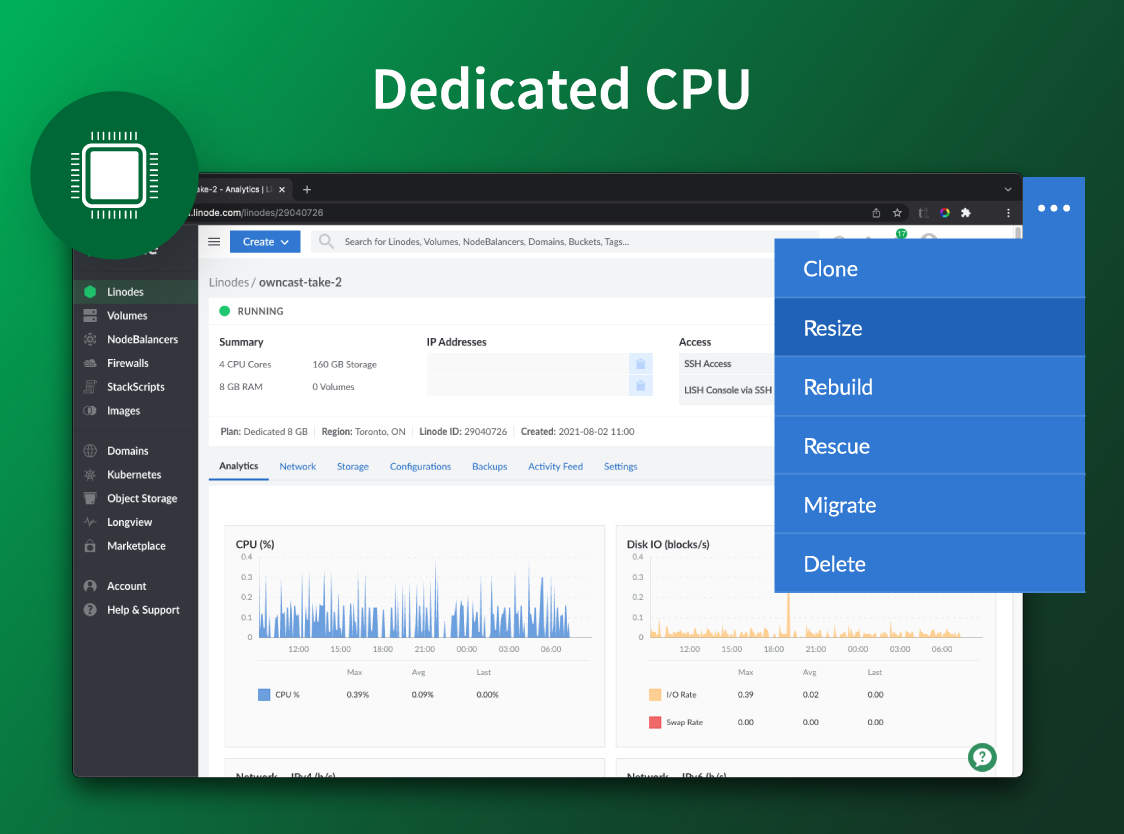
Akamai Cloud Computing (formerly Linode) include scalable and accessible Linux cloud solutions and services. These products and services support developers and enterprises as they build, deploy, secure, and scale applications.
F5 Distributed Cloud WAF leverages F5's Advanced WAF technology, delivering WAF-as-a-Service and combining signature- and behavior-based protection for web applications. It acts as an intermediate proxy to inspect application requests and responses to block and mitigate a broad spectrum of risks stemming from the OW ASP Top 10, persistent and coordinated threat campaigns, bots, and layer 7 DoS.
N/A
UpCloud
Score 8.1 out of 10
N/A
UpCloud is a global cloud hosting company offering cloud servers on an hourly billed infrastructure-as-a-service. Their IaaS services include MaxIOPS block storage, their Simple backup service, SDN services, and resource isolation.
CPU, transfer, storage, and RAM are bundled into one price. Storage capacity can be increased with additional Block Storage or S3-compatible Object Storage. Instant Backups can be added with complete independence to the stack. Linode NodeBalancers ensure applications are available.
Linode is cheaper than UpCloud, but disk IO is significantly slower. Linode and DigitalOcean pricing is on par, as are server specs. DO has more services like managed databases, but Linode support has proved significantly more helpful. Linode servers give you significantly more …
Linode ultimately has better value for money. Not as many features/services as AWS but they do cloud computing very well. Managed databases are something we’d like to see and it’s on Linode’s roadmap. AWS nickels and dimes you for everything. We’ve also considered UpCloud, …
We trialed UpCloud to see if it would be better than DigitalOcean but for our needs, it was not. On DigitalOcean once a droplet is created, almost no thought needs to go into maintenance, outages, or other reliability-based issues.
Akamai Connected Cloud Linode would be a good service to host a content delivery network (CDN) because of its edge network but I'd prefer not to use Akamai Connected Cloud Linode for tasks that need GPU power such as Machine Learning or Artificial Intelligence (AI) because Akamai Connected Cloud Linode lacks deep GPU compute compared to AWS or Google Cloud or Microsoft Azure
It helps our website to manage well during high traffic seasons and Holidays. This plaform manages the website overall performance and also protect it against DDoS attacks during these High demand period. It also protects transactions done on our website for the booking of services and products buying by our customers and keep their data safe.
If you're looking for a cost-effective solution then this is a good choice, be sure to keep on top of your balance! The 100% uptime is also a nice addition, although not unique in a cloud hosting service.
Layer seven attacks are becoming far more common. Traditionally it was always layered three, layer four, where you get an additional firewall, but with the application layer attacks become more frequent, more popular, et cetera. So having the web application firewall protecting us, and then with the recent Log4j, that's the most recent use case when it gave us that instant level of protection whilst we remediated the Log4j that we had that and the F5 Distributed Cloud WAF was protecting us.
I have a great relationship with the account manager, my account manager, and I think he drives the best price possible, um, for me, and I'm happy with that price.
F5 Distributed Cloud WAF is always innovating and evolving.
We run a very competitive proof value where we run numerous competitors against each other, and then we evaluate from that and then make the selection, and F5 Distributed Cloud WAF was the winner.
I've been with them a long time. They provide me with the capabilities I need coupled with knowledgeable support that's not pay-for-extra. However, if I move to a non-Linux OS, the level of support by necessity will drop off. I can still ask questions about the infrastructure but I my ability to ask about OS features will decrease.
We gave it an 8 because it protects our web apps well and is reliable. The WAF is flexible and meets most of our needs. It could improve in user interface and make integrations easier, but overall, it’s a solid and effective security tool for us.
Simple and clear, no BS interface. From a design perspective it's no Apple or Stripe, but it does what it needs without making me want to stick a fork in my eyes, like when being forced to use Azure, AWS or GCP.
I believe is a solution that was designed from the start to be simple and easy to use. Coming from Imperva, it simply eased the burden and complexity of managing and securing our apps on different environments (cloud and on-prem). It easy to scale and very quick to deploy (as a cloud waf should be), provide us with DevOps integrations, visibility and automatic insights from multiple events that guarantee peace of mind for us analysts and opp managers.
There is very little planned downtime. Whenever planned downtime is necessary I'm always given lots of advanced notice and an explanation that I can pass along to my users that they'll understand. I really appreciate that Linode appreciates my commitment to reliable service to my users. It shows that they believe they've been successful when I'm successful.
Servers are well dimensioned and price performant. Of course one always wants more, so if they were to upgrade their hardware for the same price I'd consider moving more workloads. Networking - never had an issue. Hardware speeds - disks are fast and can grow to great size.
Support was excellent and fast. The documentation is extensive and helpful. I learned many things from their online documentation. I did not contact them by phone, but email took a day or less. Complex problems would probably need a service contract. I liked the friendly and polite tone of the support.
We got kick started with an initial walkthrough along with some free credits. The initial walkthrough helped us to understand Linode's ecosystem and start our hands on with Linode. We tried out some apps from Marketplace initially with the free credits, which not only helped us understand Linode better, but also those apps. We had implemented many such apps to our customers with Linode
We're a small organization. The implementation of our Linode solution was trivial. Once I justified a cloud server to my bosses over a co-location -- the co-lo wasn't as fast as our linode server in load tests -- it was a matter of moving one Linux implementation to another. Trivial.
We switched to Linode from Namecheap due to poor uptime, and never had any issues with stability ever again after switching. We also cut our costs in half by switching. We compared Linode to DigitalOcean and Vultr, with the primary factor that caused us to go with Linode initially being their documentation. After using Linode for 3 years, their amazing support is another reason why we wouldn't consider anyone else at this point.
It provides fewer false positives and a more granular approach to eliminating them, allowing us to focus on threats. Also, with the need to secure both on-premise and cloud-based web applications, we can only use Azure on the cloud part, but we still need to cover on-premise apps with WAF, so we would need to double the time to deploy and manage. Also, its flexibility of deployment scenarios offers us a faster time to deploy WAF without adjusting the app delivery process to WAF's existence.
We trialed UpCloud to see if it would be better than DigitalOcean but for our needs, it was not. On DigitalOcean once a droplet is created, almost no thought needs to go into maintenance, outages, or other reliability-based issues.
Although I use only a fraction of their product offerings, the total set makes scalability an easy goal to shoot for. As I said, I have a few customers that use the services my Linode provides...and I like it that way. However, should I need to scale up, I can...without incurring any more cost than I need to.
The biggest gain for us was speed. Before F5 Distributed Cloud WAF, onboarding a new app to our WAF stack meant manual rule tuning, traffic sampling and regression testing. Right now, we spin up a service, tag it with the right policy and its ready (production ready) within hours