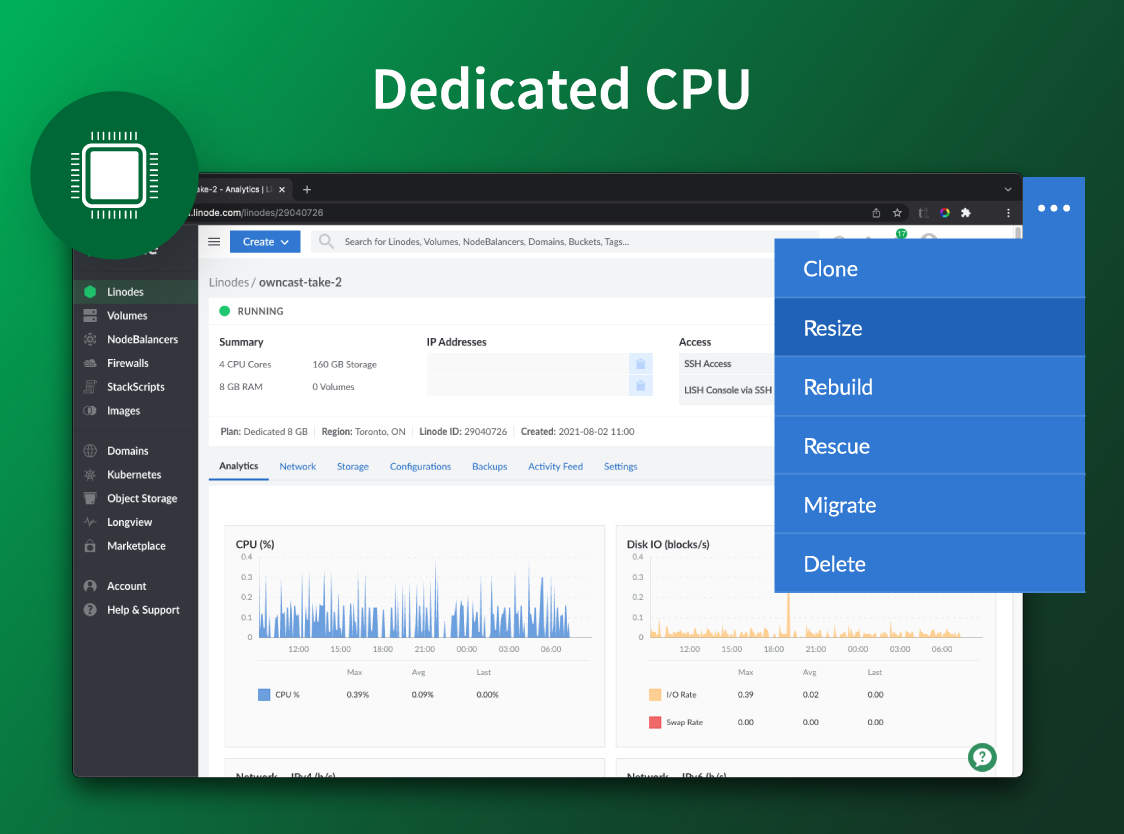
Akamai Cloud Computing (formerly Linode) include scalable and accessible Linux cloud solutions and services. These products and services support developers and enterprises as they build, deploy, secure, and scale applications.
$5
per month
Hitachi Enterprise Cloud
Score 7.0 out of 10
N/A
Hitachi Vantara offers the Hitachi Enterprise Cloud, an infrastructure-as-a-service platform. Hitachi provides a full portfolio of integrated hardware, software and enablement services designed to bring a pre-engineered level of efficiency and predictability to creating a cloud platform.
N/A
UpCloud
Score 8.1 out of 10
N/A
UpCloud is a global cloud hosting company offering cloud servers on an hourly billed infrastructure-as-a-service. Their IaaS services include MaxIOPS block storage, their Simple backup service, SDN services, and resource isolation.
$0.09
per month per GB
Pricing
Akamai Cloud Computing
Hitachi Enterprise Cloud
UpCloud
Editions & Modules
No answers on this topic
No answers on this topic
Private Cloud Storage
€0.085
per month per GB
Block Storage - Standard
€0.085
per month
Block Storage - MaxIOPS
€0.220
per month
SDN Private Networks - Floating IP address
€3.15
per month
Private Cloud Hosts -Standard Nodes
€2,499
per month
Cloud Servers - General Purpose
Starting from €7
per month
GPU Servers
Starting from €1.111
per hour
Cloud Servers - High CPU
Starting from €130
per month
Cloud Servers - Developer
Starting from €3
per month
Cloud Servers - High Memory
Starting from €40
per month
Cloud Servers - Cloud Native
Starting from €12
per month
Relational Databases - 1 Node
Starting from €30
per month
Managed Object Storage
starting from €5
per month 250GB
Offerings
Pricing Offerings
Akamai Cloud Computing
Hitachi Enterprise Cloud
UpCloud
Free Trial
Yes
No
Yes
Free/Freemium Version
No
No
No
Premium Consulting/Integration Services
Yes
No
No
Entry-level Setup Fee
Optional
No setup fee
No setup fee
Additional Details
CPU, transfer, storage, and RAM are bundled into one price. Storage capacity can be increased with additional Block Storage or S3-compatible Object Storage. Instant Backups can be added with complete independence to the stack. Linode NodeBalancers ensure applications are available.
Linode is cheaper than UpCloud, but disk IO is significantly slower. Linode and DigitalOcean pricing is on par, as are server specs. DO has more services like managed databases, but Linode support has proved significantly more helpful. Linode servers give you significantly more …
Linode ultimately has better value for money. Not as many features/services as AWS but they do cloud computing very well. Managed databases are something we’d like to see and it’s on Linode’s roadmap. AWS nickels and dimes you for everything. We’ve also considered UpCloud, …
We trialed UpCloud to see if it would be better than DigitalOcean but for our needs, it was not. On DigitalOcean once a droplet is created, almost no thought needs to go into maintenance, outages, or other reliability-based issues.
Akamai Connected Cloud Linode would be a good service to host a content delivery network (CDN) because of its edge network but I'd prefer not to use Akamai Connected Cloud Linode for tasks that need GPU power such as Machine Learning or Artificial Intelligence (AI) because Akamai Connected Cloud Linode lacks deep GPU compute compared to AWS or Google Cloud or Microsoft Azure
1) If you are gathering lots of data from many different points and transforming that data into something customized, and you need it secure yet accessible, this is a great option. 2) If you are looking for a platform and not just a service provider, this would be a great option. As a platform, there is a one-stop-shop feeling that gets you some better customer service and performance. But it also locks you into one provider, so don’t jump in if you feel like you’ll want a lot of flexibility. 3) Building or running VMware is really what this platform is all about. If you’re creating an app drawing from some complex data/sources, it’s an easier go with this tool than most others.
If you're looking for a cost-effective solution then this is a good choice, be sure to keep on top of your balance! The 100% uptime is also a nice addition, although not unique in a cloud hosting service.
It fills a niche that was needed before we as a company fully embraced the cloud with Azure. It was a great introduction to the cloud and there are some features I wish were more readily available with some of our Azure tools. Staying on top of your expenses is much harder without the transparency Hitachi provides.
It allows the small team managing it to simplify cloud operations using prebuilt computing and storage templates. Very easy to monitor, manage and optimize cloud operations.
Pre-Engineered, turnkey solutions with prebuilt services make it quick and easy to select the service needed for each app. With many different suppliers, we cater to many different connectors.
Their ability to offer a public cloud solution that feels like a private cloud solution is a great feature, but not one that is easily understood outside of someone using the tool. I think they need more training and marketing around what they can do for cloud-native development.
I think they are lacking a solution to play in other playgrounds easily. Many of their offerings are better than what Azure provides, so I think there is room for them to leverage Azure size with customized, personalized features.
They really need something big to set them apart from the larger players in this space. I think of Snowflake with their amazing pricing model and the “oops!” button that undoes serious accidental deletes. Something like that would grow the user base and make it a major player.
I've been with them a long time. They provide me with the capabilities I need coupled with knowledgeable support that's not pay-for-extra. However, if I move to a non-Linux OS, the level of support by necessity will drop off. I can still ask questions about the infrastructure but I my ability to ask about OS features will decrease.
Simple and clear, no BS interface. From a design perspective it's no Apple or Stripe, but it does what it needs without making me want to stick a fork in my eyes, like when being forced to use Azure, AWS or GCP.
There is very little planned downtime. Whenever planned downtime is necessary I'm always given lots of advanced notice and an explanation that I can pass along to my users that they'll understand. I really appreciate that Linode appreciates my commitment to reliable service to my users. It shows that they believe they've been successful when I'm successful.
Servers are well dimensioned and price performant. Of course one always wants more, so if they were to upgrade their hardware for the same price I'd consider moving more workloads. Networking - never had an issue. Hardware speeds - disks are fast and can grow to great size.
Support was excellent and fast. The documentation is extensive and helpful. I learned many things from their online documentation. I did not contact them by phone, but email took a day or less. Complex problems would probably need a service contract. I liked the friendly and polite tone of the support.
We got kick started with an initial walkthrough along with some free credits. The initial walkthrough helped us to understand Linode's ecosystem and start our hands on with Linode. We tried out some apps from Marketplace initially with the free credits, which not only helped us understand Linode better, but also those apps. We had implemented many such apps to our customers with Linode
We're a small organization. The implementation of our Linode solution was trivial. Once I justified a cloud server to my bosses over a co-location -- the co-lo wasn't as fast as our linode server in load tests -- it was a matter of moving one Linux implementation to another. Trivial.
We switched to Linode from Namecheap due to poor uptime, and never had any issues with stability ever again after switching. We also cut our costs in half by switching. We compared Linode to DigitalOcean and Vultr, with the primary factor that caused us to go with Linode initially being their documentation. After using Linode for 3 years, their amazing support is another reason why we wouldn't consider anyone else at this point.
Hitachi Enterprise Cloud is a pleasant surprise, offering better management and control of your cloud containers and VMware. It is a platform and contains all you need to get going, so there is great appeal in smaller companies and isolated divisions/departments in larger companies. If I were managing a small group with a specific endpoint I would no doubt choose a solution like this, but being a large corporation we tend to drive towards larger solutions with internal competencies to support those larger roll-outs.
We trialed UpCloud to see if it would be better than DigitalOcean but for our needs, it was not. On DigitalOcean once a droplet is created, almost no thought needs to go into maintenance, outages, or other reliability-based issues.
Although I use only a fraction of their product offerings, the total set makes scalability an easy goal to shoot for. As I said, I have a few customers that use the services my Linode provides...and I like it that way. However, should I need to scale up, I can...without incurring any more cost than I need to.
The positive pricing aspect has been with the rate card and compute pricing transparency, being better able to manage the budget.
It is a small solution for us, so we are probably not realizing the potential savings we could get by rolling all our corporate cloud work into a single solution, but it is also good to keep multiple irons in the fire, so to speak.
The implementation has done very well in a small, controlled atmosphere. So while the ROI may not have been as high as we’d like to see, the success of the project has made it valuable none the less.