Apache Airflow is an open source tool that can be used to programmatically author, schedule and monitor data pipelines using Python and SQL.
N/A
Skyvia
Score 10.0 out of 10
Mid-Size Companies (51-1,000 employees)
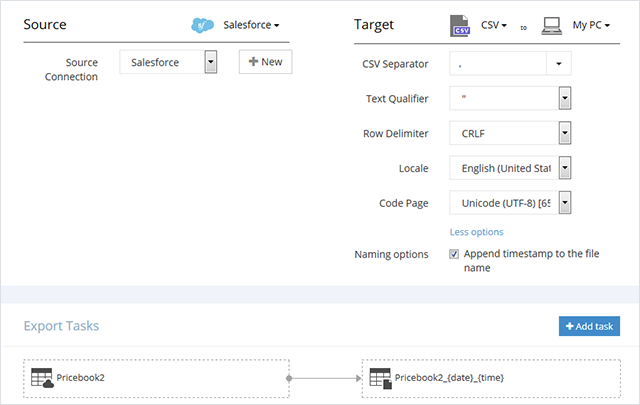
Skyvia is a no-code cloud data integration platform for ETL, ELT, Reverse ETL, data migration, one-way and bi-directional data sync, workflow automation, and real-time connectivity. Benefits of Using Skyvia: • Cost efficiency: With flexible pricing plans for each product, Skyvia suites for businesses of any size. • Flexibility: Skyvia provides adaptable, no-code integration tools for both basic and advanced business…
$99
per month
Zapier
Score 8.9 out of 10
N/A
The Zapier Automation Platform designed to integrate data between web apps. It is scaled for small to mid-sized businesses, with a functional but limited free version of the program.
$29.99
per month 750 tasks per month
Pricing
Apache Airflow
Skyvia
Zapier
Editions & Modules
No answers on this topic
Basic
$99
per month
Standard
$199
per month
Professional
$249
per month
Starter
$29.99
per month 750 tasks per month
Professional
$73.50
per month 2k tasks per month
Team
$103.50
per month 2k tasks per month
Company
Contact Sales
Offerings
Pricing Offerings
Apache Airflow
Skyvia
Zapier
Free Trial
No
Yes
No
Free/Freemium Version
Yes
Yes
Yes
Premium Consulting/Integration Services
No
No
No
Entry-level Setup Fee
No setup fee
No setup fee
No setup fee
Additional Details
—
20% discount for annual pricing.
33% discount for annual pricing.
More Pricing Information
Community Pulse
Apache Airflow
Skyvia
Zapier
Features
Apache Airflow
Skyvia
Zapier
Workload Automation
Comparison of Workload Automation features of Product A and Product B
Apache Airflow
8.6
12 Ratings
4% above category average
Skyvia
-
Ratings
Zapier
-
Ratings
Multi-platform scheduling
9.212 Ratings
00 Ratings
00 Ratings
Central monitoring
8.812 Ratings
00 Ratings
00 Ratings
Logging
8.412 Ratings
00 Ratings
00 Ratings
Alerts and notifications
9.212 Ratings
00 Ratings
00 Ratings
Analysis and visualization
6.512 Ratings
00 Ratings
00 Ratings
Application integration
9.412 Ratings
00 Ratings
00 Ratings
Data Source Connection
Comparison of Data Source Connection features of Product A and Product B
Apache Airflow
-
Ratings
Skyvia
9.6
25 Ratings
15% above category average
Zapier
-
Ratings
Connect to traditional data sources
00 Ratings
9.625 Ratings
00 Ratings
Data Transformations
Comparison of Data Transformations features of Product A and Product B
Apache Airflow
-
Ratings
Skyvia
9.3
22 Ratings
14% above category average
Zapier
-
Ratings
Simple transformations
00 Ratings
9.322 Ratings
00 Ratings
Data Modeling
Comparison of Data Modeling features of Product A and Product B
Apache Airflow
-
Ratings
Skyvia
9.4
20 Ratings
18% above category average
Zapier
-
Ratings
Data model creation
00 Ratings
8.817 Ratings
00 Ratings
Business rules and workflow
00 Ratings
10.016 Ratings
00 Ratings
Cloud Data Integration
Comparison of Cloud Data Integration features of Product A and Product B
Airflow is well-suited for data engineering pipelines, creating scheduled workflows, and working with various data sources. You can implement almost any kind of DAG for any use case using the different operators or enforce your operator using the Python operator with ease. The MLOps feature of Airflow can be enhanced to match MLFlow-like features, making Airflow the go-to solution for all workloads, from data science to data engineering.
A great tool for both prototyping and developing models to extract or query of data. When you don't have a specialised developer for pulling data, Skyvia is great solution. Very affordable for us. We did not find any areas where Skyvia let us down so very happy to recommend it to other users.
If you have processes that are now managed and controlled using a spreadsheet, Zapier will give you a lot more control over what is happening and will help you increase productivity by eliminating simple steps such as sending emails and sharing information with your colleagues. It frees time for very transactional activities.
Apache Airflow is one of the best Orchestration platforms and a go-to scheduler for teams building a data platform or pipelines.
Apache Airflow supports multiple operators, such as the Databricks, Spark, and Python operators. All of these provide us with functionality to implement any business logic.
Apache Airflow is highly scalable, and we can run a large number of DAGs with ease. It provided HA and replication for workers. Maintaining airflow deployments is very easy, even for smaller teams, and we also get lots of metrics for observability.
Ease of use - multiple people in the organization can set up and run Zaps per their specific use cases without much training.
Connectivity - Zapier is able to connect to multiple applications we use on a regular basis.
Functionality - Zapier provides embedded functionality within the app itself (email, data conversion), but also appropriate triggers and actions for apps it connects to.
Versatile - Zapier can execute complicated and simple tasks and thus has many use cases.
UI/Dashboard can be updated to be customisable, and jobs summary in groups of errors/failures/success, instead of each job, so that a summary of errors can be used as a starting point for reviewing them.
Navigation - It's a bit dated. Could do with more modern web navigation UX. i.e. sidebars navigation instead of browser back/forward.
Again core functional reorg in terms of UX. Navigation can be improved for core functions as well, instead of discovery.
For its capability to connect with multicloud environments. Access Control management is something that we don't get in all the schedulers and orchestrators. But although it provides so many flexibility and options to due to python , some level of knowledge of python is needed to be able to build workflows.
Loved using Skyvia for our projects, it saved time, allowed us to reach the desired outcome quickly and was easy to maintain. When we first used it we weren't sure we would be able achieve the outcome desired but during the trial it was quickly obvious we would be able to achieve what we needed for data connection and reporting.
The interface is very user-friendly, and there are also many tools to help a brand-new user get started. For example, you can put your Zap idea into the AI bot, and it will basically build a shell of your Zap to get started on. The format for each step within a Zap is also very helpful (set up the connection/app, set up the fields/details, then test).
Before we purchased Zapier, I contacted support and asked them if Zapier could support my intended workflow (this is actually a selection on their support form - awesome). Within 2 hours, I was contacted by a support team member who seemed sure it would work, but granted me premium access for 2 weeks to try it out for myself. Sure enough, it did! Ever since then, support has replied rapidly to any problems I have experienced and answered my questions within a few sentences.
Multiple DAGs can be orchestrated simultaneously at varying times, and runs can be reproduced or replicated with relative ease. Overall, utilizing Apache Airflow is easier to use than other solutions now on the market. It is simple to integrate in Apache Airflow, and the workflow can be monitored and scheduling can be done quickly using Apache Airflow. We advocate using this tool for automating the data pipeline or process.
Compared to similar user-friendly data integration systems like Integrate.io, Stitch, or Azure, Skyvia still wins in the number of connectors and pricing policy. Skyvia is a tool for companies like ours, starving for simple but, at the same time, robust and cost-effective data transfer solutions. It doesn't require additional knowledge for implementation and usage because it's no code. We'd recommend Skyvia as the best solution for non-technical staff.
We actually utilize both Integromat and Zapier at our company, for all the reasons detailed in this review. Though Zapier is excellent for simple client integrations, we often run into internal use cases that require complexity that Zapier cannot provide. Specifically working with API calls (not just webhooks), complex multi-step integrations with Routing/parsing/etc, and large volume integrations. Integromat is perfect for these use cases, but doesn’t provide the simplicity and account scalability that Zapier offers.
Impact Depends on number of workflows. If there are lot of workflows then it has a better usecase as the implementation is justified as it needs resources , dedicated VMs, Database that has a cost
The core of our business lies in analyzing data from various sources, and while ETL itself is not our primary focus, it is a necessary process to achieve our goals. Thanks to Skyvia, we are able to streamline the ETL process at a reasonable price, allowing us to dedicate our efforts to data analysis without the burden of ETL complexities.