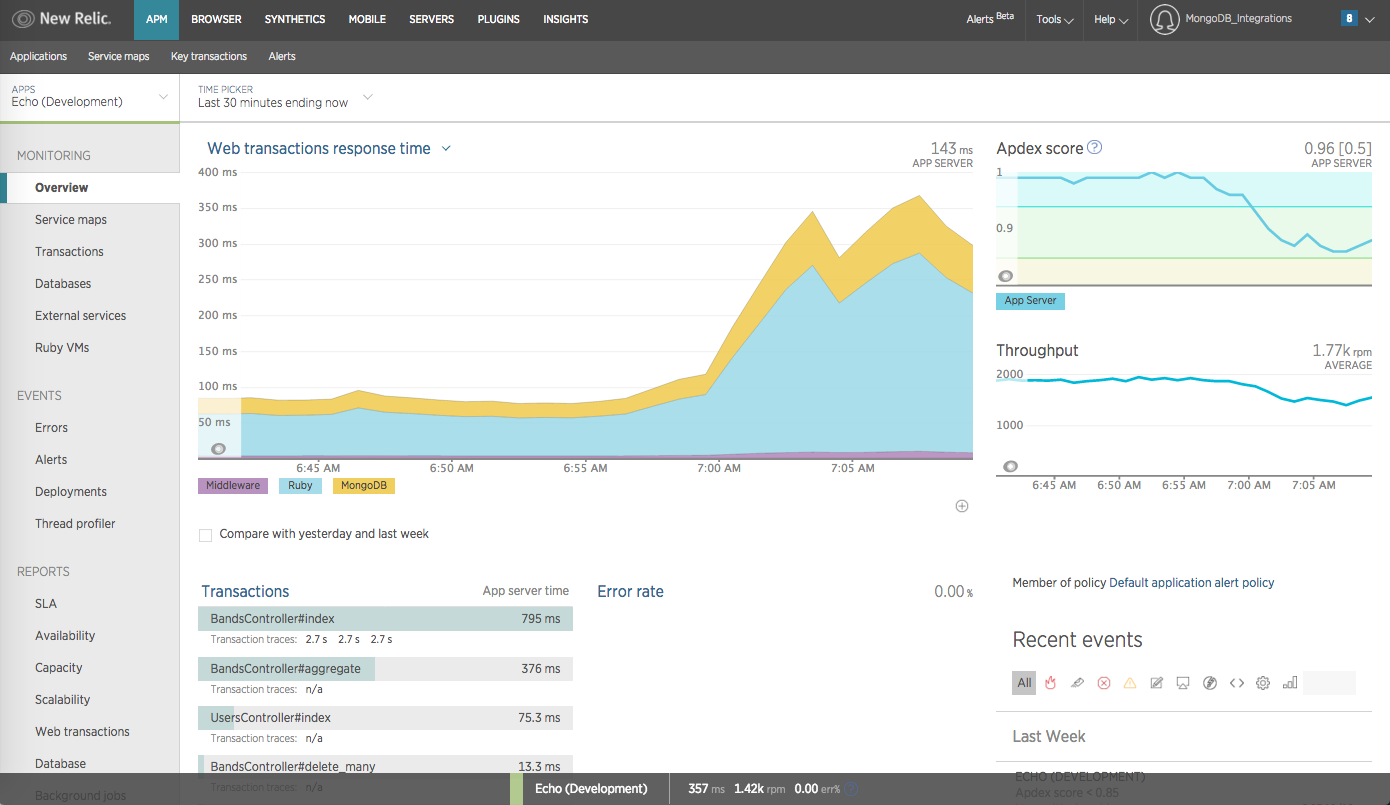
MongoDB is an open source document-oriented database system. It is part of the NoSQL family of database systems. Instead of storing data in tables as is done in a "classical" relational database, MongoDB stores structured data as JSON-like documents with dynamic schemas (MongoDB calls the format BSON), making the integration of data in certain types of applications easier and faster.
$0.10
million reads
PostgreSQL
Score8.8 out of 10
N/A
PostgreSQL (alternately Postgres) is a free and open source object-relational database system boasting over 30 years of active development, reliability, feature robustness, and performance. It supports SQL and is designed to support various workloads flexibly.
N/A
Pricing
Cassandra
MongoDB
PostgreSQL
Editions & Modules
No answers on this topic
Shared
$0
per month
Serverless
$0.10million reads
million reads
Dedicated
$57
per month
No answers on this topic
Offerings
Pricing Offerings
Cassandra
MongoDB
PostgreSQL
Free Trial
No
Yes
No
Free/Freemium Version
No
Yes
No
Premium Consulting/Integration Services
No
No
No
Entry-level Setup Fee
No setup fee
No setup fee
No setup fee
Additional Details
—
Fully managed, global cloud database on AWS, Azure, and GCP
A de minimis incentive was given to thank the reviewer for their time. The incentive was not used to bias or drive a particular response, nor was the incentive contingent on a positive endorsement. More Info
IT Strategic Technical Advisor in Information Technology at FedEx Express (Package/Freight Delivery, 10,001+ employees)
Chose Cassandra
We evaluated MongoDB also, but don't like the single point failure possibility. The HBase coupled us too tightly to the Hadoop world while we prefer more technical flexibility. Also HBase is designed for "cold"/old historical data lake use cases and is not typically used for …
A de minimis incentive was given to thank the reviewer for their time. The incentive was not used to bias or drive a particular response, nor was the incentive contingent on a positive endorsement. More Info
Staff Software Engineer in Information Technology at Intuit (Computer Software, 5001-10,000 employees)
Chose Cassandra
Apache Cassandra has the best of both worlds, it is a Java based NoSQL, linearly scalable, best in class
tunable performance across different workloads, fault tolerant, distributed, masterless, time series database. We have used both Apache HBase and MongoDB for some use cases …
A de minimis incentive was given to thank the reviewer for their time. The incentive was not used to bias or drive a particular response, nor was the incentive contingent on a positive endorsement. More Info
Chief Technology Officer in Information Technology at Algorithmic Ads (Marketing and Advertising, 1-10 employees)
Chose Cassandra
Four years ago, I needed to choose a web-scale database. Having used relational databases for years (PostgreSQL is my favorite), I needed something that could perform well at scale with no downtime. I considered VoltDB for its in-memory speed, but it's limited in scale. I …
A de minimis incentive was given to thank the reviewer for their time. The incentive was not used to bias or drive a particular response, nor was the incentive contingent on a positive endorsement. More Info
Verified User
Chose Cassandra
DynamoDB is good and is also a truly global database as a service on AWS. However, if your organization is not using AWS, then Cassandra will provide a highly scalable and tuneable, consistent database. Cassandra is also fault-tolerant and good for replication across multiple …
A de minimis incentive was given to thank the reviewer for their time. The incentive was not used to bias or drive a particular response, nor was the incentive contingent on a positive endorsement. More Info
Lead Engineer Consultant in Information Technology at TEKSystems [Client : Target] (Retail, 10,001+ employees)
Chose Cassandra
Technology selection should be done based on the need and not based on buzz words in the market (google searching). If your data need flat file approach and more searchable based on index and partition keys, then it's better to go for Cassandra. Cassandra is a better choice …
A de minimis incentive was given to thank the reviewer for their time. The incentive was not used to bias or drive a particular response, nor was the incentive contingent on a positive endorsement. More Info
Verified User
Chose Cassandra
Cassandra is the only NoSQL database I have extensive experience with. In terms of other open source database solutions, I can say that I like Cassandra as much or equally as traditional Oracle MySQL, and a lot more than PostgresSQL. The decision to use Cassandra was driven by …
A de minimis incentive was given to thank the reviewer for their time. The incentive was not used to bias or drive a particular response, nor was the incentive contingent on a positive endorsement. More Info
Data Lord in Engineering at PlaceIQ (Marketing and Advertising, 51-200 employees)
Chose Cassandra
Against HBase, writes were faster. Reads not so much. Also ability to store in other formats would be good (such as objects). Compared to aerospike, does not compare. Aerospike blows it out of water.
A de minimis incentive was given to thank the reviewer for their time. The incentive was not used to bias or drive a particular response, nor was the incentive contingent on a positive endorsement. More Info
Verified User
Chose Cassandra
These are the features which makes Cassandra different from others:
Cassandra is a distributed datastore, with a built-in coordinator. This means that requests are intelligently forwarded to the correct node.
It is generally very fast, and especially shines with write heavy …
A de minimis incentive was given to thank the reviewer for their time. The incentive was not used to bias or drive a particular response, nor was the incentive contingent on a positive endorsement. More Info
Java Software Engineer in Information Technology at EPAM Anywhere (Information Technology & Services, 10,001+ employees)
Chose MongoDB
We have [measured] the speed in reading/write operations in high load and finally select the winner = MongoDBWe have [not] too much data but in case there will be 10 [times] more we need Cassandra. Cassandra's storage engine provides constant-time writes no matter how big your …
A de minimis incentive was given to thank the reviewer for their time. The incentive was not used to bias or drive a particular response, nor was the incentive contingent on a positive endorsement. TR verified that a representative sample of customers was invited. More Info
Development Team Lead in Engineering at Xactware (Insurance, 1001-5000 employees)
Chose MongoDB
Looking into PostgreSQL happened post move to Mongo. Had we considered both options at the time we likely would have went with PostgreSQL. We may migrate at some point in the future but currently it doesn't make sense.
A de minimis incentive was given to thank the reviewer for their time. The incentive was not used to bias or drive a particular response, nor was the incentive contingent on a positive endorsement. More Info
A de minimis incentive was given to thank the reviewer for their time. The incentive was not used to bias or drive a particular response, nor was the incentive contingent on a positive endorsement. More Info
Verified User
Chose MongoDB
Both Couchbase and MongoDB are document-oriented NoSQL databases, so they have very similar features. While they do have some fundamental differences in terms of how they scale, shard, etc. the one key reason why we went with MongoDB is its availability and support from the …
A de minimis incentive was given to thank the reviewer for their time. The incentive was not used to bias or drive a particular response, nor was the incentive contingent on a positive endorsement. More Info
Verified User
Chose MongoDB
The flexible structure underlying MongoDB's construction is not found in other competitors; the ability to easily change the structure without affecting other stored documents. It is very ideal for projects that you cannot predict that the structure will change this way. Of …
A de minimis incentive was given to thank the reviewer for their time. The incentive was not used to bias or drive a particular response, nor was the incentive contingent on a positive endorsement. More Info
Verified User
Chose MongoDB
I would say Cassandra is better than MongoDB since it has the backing of Facebook to it. Its inherent properties like versioning put it into the other category of columnar databases, but it's one of the NoSQL databases which you should definitely consider for your organization …
A de minimis incentive was given to thank the reviewer for their time. The incentive was not used to bias or drive a particular response, nor was the incentive contingent on a positive endorsement. More Info
A de minimis incentive was given to thank the reviewer for their time. The incentive was not used to bias or drive a particular response, nor was the incentive contingent on a positive endorsement. More Info
A de minimis incentive was given to thank the reviewer for their time. The incentive was not used to bias or drive a particular response, nor was the incentive contingent on a positive endorsement. More Info
Verified User
Chose MongoDB
MongoDB is our go-to database solution for any project, and the more we work with it the more we love it. Some say that NoSQL is pointless... Our developers wholeheartedly disagree, because they love working with it. Though both NoSQL and SQL have their purposes, in most …
A de minimis incentive was given to thank the reviewer for their time. The incentive was not used to bias or drive a particular response, nor was the incentive contingent on a positive endorsement. More Info
Senior Software Engineer in Engineering at Seebo (Internet, 11-50 employees)
Chose MongoDB
Your default choice should not be MongoDB in my opinion. Most user-facing systems are relational by nature so a well known and reliable SQL database would be easier to maintain and simpler to develop long term. If you highly value speed of development go with Firebase. If you …
A de minimis incentive was given to thank the reviewer for their time. The incentive was not used to bias or drive a particular response, nor was the incentive contingent on a positive endorsement. More Info
Ab Initio Developer in Research & Development at Tata Consultancy Services (Information Technology and Services, 10,001+ employees)
Chose MongoDB
MongoDB and Cassandra are both database system from the NoSQL family. MongoDB can be used in lots of use cases while Cassandra has a specific usage. There are some features that MongoDB provides efficiently while Cassandra doesn't and vice-versa. Like, you can update the data …
A de minimis incentive was given to thank the reviewer for their time. The incentive was not used to bias or drive a particular response, nor was the incentive contingent on a positive endorsement. More Info
Verified User
Chose MongoDB
We tend to choose MongoDB when we're faced with a particular situation: we know that we need a NoSQL database in general, and want an open-source implementation that allows us to prevent against platform lock-in. Amazon's new DocumentDB product even allows us to choose to use …
A de minimis incentive was given to thank the reviewer for their time. The incentive was not used to bias or drive a particular response, nor was the incentive contingent on a positive endorsement. More Info
Verified User
Chose MongoDB
In the beginning, we considered several products in the market. Since our project was a science and research project, our budget wasn't as big as a commercial project, but still, we wanted the product to be scalable so that we could deal with "smooth transition" from research …
A de minimis incentive was given to thank the reviewer for their time. The incentive was not used to bias or drive a particular response, nor was the incentive contingent on a positive endorsement. More Info
Senior Software Engineer in Engineering at Rocketrip (Computer Software, 11-50 employees)
Chose MongoDB
MongoDB is the best NoSQL database out there. There are others, but Mongo has the largest community, is very easy to set up, and is extremely performant. Compared to a relational DB (like MySQL or Postgres) is like comparing apples and oranges. One isn't better or worse than …
A de minimis incentive was given to thank the reviewer for their time. The incentive was not used to bias or drive a particular response, nor was the incentive contingent on a positive endorsement. More Info
Verified User
Chose MongoDB
MongoDB is very easy to use and the best advantage is the NoSQL database. No concept of the relational database.
A de minimis incentive was given to thank the reviewer for their time. The incentive was not used to bias or drive a particular response, nor was the incentive contingent on a positive endorsement. More Info
Developer in Research & Development at By the Book, Inc (Software For Churches/NonProfits) (Religious Institutions, 1-10 employees)
Chose MongoDB
I recently tried out Firestore from the Google firebase family of development products. While it allows structuring of data similar to MongoDB, it handles things a little differently. MongoDB documents are incredibly flexible and can be structured really any way you can …
A de minimis incentive was given to thank the reviewer for their time. The incentive was not used to bias or drive a particular response, nor was the incentive contingent on a positive endorsement. More Info
A de minimis incentive was given to thank the reviewer for their time. The incentive was not used to bias or drive a particular response, nor was the incentive contingent on a positive endorsement. More Info
A de minimis incentive was given to thank the reviewer for their time. The incentive was not used to bias or drive a particular response, nor was the incentive contingent on a positive endorsement. More Info
Senior Software Engineer in Information Technology at Accion Labs (Information Technology and Services, 1001-5000 employees)
Chose MongoDB
From the beginning, we thought we would have a large volume of data, so MongoDB was a natural choice. Next we started the project and found MongoDB is also developing new features that are more like SQL which was very nice for us. As data volume is growing with time, no need to …
A de minimis incentive was given to thank the reviewer for their time. The incentive was not used to bias or drive a particular response, nor was the incentive contingent on a positive endorsement. More Info
Verified User
Chose MongoDB
Cassandra: may be better for bigger use cases, in PB range, due to our use cases being slightly smaller, we did not need this, but we highly rely on efficient indexing, and low latency, which seemed to be better based on our testing in Mongodb. Couchbase Server: Document …
A de minimis incentive was given to thank the reviewer for their time. The incentive was not used to bias or drive a particular response, nor was the incentive contingent on a positive endorsement. More Info
Information Technology Manager in Information Technology at rit (Information Technology and Services, 51-200 employees)
Chose MongoDB
MongoDB provides better performance on a big database. If you prefer to define indexes rather than a map/reduce function, MongoDB is good for you. It's quick to start it up and very easy to learn, basically no entry barrier. MongoDB's community is very welcoming.
A de minimis incentive was given to thank the reviewer for their time. The incentive was not used to bias or drive a particular response, nor was the incentive contingent on a positive endorsement. More Info
Verified User
Chose MongoDB
I have used KairosDB, Cassandra and MySQL and mongodb proves out to be the best of them. Mainly due to it being a document-oriented database.
A de minimis incentive was given to thank the reviewer for their time. The incentive was not used to bias or drive a particular response, nor was the incentive contingent on a positive endorsement. More Info
A de minimis incentive was given to thank the reviewer for their time. The incentive was not used to bias or drive a particular response, nor was the incentive contingent on a positive endorsement. More Info
PostgreSQL Global Development Group
Verified User
Chose PostgreSQL
MySQL is a popular open-source alternative to PostgreSQL, but in my experience it lacks the robustness, durability, and flexibility of PostgreSQL. It has also changed hands frequently, so support isn't the greatest. MongoDB and other NoSQL databases are helpful in certain …
A de minimis incentive was given to thank the reviewer for their time. The incentive was not used to bias or drive a particular response, nor was the incentive contingent on a positive endorsement. More Info
Lider de Proyecto in Information Technology at ARCA International Group (Banking, 201-500 employees)
Chose PostgreSQL
Despite being all open source options, what ended up making us choose PostgreSQL was the robustness of its core, which allows the great workflow that can support timely and efficient response to the demand and demand for resources. In the case of MongoDB, it is a non-relational …
A de minimis incentive was given to thank the reviewer for their time. The incentive was not used to bias or drive a particular response, nor was the incentive contingent on a positive endorsement. More Info
Software Developer in Information Technology at Curve Dental, Inc. (Information Technology and Services, 11-50 employees)
Chose PostgreSQL
The features between these database are quite comparable - except for possibly MongoDB. MongoDB being a different type of database and geared towards big data - I don't compare it to PostgreSQL. The other two I have used and would say PostgreSQL does fairly well when compared …
A de minimis incentive was given to thank the reviewer for their time. The incentive was not used to bias or drive a particular response, nor was the incentive contingent on a positive endorsement. More Info
Consultant and author in Professional Services at The Data Studio (Computer Software, 1-10 employees)
Chose PostgreSQL
In my experience using all of these products over many years, PostgreSQL is better than any of them in reliability, performance, productivity, cost, scalability and interoperability across operating systems.
A de minimis incentive was given to thank the reviewer for their time. The incentive was not used to bias or drive a particular response, nor was the incentive contingent on a positive endorsement. More Info
Software Engineer L3 in Engineering at ReliableSoft Technologies Pvt. Ltd. - India (Computer Software, 51-200 employees)
Chose PostgreSQL
First It's open source and it's cost-effective compared to other databases.PostgreSQL can be easily integrated with numerous platforms. It is well known and appreciated so relying on it as our system database can be easily accepted by our customers. And if your developing a …
A de minimis incentive was given to thank the reviewer for their time. The incentive was not used to bias or drive a particular response, nor was the incentive contingent on a positive endorsement. More Info
Principal Engineer in Engineering at Booster Fuels (Transportation/Trucking/Railroad, 51-200 employees)
Chose PostgreSQL
When we were originally evaluating Redshift we ran into some issue with dates. Either way, Postgres is a better choice than Redshift because it avoids vendor lockin. We ended up choosing Postgres over MySQL because it was easier at the time to get a hosted Postgres cluster up …
A de minimis incentive was given to thank the reviewer for their time. The incentive was not used to bias or drive a particular response, nor was the incentive contingent on a positive endorsement. More Info
Verified User
Chose PostgreSQL
As I have been telling all along, PostgreSQL is much cheaper compared to the other RDBMS solutions. It has got better performance with some of the application services that we are using and is easy to maintain. Overall, we are satisfied migrating to PostgreSQL database clusters.
A de minimis incentive was given to thank the reviewer for their time. The incentive was not used to bias or drive a particular response, nor was the incentive contingent on a positive endorsement. More Info
Vice President of Information Technology in Information Technology at MedSurvey (Market Research, 11-50 employees)
Chose PostgreSQL
Much more mature and stable when compared to MySQL with features such as MVCC, complex subquery plans, ORDBMS, and NoSQL support. With Oracle retaining rights to MySQL its future as an open database is less secure and is no longer in the hands of the community. PostgreSQL also …
A de minimis incentive was given to thank the reviewer for their time. The incentive was not used to bias or drive a particular response, nor was the incentive contingent on a positive endorsement. More Info
Data Czar in Engineering at Envisagenics, Inc. (Biotechnology, 11-50 employees)
Chose PostgreSQL
PostgrPostgreSQL as a transaction db engine against oracle and sql server works well. TPM wise compared to MySQL and MariaDB, on an evan scale. SQL function supports, far outweighs compared to MySQL and MariaDB. PG Extensions allow for flexibiltity and scalability. Allows …
A de minimis incentive was given to thank the reviewer for their time. The incentive was not used to bias or drive a particular response, nor was the incentive contingent on a positive endorsement. More Info
Senior Staff Engineer in Engineering at SafetyCulture Pty Ltd (Computer Software, 201-500 employees)
Chose PostgreSQL
We selected PostgreSQL due to the number of employees who have used it in the past. The data consistency guarantees. The multiple transaction isolation levels support.
A de minimis incentive was given to thank the reviewer for their time. The incentive was not used to bias or drive a particular response, nor was the incentive contingent on a positive endorsement. More Info
Technical Lead in Information Technology at Sphere (Health, Wellness and Fitness, 11-50 employees)
Chose PostgreSQL
PostgreSQL outperforms every other option. It is faster, more flexible, more reliable, easier to maintain, and more consistent in behaviour than any of the other offerings.
A de minimis incentive was given to thank the reviewer for their time. The incentive was not used to bias or drive a particular response, nor was the incentive contingent on a positive endorsement. More Info
Software Developer in Engineering at Webvalto Ltd. (Banking, 51-200 employees)
Chose PostgreSQL
It's a viable alternative, with a rich feature set and a reliable system. PostgreSQL is one of the best RDBMS's currently on the market in 2020, it serves just as well as a starter, PoC DB for any software idea as a final, highly valuable database solution for big systems.
A de minimis incentive was given to thank the reviewer for their time. The incentive was not used to bias or drive a particular response, nor was the incentive contingent on a positive endorsement. More Info
Verified User
Chose PostgreSQL
PostgreSQL is the proper tool when data consistency matters and other BASE or document-based databases are simply improper. I think PostgreSQL has a fantastic system of slony replication, triggers, and other data maintenance functionality that other databases generally don't …
A de minimis incentive was given to thank the reviewer for their time. The incentive was not used to bias or drive a particular response, nor was the incentive contingent on a positive endorsement. More Info
Verified User
Chose PostgreSQL
I found PostgreSQL to be better compared to MySQL. The community support is very good. Some features that I feel are not present in MySQL are:
A de minimis incentive was given to thank the reviewer for their time. The incentive was not used to bias or drive a particular response, nor was the incentive contingent on a positive endorsement. More Info
Research Assistant in Engineering at Apple (Research, 5001-10,000 employees)
Chose PostgreSQL
Compared to MySQL, it works well if you need to extend to your use case Compared to Spark, it works better w.r.t development time in a central database setting Like Redis, it cannot be used for caching and quick access of non-structured data
A de minimis incentive was given to thank the reviewer for their time. The incentive was not used to bias or drive a particular response, nor was the incentive contingent on a positive endorsement. More Info
Verified User
Chose PostgreSQL
As I said, Postgres and MySQL are open source which is important for small start ups. Oracle is EXPENSIVE :) Postgres is faster than MySQL (Big factor) MySQL supports replication which makes it more scalable.
A de minimis incentive was given to thank the reviewer for their time. The incentive was not used to bias or drive a particular response, nor was the incentive contingent on a positive endorsement. More Info
Verified User
Chose PostgreSQL
I am currently using MySQL and it is difficult to notice much of a difference at all. For free relational databases, there hasn't been enough for me to choose a clear winner. If you're already using a free solution, there would be no reason to change. In terms of comparing to a …
A de minimis incentive was given to thank the reviewer for their time. The incentive was not used to bias or drive a particular response, nor was the incentive contingent on a positive endorsement. More Info
Apache Cassandra is a NoSQL database and well suited where you need highly available, linearly scalable, tunable consistency and high performance across varying workloads. It has worked well for our use cases, and I shared my experiences to use it effectively at the last Cassandra summit! http://bit.ly/1Ok56TK It is a NoSQL database, finally you can tune it to be strongly consistent and successfully use it as such. However those are not usual patterns, as you negotiate on latency. It works well if you require that. If your use case needs strongly consistent environments with semantics of a relational database or if the use case needs a data warehouse, or if you need NoSQL with ACID transactions, Apache Cassandra may not be the optimum choice.
A de minimis incentive was given to thank the reviewer for their time. The incentive was not used to bias or drive a particular response, nor was the incentive contingent on a positive endorsement. More Info
If asked by a colleague I would highly recommend MongoDB. MongoDB provides incredible flexibility and is quick and easy to set up. It also provides extensive documentation which is very useful for someone new to the tool. Though I've used it for years and still referenced the docs often. From my experience and the use cases I've worked on, I'd suggest using it anywhere that needs a fast, efficient storage space for non-relational data. If a relational database is needed then another tool would be more apt.
A de minimis incentive was given to thank the reviewer for their time. The incentive was not used to bias or drive a particular response, nor was the incentive contingent on a positive endorsement. More Info
PostgreSQL is best used for structured data, and best when following relational database design principles. I would not use PostgreSQL for large unstructured data such as video, images, sound files, xml documents, web-pages, especially if these files have their own highly variable, internal structure.
A de minimis incentive was given to thank the reviewer for their time. The incentive was not used to bias or drive a particular response, nor was the incentive contingent on a positive endorsement. More Info
Continuous availability: as a fully distributed database (no master nodes), we can update nodes with rolling restarts and accommodate minor outages without impacting our customer services.
Linear scalability: for every unit of compute that you add, you get an equivalent unit of capacity. The same application can scale from a single developer's laptop to a web-scale service with billions of rows in a table.
Amazing performance: if you design your data model correctly, bearing in mind the queries you need to answer, you can get answers in milliseconds.
Time-series data: Cassandra excels at recording, processing, and retrieving time-series data. It's a simple matter to version everything and simply record what happens, rather than going back and editing things. Then, you can compute things from the recorded history.
A de minimis incentive was given to thank the reviewer for their time. The incentive was not used to bias or drive a particular response, nor was the incentive contingent on a positive endorsement. More Info
Being a JSON language optimizes the response time of a query, you can directly build a query logic from the same service
You can install a local, database-based environment rather than the non-relational real-time bases such a firebase does not allow, the local environment is paramount since you can work without relying on the internet.
Forming collections in Mango is relatively simple, you do not need to know of query to work with it, since it has a simple graphic environment that allows you to manage databases for those who are not experts in console management.
A de minimis incentive was given to thank the reviewer for their time. The incentive was not used to bias or drive a particular response, nor was the incentive contingent on a positive endorsement. More Info
Cassandra runs on the JVM and therefor may require a lot of GC tuning for read/write intensive applications.
Requires manual periodic maintenance - for example it is recommended to run a cleanup on a regular basis.
There are a lot of knobs and buttons to configure the system. For many cases the default configuration will be sufficient, but if its not - you will need significant ramp up on the inner workings of Cassandra in order to effectively tune it.
A de minimis incentive was given to thank the reviewer for their time. The incentive was not used to bias or drive a particular response, nor was the incentive contingent on a positive endorsement. More Info
An aggregate pipeline can be a bit overwhelming as a newcomer.
There's still no real concept of joins with references/foreign keys, although the aggregate framework has a feature that is close.
Database management/dev ops can still be time-consuming if rolling your own deployments. (Thankfully there are plenty of providers like Compose or even MongoDB's own Atlas that helps take care of the nitty-gritty.
A de minimis incentive was given to thank the reviewer for their time. The incentive was not used to bias or drive a particular response, nor was the incentive contingent on a positive endorsement. More Info
A de minimis incentive was given to thank the reviewer for their time. The incentive was not used to bias or drive a particular response, nor was the incentive contingent on a positive endorsement. More Info
I would recommend Cassandra DB to those who know their use case very well, as well as know how they are going to store and retrieve data. If you need a guarantee in data storage and retrieval, and a DB that can be linearly grown by adding nodes across availability zones and regions, then this is the database you should choose.
A de minimis incentive was given to thank the reviewer for their time. The incentive was not used to bias or drive a particular response, nor was the incentive contingent on a positive endorsement. More Info
I am looking forward to increasing our SaaS subscriptions such that I get to experience global replica sets, working in reads from secondaries, and what not. Can't wait to be able to exploit some of the power that the "Big Boys" use MongoDB for.
A de minimis incentive was given to thank the reviewer for their time. The incentive was not used to bias or drive a particular response, nor was the incentive contingent on a positive endorsement. More Info
A de minimis incentive was given to thank the reviewer for their time. The incentive was not used to bias or drive a particular response, nor was the incentive contingent on a positive endorsement. More Info
A de minimis incentive was given to thank the reviewer for their time. The incentive was not used to bias or drive a particular response, nor was the incentive contingent on a positive endorsement. More Info
NoSQL database systems such as MongoDB lack graphical interfaces by default and therefore to improve usability it is necessary to install third-party applications to see more visually the schemas and stored documents. In addition, these tools also allow us to visualize the commands to be executed for each operation.
A de minimis incentive was given to thank the reviewer for their time. The incentive was not used to bias or drive a particular response, nor was the incentive contingent on a positive endorsement. More Info
Postgresql is the best tool out there for relational data so I have to give it a high rating when it comes to analytics, data availability and consistency, so on and so forth. SQL is also a relatively consistent language so when it comes to building new tables and loading data in from the OLTP database, there are enough tools where we can perform ETL on a scalable basis.
A de minimis incentive was given to thank the reviewer for their time. The incentive was not used to bias or drive a particular response, nor was the incentive contingent on a positive endorsement. More Info
A de minimis incentive was given to thank the reviewer for their time. The incentive was not used to bias or drive a particular response, nor was the incentive contingent on a positive endorsement. More Info
The data queries are relatively quick for a small to medium sized table. With complex joins, and a wide and deep table however, the performance of the query has room for improvement.
A de minimis incentive was given to thank the reviewer for their time. The incentive was not used to bias or drive a particular response, nor was the incentive contingent on a positive endorsement. More Info
A de minimis incentive was given to thank the reviewer for their time. The incentive was not used to bias or drive a particular response, nor was the incentive contingent on a positive endorsement. More Info
Finding support from local companies can be difficult. There were times when the local company could not find a solution and we reached a solution by getting support globally. If a good local company is found, it will overcome all your problems with its global support.
A de minimis incentive was given to thank the reviewer for their time. The incentive was not used to bias or drive a particular response, nor was the incentive contingent on a positive endorsement. More Info
There are several companies that you can contract for technical support, like EnterpriseDB or Percona, both first level in expertise and commitment to the software.
But we do not have contracts with them, we have done all the way from googling to forums, and never have a problem that we cannot resolve or pass around. And for dozens of projects and more than 15 years now.
A de minimis incentive was given to thank the reviewer for their time. The incentive was not used to bias or drive a particular response, nor was the incentive contingent on a positive endorsement. More Info
The online training is request based. Had there been recorded videos available online for potential users to benefit from, I could have rated it higher. The online documentation however is very helpful. The online documentation PDF is downloadable and allows users to pace their own learning. With examples and code snippets, the documentation is great starting point.
A de minimis incentive was given to thank the reviewer for their time. The incentive was not used to bias or drive a particular response, nor was the incentive contingent on a positive endorsement. More Info
While the setup and configuration of MongoDB is pretty straight forward, having a vendor that performs automatic backups and scales the cluster automatically is very convenient. If you do not have a system administrator or DBA familiar with MongoDB on hand, it's a very good idea to use a 3rd party vendor that specializes in MongoDB hosting. The value is very well worth it over hosting it yourself since the cost is often reasonable among providers.
A de minimis incentive was given to thank the reviewer for their time. The incentive was not used to bias or drive a particular response, nor was the incentive contingent on a positive endorsement. More Info
A de minimis incentive was given to thank the reviewer for their time. The incentive was not used to bias or drive a particular response, nor was the incentive contingent on a positive endorsement. More Info
We evaluated MongoDB also, but don't like the single point failure possibility. The HBase coupled us too tightly to the Hadoop world while we prefer more technical flexibility. Also HBase is designed for "cold"/old historical data lake use cases and is not typically used for web and mobile applications due to its performance concern. Cassandra, by contrast, offers the availability and performance necessary for developing highly available applications. Furthermore, the Hadoop technology stack is typically deployed in a single location, while in the big international enterprise context, we demand the feasibility for deployment across countries and continents, hence finally we are favor of Cassandra
A de minimis incentive was given to thank the reviewer for their time. The incentive was not used to bias or drive a particular response, nor was the incentive contingent on a positive endorsement. More Info
We have [measured] the speed in reading/write operations in high load and finally select the winner = MongoDBWe have [not] too much data but in case there will be 10 [times] more we need Cassandra. Cassandra's storage engine provides constant-time writes no matter how big your data set grows. For analytics, MongoDB provides a custom map/reduce implementation; Cassandra provides native Hadoop support.
Although the competition between the different databases is increasingly aggressive in the sense that they provide many improvements, new functionalities, compatibility with complementary components or environments, in some cases it requires that it be followed within the same family of applications that performs the company that develops it and that is not all bad, but being able to adapt or configure different programs, applications or other environments developed by third parties apart is what gives PostgreSQL a certain advantage and this diversification in the components that can be joined with it, is the reason why it is a great option to choose.
A de minimis incentive was given to thank the reviewer for their time. The incentive was not used to bias or drive a particular response, nor was the incentive contingent on a positive endorsement. More Info
A de minimis incentive was given to thank the reviewer for their time. The incentive was not used to bias or drive a particular response, nor was the incentive contingent on a positive endorsement. More Info
I have no experience with this but from the blogs and news what I believe is that in businesses where there is high demand for scalability, Cassandra is a good choice to go for.
Since it works on CQL, it is quite familiar with SQL in understanding therefore it does not prevent a new employee to start in learning and having the Cassandra experience at an industrial level.
A de minimis incentive was given to thank the reviewer for their time. The incentive was not used to bias or drive a particular response, nor was the incentive contingent on a positive endorsement. More Info
Open Source w/ reasonable support costs have a direct, positive impact on the ROI (we moved away from large, monolithic, locked in licensing models)
You do have to balance the necessary level of HA & DR with the number of servers required to scale up and scale out. Servers cost money - so DR & HR doesn't come for free (even though it's built into the architecture of MongoDB
Easy to administer so our DevOps team has only ever used minimal time to setup, tune, and maintain.
Easy to interface with so our Engineering team has only ever used minimal time to query or modify the database. Getting the data is straightforward, what we do with it is the bigger concern.
A de minimis incentive was given to thank the reviewer for their time. The incentive was not used to bias or drive a particular response, nor was the incentive contingent on a positive endorsement. More Info