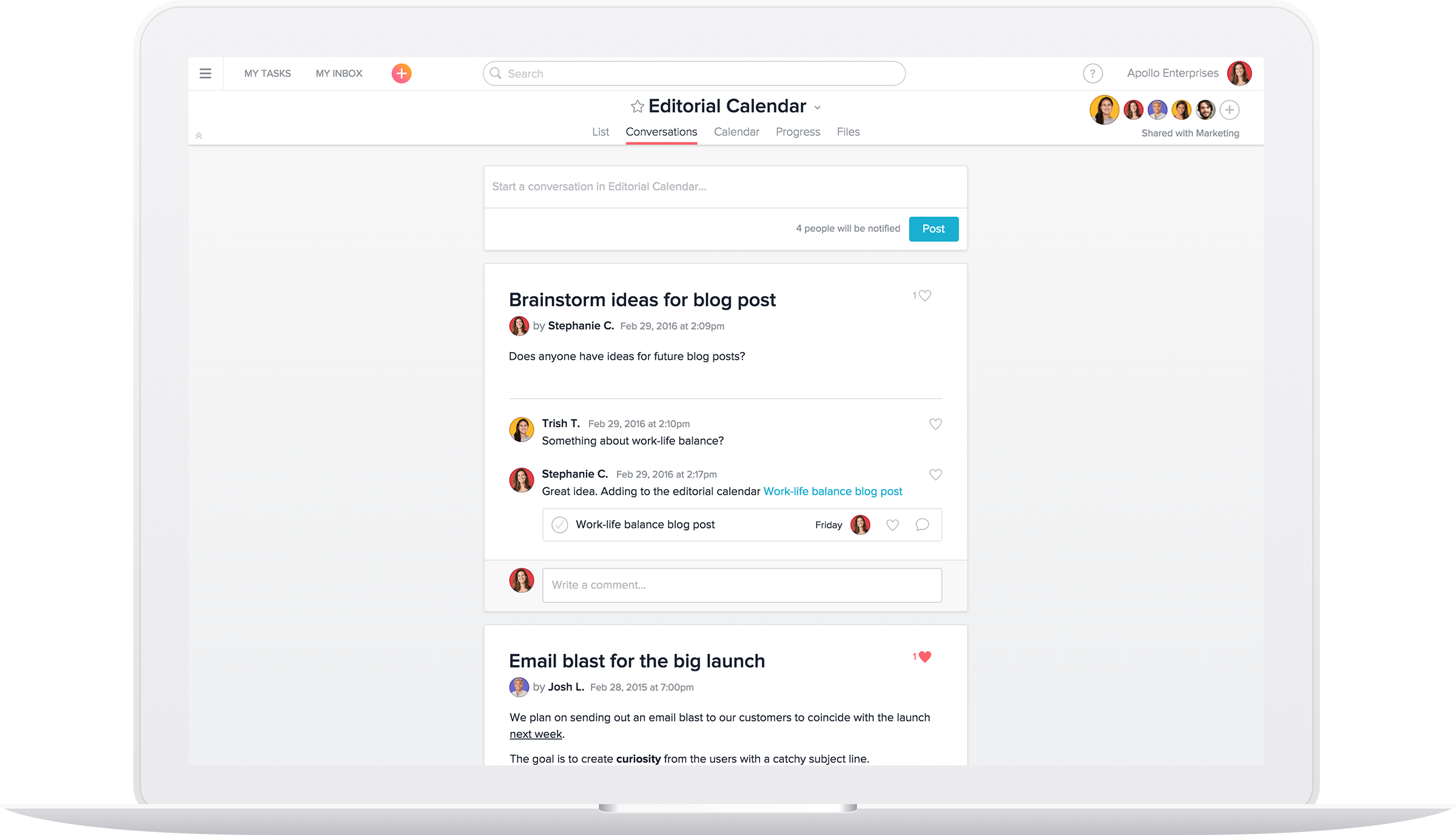
Asana is a web and mobile project management app. With tasks, projects, conversations, and dashboards, Asana lets an entire team know who's doing what by when, enabling workload balancing. Users can also add integrations for GANTT charts, time tracking and more.
The usability of Asana is broad since it's available in a variety of platforms that are widely used nowadays. I think that it would be great for people who are constantly on the move and switching devices, since it has allowed me to work from my phone, too. I also think that Asana has proven itself to handle a large quantity of work
BookStack is fantastic for having business users and not-so-technically-savvy IT users. It enables them to create a documentation they like in a visual way while still forcing them to adhere to logical structure of a document. It works fine even for more technical matters such as integration guidelines, especially when these concern some of the more obscure technologies. The exported docs are presentable but lack any interactivity. Where it lacks is generating heavily technical documentations. Heavier REST or GraphQL integrations should for example be documented through other means. As for developer documentations, there are definitely more suitable alternatives, also.
A de minimis incentive was given to thank the reviewer for their time. The incentive was not used to bias or drive a particular response, nor was the incentive contingent on a positive endorsement. More Info
Through it, we were able to communicate and cooperate with the rest of the team to complete the work in the required manner and at the appropriate time.
A de minimis incentive was given to thank the reviewer for their time. The incentive was not used to bias or drive a particular response, nor was the incentive contingent on a positive endorsement. More Info
A de minimis incentive was given to thank the reviewer for their time. The incentive was not used to bias or drive a particular response, nor was the incentive contingent on a positive endorsement. More Info
A de minimis incentive was given to thank the reviewer for their time. The incentive was not used to bias or drive a particular response, nor was the incentive contingent on a positive endorsement. More Info
A de minimis incentive was given to thank the reviewer for their time. The incentive was not used to bias or drive a particular response, nor was the incentive contingent on a positive endorsement. More Info
It is very user-friendly. Takes a new employee an hour to start figuring out how the system works. That's an important factor. You don't want to encounter the issue where employees need a week to understand how the system works. For example, JIRA, I tried using it for a week and I still don't understand the complicated layout. Asana has a simple interface. Once you see it, you get it type of program.
A de minimis incentive was given to thank the reviewer for their time. The incentive was not used to bias or drive a particular response, nor was the incentive contingent on a positive endorsement. More Info
I haven't had to use their support so I can't rate it. The fact that I haven't needed them reflects the ease of use of the product. I would recommend that any new users schedule a complete demo of the product to ensure that they are using it to it's fullest (there's a lot of useful features).
A de minimis incentive was given to thank the reviewer for their time. The incentive was not used to bias or drive a particular response, nor was the incentive contingent on a positive endorsement. More Info
Asana is a top-tier project management software that helps us organize and track projects from start to finish. It allows us to apply tasks/to-dos to multiple projects without duplication, divide complex projects into smaller tasks, and track project progress. It also helps us organize work on Kanban boards or linear lists. It stands out from the crowd in a big way compared to the competition.
Confluence, having only a slight advantage in terms of features compared to BookStack, really only makes sense to procure as a part of the Jira bundle. It requires much more maintenance from my experience and does not really deliver any extra value aside from the very strict certifications like HIPAA. DokuWiki and MediaWiki both provided way too much in terms of customizability, not really focusing on the business need. Of course, MediaWiki was conceived for a whole different purpose but is very often seen being used for both internal and public documentation delivery. DokuWiki did not provide the authors with the user-friendly environment that BookStack has and integrated most poorly with LDAP. As for OneNote, which was used for support docs prior to BookStack, it provided the authors with too much of a user-friendly environment, rendering the product of their work very inconsistent. Also, the sharing model was either peer-to-peer or within Teams, neither of which made it easy to audit and supervise.
A de minimis incentive was given to thank the reviewer for their time. The incentive was not used to bias or drive a particular response, nor was the incentive contingent on a positive endorsement. More Info
A de minimis incentive was given to thank the reviewer for their time. The incentive was not used to bias or drive a particular response, nor was the incentive contingent on a positive endorsement. More Info
Spillover within Business IT staff up, nearly double substitutability. This is through the ability of a support technician servicing a different product to find a guide describing how to solve the more frequent issues the way a product lead would do it.
Time to draft and publish a documentation down some 20% compared to previous solution.
OpenSource that integrates fine with enterprise-grade software and somehow even passes security audit. 20 times cheaper to implement compared to Confluence, almost free to maintain.
A de minimis incentive was given to thank the reviewer for their time. The incentive was not used to bias or drive a particular response, nor was the incentive contingent on a positive endorsement. More Info