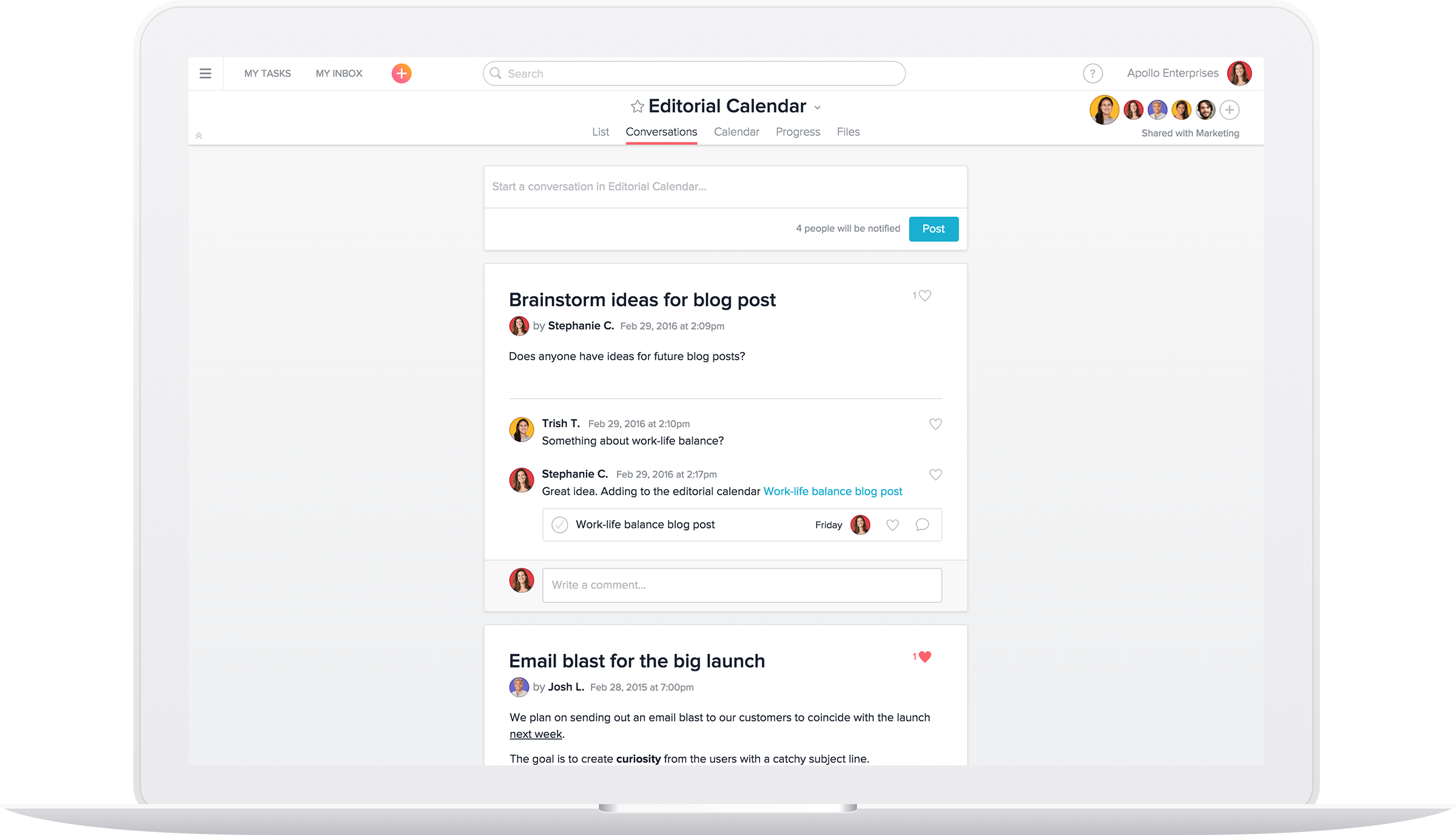
Asana is a web and mobile project management app. With tasks, projects, conversations, and dashboards, Asana lets an entire team know who's doing what by when, enabling workload balancing. Users can also add integrations for GANTT charts, time tracking and more.
$13.49
per month per user
Certinia PS Cloud
Score 7.0 out of 10
N/A
Certinia PS Cloud software is a cloud-based services solution that is built on the Force.com platform. It allows companies to manage professional resources, customers, projects and financials in one integrated services management application. Because the solution works natively with Force.com, it utilizes the same data for sales, services and finance on one system.
N/A
Flow (discontinued)
Score 9.7 out of 10
N/A
The Flow task management app featured a range of tools like kanban board, checklist, timeline, and other features for tracking projects from start to finish. The product is discontinued, and the company Flow Technologies is no longer operating.
N/A
Pricing
Asana
Certinia PS Cloud
Flow (discontinued)
Editions & Modules
Starter
$13.49
per month per user
Advanced
$30.49
per month per user
Enterprise
Contact Sales
Personal
Free
No answers on this topic
No answers on this topic
Offerings
Pricing Offerings
Asana
Certinia PS Cloud
Flow (discontinued)
Free Trial
Yes
No
No
Free/Freemium Version
Yes
No
No
Premium Consulting/Integration Services
Yes
Yes
No
Entry-level Setup Fee
Optional
Required
No setup fee
Additional Details
A discount is offered for annual billing.
Certinia Professional Services Cloud software follows a subscription-based pricing model that is typically structured according to the number of users and the level of features required. The software’s pricing may vary depending on the organization’s size and needs, with options to select modules or add-ons for additional functionality. Specific pricing details may require a consultation or quote from Certinia for tailored solutions.
Flow and Asana have many similar properties. The largest difference would be the flow desktop app - which we love. On the other hand, Asana allows free and paid users, as well as guests. The feature gap, however, has been narrowed even more in recent months.
The usability of Asana is broad since it's available in a variety of platforms that are widely used nowadays. I think that it would be great for people who are constantly on the move and switching devices, since it has allowed me to work from my phone, too. I also think that Asana has proven itself to handle a large quantity of work
PSA is great at capturing all the data you would need to accurately track and report on consulting projects. It captures project financials, calculates projected GM%, and (among others) allows for hourly tracking of employees, which breaks it up between billable and non-billable for utilization tracking to accurately understand costs. However, the user interface is tough to learn, and the stability of the data reporting functions is questionable. This tool would be great for smaller consulting shops that fit the standard contracting mold. If your business is fairly straightforward without a lot of shades of gray, you shouldn't have much trouble with the tool. However, if your business practices have a lot of exceptions based on clients, then you'll have a tall administrative task on your hands.
If you are used to using apps such as Slack, Box or Harvest, you will have an easy time getting use to Flow's UI. Drag and drop features, messaging between users, @tagging for notifications that alert you not only on your desktop but your as well email are particularly useful. If you need projects done fast and easily between multiple teams this is a great application for your business. A particular scenario where Flow is NOT suitable would be if you are used to working soley from your phone. Flows mobile app is slow, not user friendly at all and hard to navigate. Also, you cannot use a mobile site because it directs you to using the app. This IMO is a great desktop project manager, but NOT mobile.
Through it, we were able to communicate and cooperate with the rest of the team to complete the work in the required manner and at the appropriate time.
The biggest strength of FinancialForce PSA is that it's built upon the force.com platform, which means it is very easily customizable to our business needs.
Projects are easily created, as well as milestones and assignments.
"Actuals" (dollars and hours) are calculated automatically, and are easily reported on.
Resources are easily managed by using the Resource Planner
There is another PSA software program that we have been looking into (DreamFactory) that could potentially replace FinancialForce PSA in our organization. Like FinancialForce PSA, it is cloud based on the force.com platform. Licensing is slightly less than FinancialForce PSA, and the Resource Management tool is far superior to FinancialForce PSA. With that said, our renewal falls in Q4 2014 and I don't foresee us implementing a new system this fiscal year.
It is very user-friendly. Takes a new employee an hour to start figuring out how the system works. That's an important factor. You don't want to encounter the issue where employees need a week to understand how the system works. For example, JIRA, I tried using it for a week and I still don't understand the complicated layout. Asana has a simple interface. Once you see it, you get it type of program.
It is maturing and does what it does well although it is not fully complete.
Integration to SF is great.
Gives great visibility to incoming services projects and allows the staffing process to start on pipeline deals.
There are certain processes that take more click-throughs then needed so there are refinement opportunities around the UI.
The resource management screen and project status views have really matured since our original purchase, and while not perfect, allow business leaders to do their jobs.
Configurations vs. customizations. We seem to have to bring in an Apex developer to do a customization for changes I would think could be configuration settings
Most of the time it is fine. There are peak periods of usage where performance noticably slows down (i.e., Monday mornings when time is due and many reports are being run)
I haven't had to use their support so I can't rate it. The fact that I haven't needed them reflects the ease of use of the product. I would recommend that any new users schedule a complete demo of the product to ensure that they are using it to it's fullest (there's a lot of useful features).
Every time I submit a new help request, whether it's an actual help request or just a question about FinancialForce PSA, I always feel that I'm receiving world class support. The support we receive from FinancialForce PSA is always very detailed and professional. There are some requests that take longer than other for the initial response, which is why I did not give a full 10.
Appirio did a good job, however, the user team didn’t know enough to make all the right configuration/customization choices. The team focused too much on replicating existing processes vs. reengineering them. In hindsight we should have had deep dive reviews at key milestones and enforced more focus on how the software would operate. We didn’t have access to true best practices expertise. In hindsight, a consultant from the outside would have been helpful to drive this.
Asana is a top-tier project management software that helps us organize and track projects from start to finish. It allows us to apply tasks/to-dos to multiple projects without duplication, divide complex projects into smaller tasks, and track project progress. It also helps us organize work on Kanban boards or linear lists. It stands out from the crowd in a big way compared to the competition.
FF PSA is a robust Project Management solution that can be configured to fits any size business. We have tried several other applications and PSA so far has met and exceeded our needs. We run our day to day operations on Salesforce so having a solution that is native was a must have. PSA met that requirement and much more.
Flow, unlike Trello, offers its users a more organized interface and much more complete tools to carry out project management, which is why I consider that for the management of business projects of medium or large companies this tool covers the needs of each. In addition, its ease of use makes it much easier to adapt to this tool because it does not require a very learning curve
FinancialForce PSA has helped us improve our data tracking and allows us to get more granular about our financial information and performance.
PSA has given more tools and reports to individual contributors to take greater ownership over their own data, and has increased accountability across the organization.
PSA has added a fairly hefty administrative burden to individuals, project managers, and our financial team.
Our biggest issue prior to flow was scrambling at the last minute to meet a project deadline. Flow has helped us manage tasks towards a deadline to execute more successful events and projects.
Since Flow is being used across our entire organization, the speed at which we can collaborate cross-departmentally has increased. This is especially true of our communication and collaboration with our Marketing team.
Flow has allowed our leadership team to be able to see the progress of a project at any time just by looking at that projects dashboard. This has both given them confidence as well as let them know when they need to intervene.