Bitbucket is a Git repository and code collaboration platform, featuring automated testing and code deployment. Bitbucket Cloud Premium provides AI-powered development, more granular access controls, and enforced code quality, and Bitbucket Data Center provides a self-hosted option.
$0
for up to 5 users
Bitbucket Server (discontinued)
Score 4.0 out of 10
N/A
Bitbucket Server (formerly Stash) from Atlassian was a self-hosted source code management solution. The product is no longer available for sale, and support for existing licenses ended in 2024.
N/A
Plastic, now part of Unity DevOps
Score 8.2 out of 10
Enterprise companies (1,001+ employees)
Plastic was a version control system for facilitating branching, diffing and merging. It was acquired by Unity, and its features are part of Unity DevOps. The application is no longer available for sale.
$6.95
per user
Pricing
Atlassian Bitbucket
Bitbucket Server (discontinued)
Plastic, now part of Unity DevOps
Editions & Modules
Free
$0
for up to 5 users
Standard
$3.30
per month per user
Premium
$6.60
per month per user
Bitbucket Data Center
starting at $44,000
per year 1 - 500
No answers on this topic
Cloud Edition
$6.95
per user
Team Edition (on prem)
$9.95
per user
Enterprise Edition
$23.25
per user
Enterprise Edition (perpetual)
$595.00
per user
Offerings
Pricing Offerings
Bitbucket
Bitbucket Server (discontinued)
Plastic, now part of Unity DevOps
Free Trial
Yes
No
Yes
Free/Freemium Version
Yes
No
Yes
Premium Consulting/Integration Services
No
No
No
Entry-level Setup Fee
No setup fee
No setup fee
Optional
Additional Details
—
—
* Educational institutions receive a substantial discount on Plastic SCM licensing fees
* Corporate/volume pricing is available
* For more information, please contact sales at sales@codicesoftware.com
The majority of SCM tools are Git based. What makes this solution stand out from the rest is it's web-based interface, which implements version control standards very intuitively. As a result, the learning curve shortens and productivity is highly improved.
Data Analyst, Regulatory Affairs and Quality Assurance
Chose Bitbucket
I didn't choose Bitbucket, but I hypothesize that my company chose it partly for its phenomenal integration with other Atlassian products such as Jira. Bitbucket has GitHub as a worthy competitor, but in my opinion, there are no real Jira Software competitors.
I have used Gitlab and Github in the past. While Gitlab is good if you are finding an open source solution for your code management and Github is good for the open source contribution, Bitbucket is an ideal choice to build an enterprise level product. The ecosystem that Jira …
I have used GitHub and GitLab before working on Bitbucket. There is no huge reason to choose Bitbucket over others. The only thing I like more about Bitbucket is security and user interface!
When we make the choice of using BitBucket at that time we didn't have a choice. It was better than GitHub but nowadays GitHub is not just a source control tool it's a DevOps platform. If we talk about GitLab it is even better than GitHub. We're in the process to phase out …
The main reason why we choose Bitbucket is because they provide a secure way to save the code using private repositories. The Access control is easy to setup too
Bitbucket is perfect for our business because it allows us to work on private projects and integrate seamlessly with our existing tools. They also provide a nice app called Sourcetree to help developers work on git environments without experience with git command-line …
When GitHub was acquired by Microsoft my previous organization had concerns about paywalls and additional restrictions that might be placed on the projects. We had made a move to Bitbucket as a result. The acquisition didn't seem to have any implications on the overall …
For the features we were looking at, Bitbucket, GitHub and GitLab were all at par and were in a similar price range. We found that GitHub was the most full featured should we need to scale very quickly. GitLab was at par with GitHub for our future needs, but GitHub was a more …
1. Github is open source and also many security vulnerabilities because it is open source. That's one of the main reasons we chose BitBucket. 2. BitBucket integrates natively with other Atlassian tools without any custom configurations.
I have used Tortoise SVN in the past with various teams. Tortoise SVN is open-source and has a lot of valuable functionality built in. That being said, Bitbucket is more user-friendly being that there is a decent user interface. The UI is not great, but it still makes working …
Bitbucket integrates with Confluence and Jira more easily than GitHub, which was a plus for us, given that we already used those tools extensively. Additionally, the pricing structure for Bitbucket makes it more affordable for our organization, which is especially important, …
Gitlab provides lesser features compared to Github. Gitlab/GitHub are both from a different company (Atlassian), which makes it tough to interrelate projects with other task management tools offered by Atlassian.
Github is a good repository to store and share code files. But Github is open to the community and public. But keeping the research codes private before publication is possible in Bitbucket.
Bitbucket is good for private repositories and reliable CI/CD integration but it's getting behind Github which every day has more and more integrations and which in my opinion has a larger customer group. Gitlab also offers some good support for private repositories but the …
We did select Bitbucket for a bit, but then we eventually moved away from using JIRA to different tools and as a result, it made more sense to move our source code to GitHub since it provides more features and is just much easier to use as everyone already knows how to use …
All 3 software works well for development and source code control, but for sure Bitbucket is the easiest to be set up and be deployed among the team. The integration with JIRA makes this a powerful tool against coding-only applications. However, for open source, it would be …
Of the three, we mostly use Gitlab the most. I don't know why as I was not part of the selection process. But if I'm to guess, this is an organization preference. Our company uses Bitbucket the most, while our partners either use Gitlab the most and sometimes ButBucket. But if …
At the time of making the selection, Bitbucket offered free private repositories when no one else did. This was the primary motivator. With GitHub, you can now have free private repositories on personal accounts, but organizations must still pay for private accounts. Overall …
Bitbucket was my repo host of choice when it came to private repos, but now that GitHub offers free private repos I’ll probably just use them. If you want to manage branch protection though you’ll need a Pro membership for GitHub whereas it was free with Bitbucket.
I think Gitlab and Bitbucket are very similar. I am very familiar with git commands so its easy for me to use both. But I would still prefer Gitlab since it has few additional features like send merge request, approvers etc.
From a cost standpoint, Bitbucket is the winner if you fall outside of the ability to use the Github and Gitlab free tiers. Both of those solutions have their own merits, but from a cost saving perspective Bitbucket is more than likely going to be the most effective option.
Bitbucket uses Git as a client which is more advanced with lots of features for source code management tool. It is very easy to scale horizontally as per our needs, and recent new features like adding multiple file systems keep Bitbucket more useful. Due to multiple file …
We migrated several of our applications to BitBucket from legacy Team Foundation Server, and the experience has been significantly better. It's easy to use and plenty flexible. Other solutions such as GitHub are also good, but we needed to keep everything on-prem due to …
Bitbucket Server (formerly Stash), as part of Atlassian products, provides a native integration framework and tools for automation. The platform supports git and mercurial repositories and provides features to export and import repositories from other projects. Migration to the …
We started off with Apache Subversion (SVN) and moved over to Git (supported via Bitbucket) as Git itself has started to become the new industry norm. The pull request feature allows developers to perform code reviews without needing another code review application. We settled …
If you are selecting a product to use and you are not currently using version control, it may be in your best interest to choose another tool. Bitbucket Server is not as feature rich and doesn't feel as mature as some other platforms and arguably, with the lost production from …
Stash was selected before I was at the company, but we're looking at these alternatives and actively considering switching. Stash seems to have all the necessary features we need to make it work, but it doesn't have any bells and whistles or extra special features that we can …
It can be daunting to set up a Git server for a developer. Managing it can be more time consuming than you want it to be. Stash helps you out by handling what you likely need. If you are already a Git pro, you won't need it, but our team loves the simplicity that Stash brings …
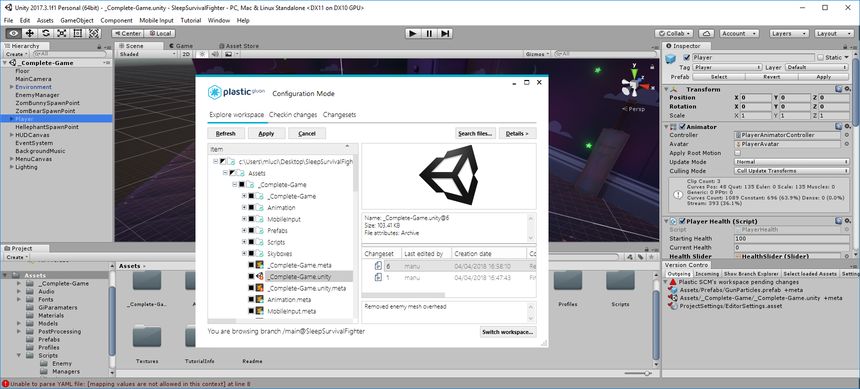
Plastic has best integration with unity - zero issues, native, straightforward. Github feels more stable but for smaller and or indie teams plastic s version control feels much more under control - you click, you feel safe. moreover, there is no need for extra tools such as …
As a team we need to push code into the repo on daily basis, Bitbucket has proven that is a reliable and secure server to save and get the code available in no time. The administration part is really easy and there's an extra tool for every developer profile either if you want to use the console or a GUI like Sourcetree.
Bitbucket Server (formerly Stash) is suitable for departments or teams with the capacity to manage and support their own products and the availability to implement the tool on their own infrastructure. Bitbucket Server (formerly Stash) enables a good framework based on git to integrate the development cycle and to handle anything from a minor group of users and repositories to an extended usage with multiple users and roles collaborating in different projects.
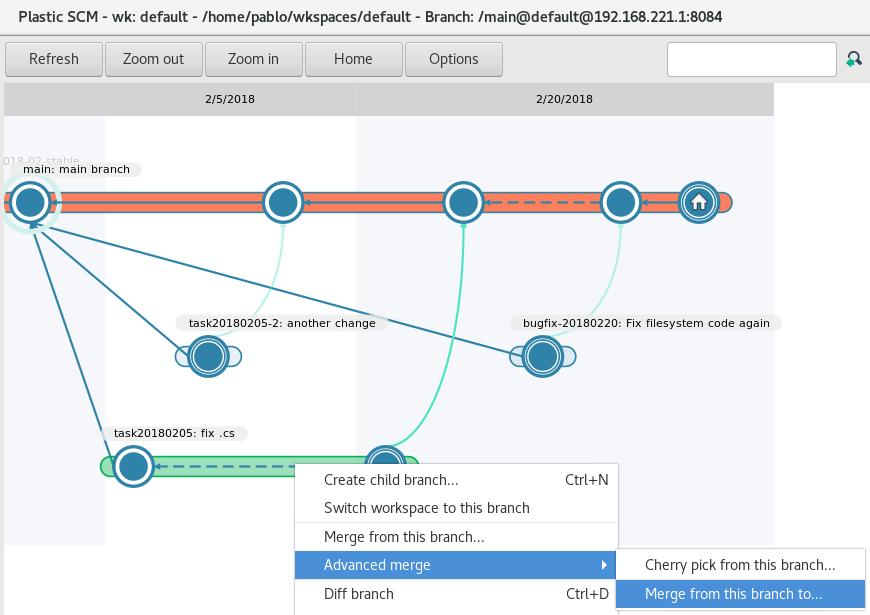
Plastic SCM is well suited for the distributed development environment, where branching and merging can easily be handled. Its a good tool for version controlling, especially for a big team which is contributing to a big project simultaneously. Situation where Plastic SCM is not at all well suited are : If the project is smaller one and need to be handled by couple of people. So in that case setting up Plastic SCM and educating people to work on it is not at all efficient
Projects & Permissions - Stash keeps you and your developers productive by providing a way to structure your repositories and manage permissions via a simple, yet powerful user interface. Stash is very easy to use, manage & administer.
Essentially Stash gives two versions of interfaces to work with.
Stash Repository hosted on a server.
Atlassian SourceTree.
Atlassian Sourcetree is a tool to work with a code in stash. The two 'web' and 'desktop' versions make working with code user friendly, intuitive and comprehensive.
Connectivity to JIRA - Stash keeps track of all issues associated with commits. Users can use Stash to quickly see all issues associated with a commit, or use the Source tab on JIRA issues for an aggregate view of all the code changes that are related to a specific JIRA issue. With this information available, your development team saves time when tracking particular bug fixes or improvements.
While it integrates flawlessly with other Atlassian products, it's lacking in 3rd party integrates, especially compared to competitors like GitHub and GitLab
Using Jira for issues gives a lot of power, but it's also a lot of overhead and complexity that may or may not be necessary for your organization. It also puts issues in another tool, adding a little friction when it comes to addressing issues in your code
Searching for and discovering other projects and GitHub isn't quite as intuitive or easy to use as competitors
You can't allow users to create new repositories without them being full admins of a whole project
There's not a way to limit who can merge a pull request (e.g. allow only the author to merge) outside of branch permissions
Some settings like default reviewers can't be easily copied to different repositories (without setting default reviewers at the project level, which we don't want to do because a single project has multiple team's code under it)
All products have room for improvement. The system improves over time with better and better integrations and I look forward to even more features without paying extra! The system has increased transparency across my organization and with this transparency comes increased throughput on projects. I don't think I can go back to any other system and we are definitely married to this product.
The architecture of Bitbucket makes it more easily scalable than other source code management repositories. Also, administration and maintaining the instance is very easy. It integrates with JIRA and other CI/CD applications which makes it more useful to reduce the efforts. It supports multiple plugins and those bring a lot of extra functionality. It increases the overall efficiency and usefulness of Bitbucket.
The usability of its interface is pretty straight forward when it comes to creating projects and repositories, but when you have to dive into finer grained portions of the UI things can get tricky. If you are used to using tools like GitHub or Gitlab -- Bitbucket is just different enough to be a bother.
The customer support provided by Atlassian (Bitbucket's parent company that also makes Jira, Confluence, etc.) is very helpful. They seem to be very concerned about any issues reported with their products and even just questions about functionality. They are constantly improving the products with new features in nearly every release. Plus they have a plethora of online documentation to reference.
Never really needed any support as the application is very easy to set up and maintain. Any questions we had were well documented in their online documentation, and community forum.
For the features we were looking at, Bitbucket, GitHub and GitLab were all at par and were in a similar price range. We found that GitHub was the most full featured should we need to scale very quickly. GitLab was at par with GitHub for our future needs, but GitHub was a more familiar tool compared to GitLab. Bitbucket won out because of its close integration with Jira and being in the Atlassian family. It was also cheaper than GitHub. As we started with Jira, Bitbucket addition became a natural next step for us. We really liked Bitbucket and stayed with it but we do know we have great options in the form of GitHub and GitLab should we need to scale fast.
We migrated several of our applications to BitBucket from legacy Team Foundation Server, and the experience has been significantly better. It's easy to use and plenty flexible. Other solutions such as GitHub are also good, but we needed to keep everything on-prem due to constraints around our industry and company, though we are currently re-evaluating whether we can move to something cloud based in the future.
Plastic has best integration with unity - zero issues, native, straightforward. GitHub feels more stable but for smaller and or indie teams plastic s version control feels much more under control - you click, you feel safe. moreover, there is no need for extra tools such as gitkraken, gitlab, Sourcetree, fork, etc. it is really easy to develop games this way.
The overall return on investment is very high compared to other source code management tools.
Having a subscription model only is making BitBucket's cost of ownership very high over the years. There should be an alternative option for the purchase of a license permanently (like proprietary software).
Paying separately for premium support is not a good idea. Premium support should be part of the package itself.
No local or on-call support available in Singapore and many other countries is also painful. There should be some local presence, at least in their leading market countries like Singapore.
In positive form, having Stash over not having it at all has provided us with a superior repository system over trying to push to some local server instance and manage branches/merging from our local machines.
There are no real negatives to using Stash, its only problem is that there are competitors out there that can offer additional features.