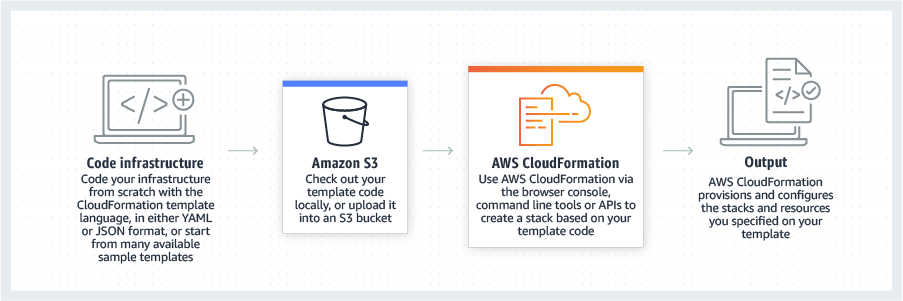
AWS CloudFormation gives developers and systems administrators a way to create and manage a collection of related AWS resources, provisioning and updating them in a predictable fashion. Use AWS CloudFormation’s sample templates or create templates to describe the AWS resources, and any associated dependencies or runtime parameters, required to run an application. Users don’t need to figure out the order for provisioning AWS services or the subtleties of making those dependencies work.…
$0
IBM Cloud Object Storage
Score 9.4 out of 10
N/A
IBM Cloud Object Storage is an IBM Cloud product in the endpoint backup and IaaS categories. It is commonly used for data archiving and backup, for web and mobile applications, and as scalable, persistent storage for analytics.
$5,000,000,000
per month
Pricing
AWS CloudFormation
IBM Cloud Object Storage
Editions & Modules
Free Tier - 1,000 Handler Operations per Month per Account
$0.00
Handler Operation
$0.0009
per handler operation
One-Rate Plan
As low as USD $12/TB a month
per month
Standard Plan
Free up to 5GB—no minimum fee, pay only for what you use
per month
Offerings
Pricing Offerings
AWS CloudFormation
IBM Cloud Object Storage
Free Trial
Yes
No
Free/Freemium Version
Yes
Yes
Premium Consulting/Integration Services
No
No
Entry-level Setup Fee
No setup fee
Optional
Additional Details
There is no additional charge for using AWS CloudFormation with resource providers in the following namespaces: AWS::*, Alexa::*, and Custom::*. In this case you pay for AWS resources (such as Amazon EC2 instances, Elastic Load Balancing load balancers, etc.) created using AWS CloudFormation as if you created them manually. You only pay for what you use, as you use it; there are no minimum fees and no required upfront commitments.
When you use resource providers with AWS CloudFormation outside the namespaces mentioned above, you incur charges per handler operation. Handler operations are create, update, delete, read, or list actions on a resource.
The One-Rate and Standard service plans for Cloud Object Storage include resiliency options, flexible data classes and built-in security. Pricing is based on the choice of location, storage class and resiliency choice.
More Pricing Information
Community Pulse
AWS CloudFormation
IBM Cloud Object Storage
Considered Both Products
AWS CloudFormation
Verified User
Anonymous
Chose AWS CloudFormation
The only real comparison would be to Terraform, which is another IaC technology at the infra level. Terraform is cloud-agnostic, which means most popular cloud providers are supported. While AWS CloudFormation is AWS-only. Although, if you consider CDK, CDK for Terraform …
Since the product I'm involved is primarily hosted on AWS we use CloudFormation but in some other products where we have hybrid cloud deployments we prefer terraform which is opensource.
Cloning a virtual machine creates a virtual machine that is cloning a virtual machine creates a virtual machine that is a copy of the original. The new virtual machine is configured with the same virtual hardware, installed software, and other properties that were configured …
As we have our whole infrastructure on AWS, that is why we selected AWS CloudFormation. AWS CloudFormation is better integrated with AWS services than other available products and also provides visibility and tracking on AWS. AWS CloudFormation is free while Terraform …
We didn't look into anything else as Cloudformation was "built-in" for AWS, it just kind of made sense to go with that. Terraform was something that we briefly looked into Terraform but decides to stick with Cloudformation because our task was relatively "simple". Apparently if …
AWS CloudFormation has more features and robustness. It is suited for professional projects since it provides stability and a wide variety of options for configurations. These include not only dividing stacks by specific code changes, but also in regions. This allows more …
We compared IBM Cloud Object Storage with Amazon S3 and chose IBM mainly because of its better cost control across regions, smooth integration with our existing IBM tools, and strong built-in security.
Mostly cost because most of them deliver a similar product and the decision for a hyperscaler (when you do not plan to use Multi Cloud) was not solely based on the object storage offering. Moreover, other components as K8s/Postgres and the overall picture inclunding consulting …
As Google Cloud Storage is our main product for this kind of thing, it remains the standard but in terms of overall performance, flexibility, stability, durability, and scalability, IBM Cloud Object Storage has put it through its paces. I think having a product put Google …
Amazon S3 has a more complex pricing model. It charges as per the requests, which will be more costly for us compared to IBM cloud object storage. The safety of our data is the main focus, and this is guaranteed with IBM.
Along with IBM Watson for AI and machine learning, IBM Aspera for fast data transport, and IBM Cloud SQL Query for data analysis, IBM Cloud Object Storage works seamlessly with other IBM Cloud services. For research initiatives that call for a variety of tools and services, …
We selected IBM Cloud Object Storage against S3 for following reasons:1. 1. We already use a lot of IBM's cloud services, IBM Cloud Object Storage would have been easier to manage. 2. It is really cost effective with the features it brings in.
Amazon S3 is a great service to safely back up your data where redundancy is guaranteed, and the cost is fair. In the past I have used Amazon S3 for data that we backup and hope we never need to access, but in the case of a catastrophic or even small slip of the finger with the …
As far as the other cloud storage services are concerned, I have limited experience. I used pleased by IBM cloud storage because it provided a smooth, running environment for my data science projects. I used IBM Watson Studio and the experience was smooth. I used IBM Db2, and …
IBM Cloud Object Storage is a product that gives us greater scalability, and important security features such as WORM, in addition to Simplicity and Enhanced file access
At the end of the day it is an IBM product that gives us a guarantee of being very robust, it is very safe, and reliable, and it also allows flexibility.
The previous cloud OSS platform that we used was provided by Google. Functionality in OSS is restricted in several ways. The setup and configuration steps are complicated, making the software difficult to operate. We had no problems at all during our time at IBM. Buckets may be …
Previously, we were a user of alibaba cloud OSS. There are some limitations on OSS features. Also, not easy to use due to some complex configurations and setup processes. We didn't face any difficulties here in IBM. Easy configuration and management of buckets can be done with …
I still give it an 8 because it's one of those tools that just quietly does the heavy lifting for you but it can really test your patience when it breaks esp with deep nested stacks. It's perfect for projects where we need clean consistent environments every time. It's less ideal for quick experimental setups like new EC2 configs or Lambda permission tweaks.
IBM Cloud Object Storage is well suited for businesses that require scalable and cost-effective data storage solutions. It excels in scenarios involving massive unstructured data, like multimedia content, backups, and archives. However, it may be less appropriate for organizations with minimal storage needs or those requiring high-performance, low-latency access to data, as it's optimized for durability and data integrity rather than real-time data retrieval.
Cloud storage allows you to save data and files in an off-site location that you access either through the public internet or a dedicated private network connection.
Cloud storage delivers a cost-effective, scalable alternative to storing files on on-premise hard drives or storage networks.
Cloud storage services provide elasticity, which means you can scale capacity as your data volumes increase or dial down capacity if necessary.
Business continuity of Storing data offsite supports business continuity in the event that a natural disaster or terrorist attack cuts access to your premises.
You just have to learn how it thinks then you'll be set. That however comes with a learning curve. Writing YAML or jSON templates feels natural now but early on, even a small syntax mistake could break a whole stack.
For my use cases, it has been a very smooth experience. Even my new colleagues have been able to get on top of things very quickly. This shows how easy it is to work with
We rarely face downtime or access issues with IBM Cloud Object Storage. It’s mostly available when we need it, even during peak hours or heavy data loads.
I would give it a 9 because it works smooth with our AI and analytics tools, no major slowdown. Pages and dashboards load fine most of the time, and reports finish in decent time even when data is heavy.
I have been working in IT sector for more than 15 years. I have worked with various vendors. IBM's sales team, support team have been really helpful. After we start to use their product, their UX design team also contacted us to get feedback from us. They are really interested about our experience.
I just researching and applying the tools on their platforms to ensure a good learning path, based on my needs. Reading the documentation related with resources, tools. Is too big, but I am trying to know more about it every day. It is a good way to know more about their resources. A new way to attract new customers. At the end of the day, we are all involved in improvement and automation of our tasks and resources for customers and end-users.
IBM's professional service for migrating data and implementing new cloud environment was perfect. They started to help us before we begin to bring together all data such as how can it could be best to transfer all data without problems. During the migration they watched all the process closely to prevent any failure. Lastly, after the migration, they gave us trainings on implementation.
Since the product I'm involved is primarily hosted on AWS we use CloudFormation but in some other products where we have hybrid cloud deployments we prefer Terraform which is opensource.
As Google Cloud Storage is our main product for this kind of thing, it remains the standard but in terms of overall performance, flexibility, stability, durability, and scalability, IBM Cloud Object Storage has put it through its paces. I think having a product put Google through its paces is always a good thing, both for businesses and for the industry overall.
Scaling up the number of users can lead to significant increases in licensing costs, which, while not a technical limitation, can be a practical constraint for some organizations
In our company, we moved from on-premise to IBM cloud, our ElasticSearch Solution storage in block storage to an ICD elastic search solution with Object storage, and we reduced our cost by more than 45%.
Object Storage is a managed service, so you can have savings in your storage-managed team.
We have improved our data availability because the Regional solution of COS is distributed in three different Availability Zones.