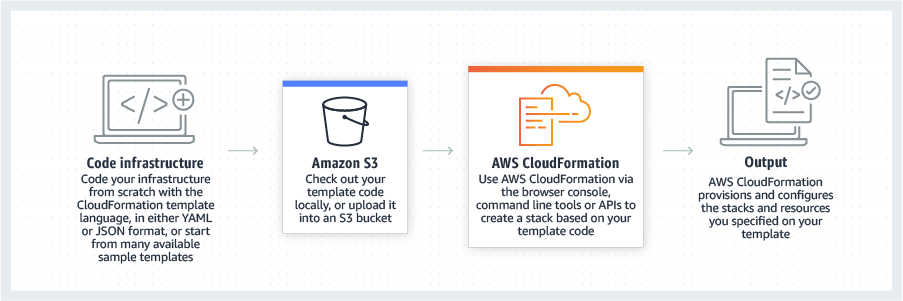
AWS CloudFormation gives developers and systems administrators a way to create and manage a collection of related AWS resources, provisioning and updating them in a predictable fashion. Use AWS CloudFormation’s sample templates or create templates to describe the AWS resources, and any associated dependencies or runtime parameters, required to run an application. Users don’t need to figure out the order for provisioning AWS services or the subtleties of making those dependencies work.…
$0
Perforce Puppet
Score 8.5 out of 10
N/A
Puppet Enteprise is an IT automation and configuration management solution that enables users to manage and automate infrastructure and complex workflows. The vendor states Puppet Enterprise combines both model‑based and task-based capabilities in a way that enables organizations to scale their multi-cloud infrastructure as their automation footprint grows, with more flexibility from both agent-based and agentless capabilities.
N/A
Receptive.io (discontinued)
Score 8.0 out of 10
N/A
Pendo Feedback (or Receptive / Receptive.io, acquired by Pendo in 2019) was a SaaS product demand intelligence platform used to collect product feedback and feature requests from customers as well as internal teams. Some years after the acquisition, the product was discontinued.
N/A
Pricing
AWS CloudFormation
Perforce Puppet
Receptive.io (discontinued)
Editions & Modules
Free Tier - 1,000 Handler Operations per Month per Account
$0.00
Handler Operation
$0.0009
per handler operation
No answers on this topic
No answers on this topic
Offerings
Pricing Offerings
AWS CloudFormation
Perforce Puppet
Receptive.io (discontinued)
Free Trial
Yes
No
No
Free/Freemium Version
Yes
No
No
Premium Consulting/Integration Services
Yes
No
No
Entry-level Setup Fee
No setup fee
No setup fee
No setup fee
Additional Details
There is no additional charge for using AWS CloudFormation with resource providers in the following namespaces: AWS::*, Alexa::*, and Custom::*. In this case you pay for AWS resources (such as Amazon EC2 instances, Elastic Load Balancing load balancers, etc.) created using AWS CloudFormation as if you created them manually. You only pay for what you use, as you use it; there are no minimum fees and no required upfront commitments.
When you use resource providers with AWS CloudFormation outside the namespaces mentioned above, you incur charges per handler operation. Handler operations are create, update, delete, read, or list actions on a resource.
—
—
More Pricing Information
Community Pulse
AWS CloudFormation
Perforce Puppet
Receptive.io (discontinued)
Considered Multiple Products
AWS CloudFormation
Verified User
Professional
Chose AWS CloudFormation
As we have our whole infrastructure on AWS, that is why we selected AWS CloudFormation. AWS CloudFormation is better integrated with AWS services than other available products and also provides visibility and tracking on AWS. AWS CloudFormation is free while Terraform …
I still give it an 8 because it's one of those tools that just quietly does the heavy lifting for you but it can really test your patience when it breaks esp with deep nested stacks. It's perfect for projects where we need clean consistent environments every time. It's less ideal for quick experimental setups like new EC2 configs or Lambda permission tweaks.
Puppet is good enough to get the job done, you can use it to automate deployments and maintain files and configurations, if this is all you're looking for it's great. If you're looking for more control over your systems as a whole without having to write your own scripts or install multiple configuration management systems then Puppet is not what you're looking for.
Receptive is very effective for multiple internal teams/department of a single product who need to scale their product feedback management effectively. We've been leveraging it for one of our products and it was so successful, that we implemented it with a second product. The main issue we ran into situationally with that was managing 2+ modules (products) in Receptive; it was a bit more difficult to present Receptive to two different customer bases/users (we couldn't change the appearance) and slightly confusing to do within the app (lots of filtering needed). I have heard that support of multiple modules is something that Receptive will likely be working on in the near future, so that's good news.
The setup of Puppet is a nightmare compared to ansible. Anyone watching a youtube video can easily set up ansible with minimal IT knowledge. All one needs is the source IP addresses and we are good to go. Setting up Puppet is a more hands-on task and pushing the puppet agents to all the boxes is another issue. If the installation and setup were simplified like ansible that would attract a lot of people to this platform
The syntax of the code for Puppet is not as easy as ansible. Ansible simply follows a YAML format and it's like typing in normal English. Even complicated tasks can be written by just understanding YAML syntax. Perhaps Puppet needs to revisit the lanugage used and try to come up with a much simpler lanugage for writing code. This will make day-to-day usage easier.
It's easy enough to get a shared template & apply it. You don't even have to download-then-upload or copy-and-paste, a publicly-accessible url works.
Diving deeper, it has enough powerful capabilities to make the life of a platform / DevOps engineer bearable.
However, you need equally deep knowledge to troubleshoot issues, when they inevitably pop up. This is the same for all IaC technologies, as they are additional abstraction layers on top of the native API provided by the cloud providers.
Puppet has top class support. You can simply mail them with their query and they will respond to your query in a timely manner. We do have enterprise license for puppet. Also there is a vibrant community for puppet out there. So even if you dont purchase a premium support option you can simply google your queries and get answers
Cloning a virtual machine creates a virtual machine that is cloning a virtual machine creates a virtual machine that is a copy of the original. The new virtual machine is configured with the same virtual hardware, installed software, and other properties that were configured for the original virtual machine. For information about persistent memory and PMem storage, see the vSphere Cloning a virtual machine creates a virtual machine that is a copy of the original. The new virtual machine is configured with the same virtual hardware, installed software, and other properties that were configured for the original virtual machine. For information. Management guide.For information copy of the original. The new virtual Cloning virtual machine creates a virtual machine that is a copy of the original. The new virtual machine is configured with the same virtual hardware, installed software, and other properties that were configured for the original virtual machine. For information about persistent memory and PMem storage, see the vSphere Resource Management Guide. For information is configured with the same virtual hardware, installed software, and other properties that were configured for the original virtual machine. For information about persistent memory and PMem storage, see the vSphere Resource Management Guide. For information
HPSA is a licensed product and incurs significant upfront investment costs due to COTS licensing. Puppet Data Center Automation has a significantly lower upfront investment and product documentation is more readily available. Chef is a very similar offering, however, at the time our decision was considered, the adoption of Chef vs. Puppet was significantly less in the community.
We had UserVoice prior to Receptive but it was just too clunky and extensive for our needs. It was less about automation and still very manual work to process feedback. It also didn't provide collaboration levels that we needed for our internal teams to work together. ProdPad was a very clean tool but also didn't enable us to automate the process like Receptive does.
We were managing these enhancements in our support ticketing system, using spreadsheets, and it was TERRIBLE. Being able to tell a user "Great idea! Submit it to Feedback!" has saved my support team hundreds of hours.
We have reduced incoming support requests when the request is really an enhancement - the ability to have a "Suggest Features" widget in our software sends users straight to Feedback.
Because we can make some fields required, we can cut down on the need to reach back out to our users for clarification.