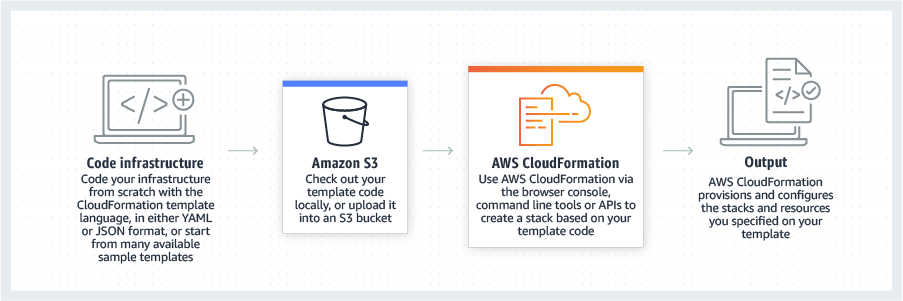
AWS CloudFormation gives developers and systems administrators a way to create and manage a collection of related AWS resources, provisioning and updating them in a predictable fashion. Use AWS CloudFormation’s sample templates or create templates to describe the AWS resources, and any associated dependencies or runtime parameters, required to run an application. Users don’t need to figure out the order for provisioning AWS services or the subtleties of making those dependencies work.…
$0
WP Engine
Score 7.3 out of 10
N/A
WP Engine is a website hosting service built to host WordPress for companies of any size, with features such as daily backups, firewall,SSL, and proprietary caching technology.
$35
per month
Pricing
AWS CloudFormation
WP Engine
Editions & Modules
Free Tier - 1,000 Handler Operations per Month per Account
$0.00
Handler Operation
$0.0009
per handler operation
Startup
$35
per month
Core
$400
per month (annual contract)
Enterprise
Custom
*Per Month
Offerings
Pricing Offerings
AWS CloudFormation
WP Engine
Free Trial
Yes
Yes
Free/Freemium Version
Yes
No
Premium Consulting/Integration Services
Yes
No
Entry-level Setup Fee
No setup fee
No setup fee
Additional Details
There is no additional charge for using AWS CloudFormation with resource providers in the following namespaces: AWS::*, Alexa::*, and Custom::*. In this case you pay for AWS resources (such as Amazon EC2 instances, Elastic Load Balancing load balancers, etc.) created using AWS CloudFormation as if you created them manually. You only pay for what you use, as you use it; there are no minimum fees and no required upfront commitments.
When you use resource providers with AWS CloudFormation outside the namespaces mentioned above, you incur charges per handler operation. Handler operations are create, update, delete, read, or list actions on a resource.
Discount available for annual billing on the Startup plan.
More Pricing Information
Community Pulse
AWS CloudFormation
WP Engine
Features
AWS CloudFormation
WP Engine
Configuration Management
Comparison of Configuration Management features of Product A and Product B
I still give it an 8 because it's one of those tools that just quietly does the heavy lifting for you but it can really test your patience when it breaks esp with deep nested stacks. It's perfect for projects where we need clean consistent environments every time. It's less ideal for quick experimental setups like new EC2 configs or Lambda permission tweaks.
I am an enterprise user of WordPress and host over 7000 sites with WPEngine. Areas that I think they are well suited for include customers that need enterprise-level support and uptime and have more complex needs than a simple blog. They also manage scale well with a variety of isolated install options that you can scale up or down depending on your contract needs. They also provide premier support for enterprises and have highly knowledgable Technical Account Managers that provide a significant value add. If I were to look at where it isn't as appropriate for usage I would focus on the low-end needs and say while they do support small sites, there are options out there for cheaper hosting that lack the support a WPEngine gives you.
I love the database backups and how quickly & easy it is to restore from an old backup point. This gives me & my clients confidence that any change can be rolled back.
The built in caching & CDN mean that I have to spend less time worrying about the speed of the server & site. The caching has some side-effects that take getting used to (on-page dynamic PHP code sometimes needs to be moved to API endpoints), but this is true for most caching systems.
They have really good support for multiple environments. It's very easy to have separate production & staging environments. It's also very simple to deploy from staging to production, making product launches and large scale website copy changes much easier to coordinate.
I'd like to see WP Engine offer their own monitoring solution. When I say monitoring, I mean specific use cases that may end up being something you could script. This would keep customers from having to pay for additional services like Pingdom, New Relic, etc.
I would like to see some proactive analysis done by WP Engine on their customer sites - at least on their home pages, and offer up suggestions. This kind of goes along with the other example.
Finally, it would be nice to see a "lighter" offering, perhaps a plan that costs $49 for those who want to host only a few sites, or even 1 site.
I was in a situation where I had to bolt Wordpress on to an existing infrastructure that could not support it. If I ever end up in that situation again, please kill me. Other than that reasonably common use case, I don't think it offers a lot of value over robust shared hosting, virtual private server (VPS) or dedicated servers.
It's easy enough to get a shared template & apply it. You don't even have to download-then-upload or copy-and-paste, a publicly-accessible url works.
Diving deeper, it has enough powerful capabilities to make the life of a platform / DevOps engineer bearable.
However, you need equally deep knowledge to troubleshoot issues, when they inevitably pop up. This is the same for all IaC technologies, as they are additional abstraction layers on top of the native API provided by the cloud providers.
From the onboarding and in the days afterward, it was very easy to get into the platform and begin creating important websites and configuring user options. The interface is easy to navigate, and the platform pages load quickly. Since the platform is built for Word plus press, it has features including backup, staging, maintenance mode, and direct WP-Admin login to make configuration and site management faster. We have never had any issues on the billing side of the account.
Support is generally great. Enterprise support is fantastic, with little to no wait times. I find that chat support can almost always take care of the problem without escalating to a ticket for a higher level of troubleshooting. The chat support for many other hosting providers can only handle basic issues. This is a big bonus for us to get quick and helpful answers.
Cloning a virtual machine creates a virtual machine that is cloning a virtual machine creates a virtual machine that is a copy of the original. The new virtual machine is configured with the same virtual hardware, installed software, and other properties that were configured for the original virtual machine. For information about persistent memory and PMem storage, see the vSphere Cloning a virtual machine creates a virtual machine that is a copy of the original. The new virtual machine is configured with the same virtual hardware, installed software, and other properties that were configured for the original virtual machine. For information. Management guide.For information copy of the original. The new virtual Cloning virtual machine creates a virtual machine that is a copy of the original. The new virtual machine is configured with the same virtual hardware, installed software, and other properties that were configured for the original virtual machine. For information about persistent memory and PMem storage, see the vSphere Resource Management Guide. For information is configured with the same virtual hardware, installed software, and other properties that were configured for the original virtual machine. For information about persistent memory and PMem storage, see the vSphere Resource Management Guide. For information
While we still use GoDaddy for some services, WP Engine definitely has been a major upgrade for our WordPress hosting. In addition to faster load speeds, WP Engine has been more adept at allowing us to manage a high number of websites without straining the system. We have never used Network Solutions for our own hosting needs, but when we do interact with them on behalf of our clients, their systems always seem to be clunky and hard to use, and they often overcharge customers by selling them products they do not need.