AWS Elastic Beanstalk is the platform-as-a-service offering provided by Amazon and designed to leverage AWS services such as Amazon Elastic Cloud Compute (Amazon EC2), Amazon Simple Storage Service (Amazon S3).
$35
per month
Datadog
Score 8.6 out of 10
N/A
Datadog is a monitoring service for IT, Dev and Ops teams who write and run applications at scale, and want to turn the massive amounts of data produced by their apps, tools and services into actionable insight.
$18
per month per host
Pricing
AWS Elastic Beanstalk
Datadog
Editions & Modules
No Charge
$0
Users pay for AWS resources (e.g. EC2, S3 buckets, etc.) used to store and run the application.
Log Management
$1.27
per month (billed annually) per host
Infrastructure
$15.00
per month (billed annually) per host
Standard
$18
per month per host
Enterprise
$27
per month per host
DevSecOps Pro
$27
per month per host
APM
$31.00
per month (billed annually) per host
DevSecOps Enterprise
$41
per month per host
Offerings
Pricing Offerings
AWS Elastic Beanstalk
Datadog
Free Trial
No
Yes
Free/Freemium Version
Yes
Yes
Premium Consulting/Integration Services
No
No
Entry-level Setup Fee
No setup fee
Optional
Additional Details
—
Discount available for annual pricing. Multi-Year/Volume discounts available (500+ hosts/mo).
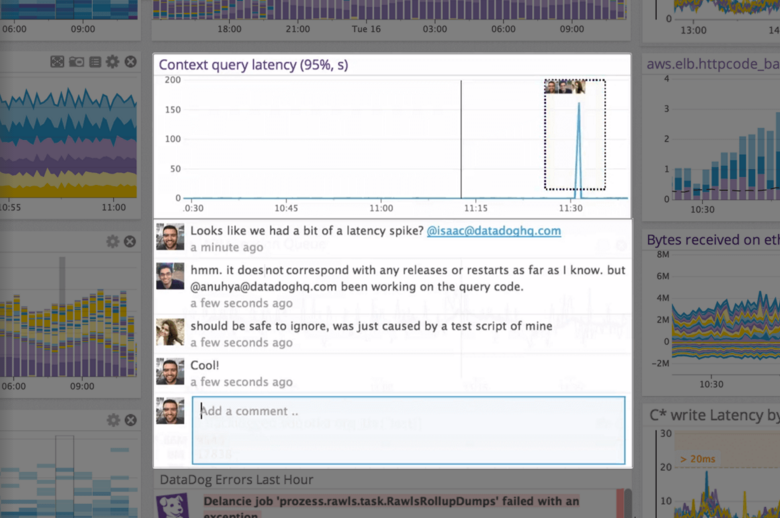
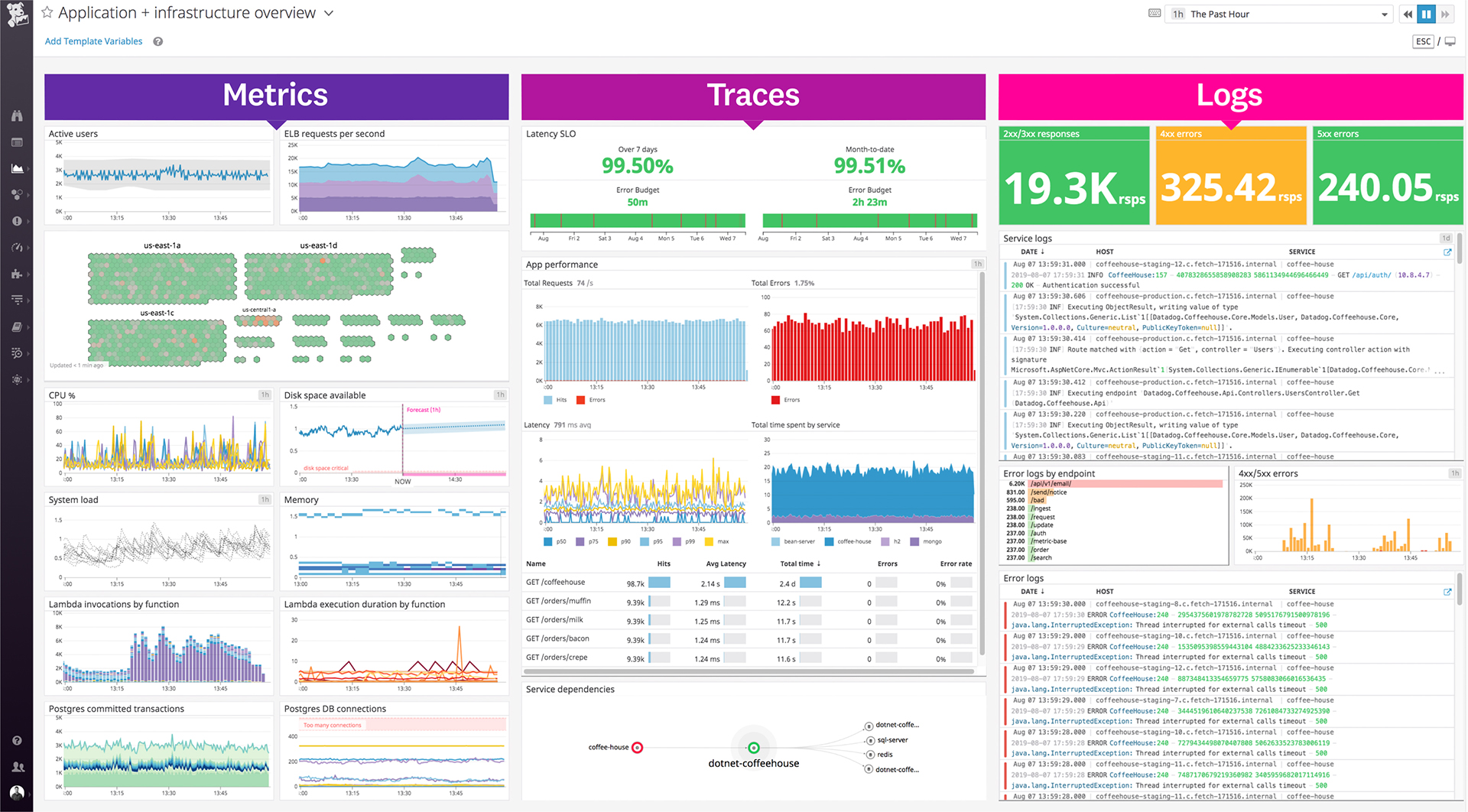
Datadog empowers us to create dashboards and visualize the state of our infrastructure in real time. It gives us control over what we want to view and how. The graphs provide deep insight into trends and anamoly detectives. These features are lacking in some of the other …
I have been using AWS Elastic Beanstalk for more than 5 years, and it has made our life so easy and hassle-free. Here are some scenarios where it excels -
I have been using different AWS services like EC2, S3, Cloudfront, Serverless, etc. And Elastic Beanstalk makes our lives easier by tieing each service together and making the deployment a smooth process.
N number of integrations with different CI/CD pipelines make this most engineer's favourite service.
Scalability & Security comes with the service, which makes it the absolute perfect product for your business.
Personally, I haven't found any situations where it's not appropriate for the use cases it can be used. The pricing is also very cost-effective.
Datadog may be better suited for teams that have a more out-of-the-box infrastructure, on the primary platforms Datadog supports. You may also have better results if you have a bigger team dedicated to devops and/or a bigger budget. We found that trying to adapt it to our use case (small team, .NET on AWS Fargate) wasn't feasible. We continually ran into roadblocks that required us to dig through documentation (and at times, having to figure out some documentation was wrong), go back and forth with support, and in my opinion, waste money on excessive and unintended usages due to opaque pricing models and inaccurate usage reports, as well as broken/non-functional rate sampling controls.
Getting a project set up using the console or CLI is easy compared to other [computing] platforms.
AWS Elastic Beanstalk supports a variety of programming languages so teams can experiment with different frameworks but still use the same compute platform for rapid prototyping.
Common application architectures can be referenced as patterns during project [setup].
Multiple environments can be deployed for an application giving more flexibility for experimentation.
The thing which Datadog does really well, one of them are its broad range of services integrations and features which makes it one step observability solution for all. We can monitor all types of our application, infrastructure, hosts, databases etc with Datadog.
Its custom dashboard feature which helps us to visualize the data in a better way . It supports different types of charts through those charts we can create our dashboard more attractive.
Its AI powered alerting capability though that we can easily identify the root cause and also it has a low noise alerting capability which means it correlated the similar type of issues.
Limited to the frameworks and configurations that AWS supports. There is no native way to use Elastic Beanstalk to deploy a Go application behind Nginx, for example.
It's not always clear what's changed on an underlying system when AWS updates an EB stack; the new version is announced, but AWS does not say what specifically changed in the underlying configuration. This can have unintended consequences and result in additional work in order to figure out what changes were made.
Alert windows cause lag in notifications (e.g. if the alert window is X errors in 1 hour, we won't get alerted until the end of the 1 hour range)
I would appreciate more supportive examples for how to filter and view metrics in the explorer
I would like a more clear interface for metrics that are missing in a time frame, rather than only showing tags/etc. for metrics that were collected within the currently viewed time frame
As our technology grows, it makes more sense to individually provision each server rather than have it done via beanstalk. There are several reasons to do so, which I cannot explain without further diving into the architecture itself, but I can tell you this. With automation, you also loose the flexibility to morph the system for your specific needs. So if you expect that in future you need more customization to your deployment process, then there is a good chance that you might try to do things individually rather than use an automation like beanstalk.
The overall usability is good enough, as far as the scaling, interactive UI and logging system is concerned, could do a lot better when it comes to the efficiency, in case of complicated node logics and complicated node architectures. It can have better software compatibility and can try to support collaboration with more softwares
There are so many features that it can be hard to figure out where you need to go for your own use case. For example, RUM monitoring us buried in a "Digital Experience" sidebar setting when this is one of our key use cases that I sometimes struggle to find in the application. It appears that ECS + Fargate monitoring was recently released which is great because we had to build a lambda reporting solution for ephemeral task monitoring. But this new feature was never on my radar until I starting clicking around the application.
As I described earlier it has been really cost effective and really easy for fellow developers who don't want to waste weeks and weeks into learning and manually deploying stuff which basically takes month to create and go live with the Minimal viable product (MVP). With AWS Beanstalk within a week a developer can go live with the Minimal viable product easily.
The support team usually gets it right. We did have a rather complicate issue setting up monitoring on a domain controller. However, they are usually responsive and helpful over chat. The downside would be I don’t think they have any phone support. If that is important to you this might not be a good fit.
- Do as many experiments as you can before you commit on using beanstalk or other AWS features. - Keep future state in mind. Think through what comes next, and if that is technically possible to do so. - Always factor in cost in terms of scaling. - We learned a valuable lesson when we wanted to go multi-region, because then we realized many things needs to change in code. So if you plan on using this a lot, factor multiple regions.
We also use Heroku and it is a great platform for smaller projects and light Node.js services, but we have found that in terms of cost, the Elastic Beanstalk option is more affordable for the projects that we undertake. The fact that it sits inside of the greater AWS Cloud offering also compels us to use it, since integration is simpler. We have also evaluated Microsoft Azure and gave up trying to get an extremely basic implementation up and running after a few days of struggling with its mediocre user interface and constant issues with documentation being outdated. The authentication model is also badly broken and trying to manage resources is a pain. One cannot compare Azure with anything that Amazon has created in the cloud space since Azure really isn't a mature platform and we are always left wanting when we have to interface with it.
Our logs are very important, and Datadog manages them exceptionally well. We frequently use Datadog services for our investigations. Use case: Monitor your apps, infrastructure, APIs, and user experience.
Key features:
Logs, metrics, and APM (Application Performance Monitoring)
Real-time alerting and dashboards
Supports Kubernetes, AWS, GCP, and other integrations
RUM (Real User Monitoring) and Synthetics
✅ Best for backend, server, and distributed systems monitoring.