
Sharmin Promi
Quality Assurance Engineer
Chose Bugzilla
Bugzilla is open source and unlimited accounts access were possible.

| Product | Rating | Most Used By | Product Summary | Starting Price |
|---|---|---|---|---|
 Bugzilla | N/A | N/A | N/A | |
 OpenText UFT One | N/A | Unified Functional Testing (UFT, formerly known as HP UFT and before that QuickTest Professional or HP QTP) is a functional and performance testing tool acquired by Micro Focus from Hewlett-Packard Enterprise, now from OpenText. | N/A | |
 SpiraTest | Mid-Size Companies (51-1,000 employees) | SpiraTest allows customers to manage their software testing and quality assurance activities. It provides requirements management, test management and bug-tracking functionality with integrated reporting. | $130.99 per month 3 concurrent users (minimum) |
| Bugzilla | OpenText UFT One | SpiraTest | ||||||||||||||||||||||
|---|---|---|---|---|---|---|---|---|---|---|---|---|---|---|---|---|---|---|---|---|---|---|---|---|
| Editions & Modules | No answers on this topic | No answers on this topic |
| |||||||||||||||||||||
| Offerings |
| |||||||||||||||||||||||
| Entry-level Setup Fee | No setup fee | No setup fee | No setup fee | |||||||||||||||||||||
| Additional Details | — | — | Discount available for annual billing on Cloud solution. 3 concurrent user minimum. Volume concurrent user discount available. | |||||||||||||||||||||
| More Pricing Information | ||||||||||||||||||||||||
| Bugzilla | OpenText UFT One | SpiraTest | |
|---|---|---|---|
| Considered Multiple Products |  Bugzilla Sharmin Promi Quality Assurance Engineer Chose Bugzilla Bugzilla is open source and unlimited accounts access were possible. |  OpenText UFT One No answer on this topic |  SpiraTest No answer on this topic |
| Bugzilla | OpenText UFT One | SpiraTest | |||||||||||||||||||||||
|---|---|---|---|---|---|---|---|---|---|---|---|---|---|---|---|---|---|---|---|---|---|---|---|---|---|
| Test Management |
|
| Bugzilla | OpenText UFT One | SpiraTest | |
|---|---|---|---|
| Small Businesses |  GitLab Score 8.7 out of 10 |  BrowserStack Score 8.5 out of 10 | BrowserStack Score 8.5 out of 10 |
| Medium-sized Companies | GitLab Score 8.7 out of 10 |  ReadyAPI Score 6.2 out of 10 | OpenText ALM/Quality Center Score 9.1 out of 10 |
| Enterprises | GitLab Score 8.7 out of 10 |  SoapUI Open Source Score 8.4 out of 10 | OpenText ALM/Quality Center Score 9.1 out of 10 |
| All Alternatives | View all alternatives | View all alternatives | View all alternatives |
| Bugzilla | OpenText UFT One | SpiraTest | |
|---|---|---|---|
| Likelihood to Recommend | 7.7 (18 ratings) | 8.0 (12 ratings) | 8.0 (8 ratings) |
| Likelihood to Renew | 6.0 (10 ratings) | - (0 ratings) | - (0 ratings) |
| Usability | 9.0 (3 ratings) | 7.0 (1 ratings) | - (0 ratings) |
| Availability | 9.0 (3 ratings) | - (0 ratings) | - (0 ratings) |
| Performance | 8.0 (2 ratings) | - (0 ratings) | - (0 ratings) |
| Support Rating | 5.1 (3 ratings) | 8.0 (1 ratings) | 9.0 (1 ratings) |
| In-Person Training | 9.0 (1 ratings) | - (0 ratings) | - (0 ratings) |
| Implementation Rating | 8.0 (2 ratings) | - (0 ratings) | - (0 ratings) |
| Configurability | 9.0 (1 ratings) | - (0 ratings) | - (0 ratings) |
| Ease of integration | 9.0 (1 ratings) | - (0 ratings) | - (0 ratings) |
| Product Scalability | 9.0 (1 ratings) | - (0 ratings) | - (0 ratings) |
| Vendor post-sale | 7.0 (1 ratings) | - (0 ratings) | - (0 ratings) |
| Vendor pre-sale | 8.0 (1 ratings) | - (0 ratings) | - (0 ratings) |
| Bugzilla | OpenText UFT One | SpiraTest | |
|---|---|---|---|
| Likelihood to Recommend | Open Source
| OpenText
 Sourav Halder Senior Specialist | Inflectra Corporation
|
| Pros | Open Source
 Anwar Mohammed, PMP Manager, Systems Analysis and Programming | OpenText
 Derek Wallis Technical Test Analyst and Automation Engineer | Inflectra Corporation
 Dave Furlani Senior Consultant - Test Manager / Project Manager |
| Cons | Open Source
 Isaiah Hayes QA Lead | OpenText
 Sourav Singla ,Safe Agilist, CSP, ICP-ACC, CSM, CSPO, SSM, LSSG Enterprise Agile Coach | Inflectra Corporation
|
| Likelihood to Renew | Open Source
 Tom Printy Consultant | OpenText No answers on this topic | Inflectra Corporation No answers on this topic |
| Usability | Open Source
| OpenText
| Inflectra Corporation No answers on this topic |
| Reliability and Availability | Open Source
 Shailesh Patel Senior Quality Assurance Analyst | OpenText No answers on this topic | Inflectra Corporation No answers on this topic |
| Performance | Open Source
Shailesh Patel Senior Quality Assurance Analyst | OpenText No answers on this topic | Inflectra Corporation No answers on this topic |
| Support Rating | Open Source
 Josh Zapin Global Director of eCommerce Operations | OpenText
Derek Wallis Technical Test Analyst and Automation Engineer | Inflectra Corporation
|
| In-Person Training | Open Source
Shailesh Patel Senior Quality Assurance Analyst | OpenText No answers on this topic | Inflectra Corporation No answers on this topic |
| Implementation Rating | Open Source
| OpenText No answers on this topic | Inflectra Corporation No answers on this topic |
| Alternatives Considered | Open Source
| OpenText
 Veeraiah Motukuri Principal Consultant | Inflectra Corporation |
| Scalability | Open Source
Shailesh Patel Senior Quality Assurance Analyst | OpenText No answers on this topic | Inflectra Corporation No answers on this topic |
| Return on Investment | Open Source
Anwar Mohammed, PMP Manager, Systems Analysis and Programming | OpenText
 Gagneet Singh Test Manager | Inflectra Corporation
|
| ScreenShots | SpiraTest Screenshots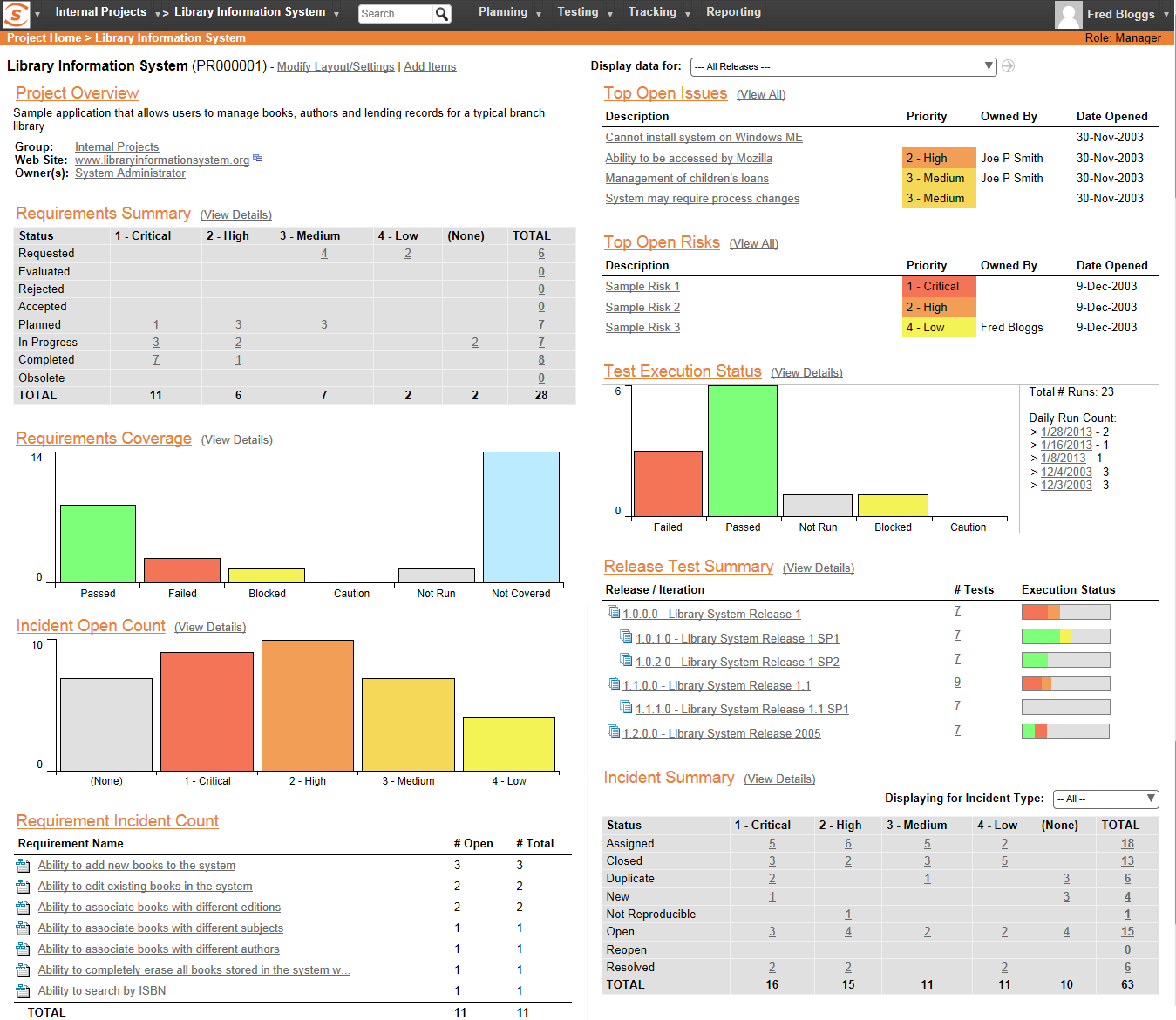    |