Cisco Intersight is an operations platform that helps IT operations teams control and automate Cisco UCS, converged, and hyperconverged infrastructure. Intersight consolidates and automates infrastructure lifecycle management from data centers to the edge in one solution delivered as-a-service.
N/A
SolarWinds Server & Application Monitor
Score 7.8 out of 10
N/A
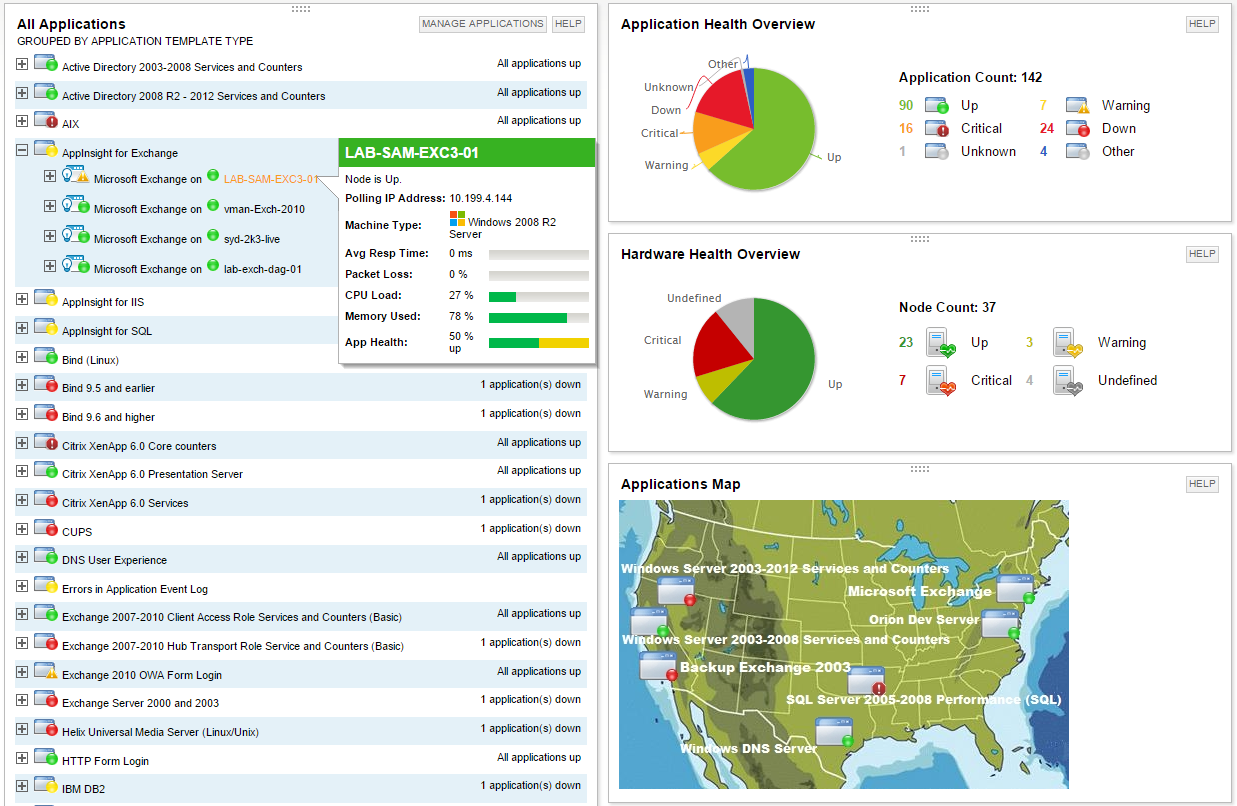
SolarWinds Server & Application Monitor (SAM) delivers application and server monitoring capabilities. SAM allows for self-service for easy setup, 1200+ monitoring templates, and customization options, as well as integrate with other SolarWinds products.
SolarWinds Server & Application Monitor is able to provide 90% of the functionality my business requires. SolarWinds is able to scale out functionality by purchasing additional modules to meet the individual needs of its customers. While this functionality provides …
It is highly suited for an organisation pushing for a standardised and centralised configuration of settings using policies, profiles and templates. It is highly suited for customers used to legacy UMM that need to refresh their environment, but instead of deploying them in UMM (which is still possible), to take the time and effort to learn Cisco Intersight Infrastructure Service and IMM as well as familiarise themselves with the differences between UMM and IMM, and the issues in UMM which IMM addresses and improves upon. We deployed in UMM initially then transitioned to IMM with the transition too. I cannot think of a scenario where Cisco Intersight Infrastructure Service would not be suited. Even for small-scale deployments, it provides significant benefits. Maybe if you come from another server vendor management environment, the learning curve may feel steep (e.g. many new concepts and constructs that one has to master).
It is a well-suited software for monitoring and surveillance of your deployed nodes. The error-readability and filter options for filtering out logs and errors could be improved. But overall, it has a good UI design, is user-friendly, and is very easy to learn and access for new users.
Standardising the environment by enforcing use of updating templates.
Show the difference on a profile between what has changed and what setting was last deployed.
Perform bulk deploy operation on profiles (like server profiles).
Policies underpin all settings (e.g. no more defining individual VLANs before being able to use them, or having to clean them up manually when they are no longer in use. You deploy a Domain VLAN policy that states which VLANs are configured on a domain (either standalone) or a domain profile template (if domains profiles are bound to an updating domain profile template).
It is difficult to spot an added or removed VLAN in an Ethernet Network Group Policy or VLAN Policy. The comparison widget will show you that something has changed, but if you have 100s of VLANs, the difference does not stand out. Workaround: we copy the data out and compare it in a text editor.
If you are transitioning from UMM to IMM, you lose some functionality like vNIC redundancy pairs.
It is not easy to map the UMM version 4.x server firmware version to the equivalent IMM version 5.x firmware version.
It is not possible to configure out-of-band management IP addresses on a per-domain basis. You have to configure these ranges via an IMC Access policy (which contains the IP address range/pool) on the server profile. This leads to "server profile template sprawl" where we have to maintain multiple server profile templates since our domains sit on different ranges, even though the servers are for the most part configured identically.
UCS domains in IMM only support one Ethernet Network Group Policy (VLAN group) per vNIC template.
Been using Cisco Software as a service (SaaS) platform in a production environment for a large medical and health professionals that has critical healthcare and patients care dependency.
Support team is very helpful getting system updated as needed, and vendor support is fantastic. Also get a dedicated Cisco networking engine to review and advise system health and recommendations.
We are heavily invested in Solarwinds products for a reason. They are generally easy to setup and run with, requiring only some interfacing with support or help articles on rare occasions. They do what we bought them to do and we can't ask for more.
Usability of Cisco Intersight is highly dependent on the licensing purchased. The default (free) license level provides a lot of value for the minimal amount of effort to implement. The paid license levels provide additional features (detailed inventory, configuration management and deployment, etc.)
SolarWinds Server & Application Monitor is quite easy to use and super versatile. It allows you to do just about anything you can through premade templates or through scripting. You can use an agent on the servers if you want to, or you can monitor through WMI or SNMP credentials. You can customize thresholds for alerting quickly, and you can configure alerts to be as complex or as simple as you want.
The graphical interface and the performance of the database leave a little to be desired, they could be better explored.Some functionality and screens do not work well depending on the browser used. The integrations never had any problems or caused crashes in other systems.
I have had servers TAC cases open for issues with Cisco Intersight. Some have yet to be resolved. One case that is still open is where the HCL status ( Hardware Compatibility List ) shows not validated when It should be. We have several servers that have the exact same hardware, OS, and the same firmware. One server will show the HCL is not validated but all others will
I think there was only a couple times I had to open a support case for SAM and one time they got multiple engineers on the phone to get a better idea what I was trying to monitor and was able to point me in the best direction to monitor that system.
I personally think that Cisco Intersight Infrastructure Service is at the top of its class when it comes to managing data center hardware. The cloud-connected design feels very modern and easy to use. The mobile app is something I wouldn't expect to get in a server management tool. The way it can update, monitor, and manage our servers is very nice. Overall, we are very happy with it.
Nagios requires far more manual work to configure than SolarWinds does, though that also encourages customization and perfect-fit solutions. Nagios also requires far, far fewer resources to run than SolarWinds: SolarWinds wants great gobs of memory and disk, while Nagios is refreshingly humble. Nagios starts working from the first minute, too, whereas SolarWinds needs lots of set-up time.
The negative thing is that we prefer to use the UCS Manager in our company because this bare metal is integrated into the FI and no extra appliance is required. SaaS is generally not viewed favorably in Germany.
Telling the user that they have to buy Intersight licenses even if they use UCS Manager annoys our customers.